Algebra 2 to Pre-Calculus Bridge Guide: Summer Prep for 2026
The jump from Algebra 2 to pre-calculus is bigger than the jump from Algebra 1 to Algebra 2, even though the names suggest a smooth ladder. Pre-calc takes everything you did with polynomials, exponentials, and logarithms and adds three new universes on top: trig identities, conic sections, and the function-analysis language calculus is built on. Students who walk into pre-calc cold often spend the first quarter playing catch-up.
This guide names every topic that needs to be solid before day one, shows where Algebra 2 weak spots will hurt you, and lays out an eight-week summer plan for 2026.
What Pre-Calc Will Demand From Day One
Most pre-calculus courses, whether honors or regular, assume you can do these Algebra 2 skills in your sleep:
| Algebra 2 skill | Why pre-calc needs it |
|---|---|
| Factoring (GCF, trinomials, difference of squares, grouping) | Polynomial behavior, rational expressions, partial fractions later |
| Solving quadratics three ways | Conic sections, complex zeros, optimization |
| Function notation and composition | Inverse trig, transformations, chain-rule prep |
| Domain, range, and end behavior | Every function unit |
| Exponential and logarithm rules | Growth, decay, and the bridge to e and ln |
| Systems of equations | Three-variable systems, matrices, intersections of curves |
| Rational expressions | Limits and asymptote work |
| Complex numbers | Polynomial zeros, polar form, roots of unity |
If any row above feels shaky, that is your first summer assignment.
The Five Pre-Calc Topics That Catch Students Cold
Pre-calc has five big units that have no obvious counterpart in Algebra 2. Get a head start on these and the year feels half as hard.
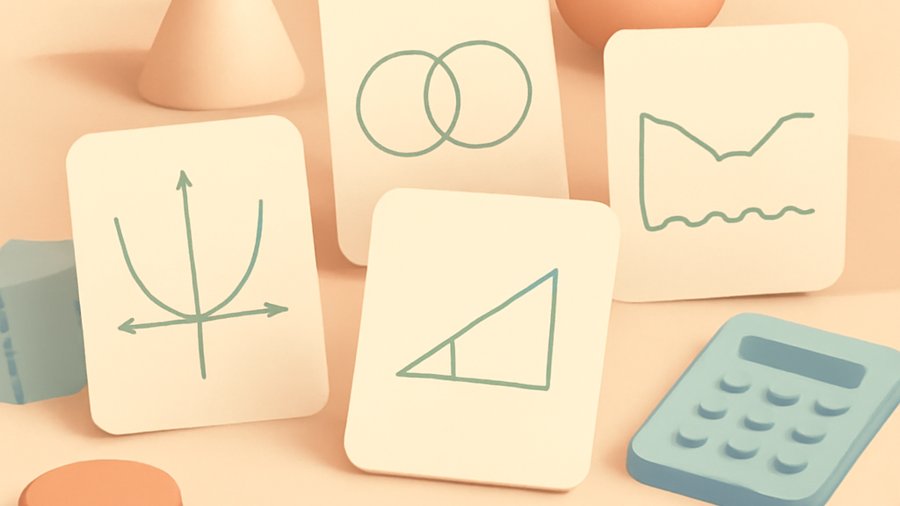
- Trigonometric functions and the unit circle.
- Trig identities and proofs.
- Vectors and parametric equations.
- Conic sections (circles, ellipses, parabolas, hyperbolas).
- Sequences, series, and the binomial theorem.
We will hit each one with the minimum you need to know before September.
The Unit Circle Is Not Optional
The single biggest pre-calc study habit is memorizing the unit circle. By the first quiz you should know, on sight, the sine and cosine of every angle at 0°, 30°, 45°, 60°, 90° and their reflections in all four quadrants. That is twelve angles in degrees, twelve more in radians.
Three ways to lock it in:
- Write the first quadrant ten times until you can do it from blank.
- Use the hand trick (thumb to pinky for 0, 30, 45, 60, 90).
- Quiz a friend on random angles every day for a week.
A student who can pull “sin(5π/6) = 1/2” out of their head before the year starts will save hours of stress.
Trig Identities: Six That Drive Everything
Pre-calc will throw dozens of identities at you. Six are non-negotiable.
- sin²θ + cos²θ = 1
- 1 + tan²θ = sec²θ
- 1 + cot²θ = csc²θ
- sin(A ± B) = sin A cos B ± cos A sin B
- cos(A ± B) = cos A cos B ∓ sin A sin B
- sin(2θ) = 2 sin θ cos θ; cos(2θ) = cos²θ − sin²θ
The rest of the identities derive from these. If you memorize six, you can build the other twenty.
Conic Sections: One Standard Form Each
Conic sections are scary because there are four shapes and each has multiple forms. Cut to the standard form for each and the unit becomes manageable.
| Conic | Standard form (center at origin) |
|---|---|
| Circle | x² + y² = r² |
| Ellipse | x²/a² + y²/b² = 1 |
| Parabola | y = ax² or x = ay² |
| Hyperbola | x²/a² − y²/b² = 1 |
Translate the center with (x − h) and (y − k). Identify which conic by the signs and coefficients. That is the entire trick.
Polynomial Functions: End Behavior and Zeros
By the end of Algebra 2 you should be able to:
- Identify the degree and leading coefficient.
- Predict end behavior from those two pieces.
- Find rational zeros with the rational root theorem.
- Divide polynomials using long division and synthetic division.
- Write a polynomial given its zeros.
Pre-calc adds the complex zero theorem and the fundamental theorem of algebra: an n-degree polynomial has exactly n zeros if you count complex zeros with multiplicity.
Exponentials and Logs: The e and ln Switch
Algebra 2 introduces logs. Pre-calc lives in them. Two extensions you need cold by September:
- The natural log: ln(x) is just log base e. All log rules apply.
- The change of base formula: log_b(x) = ln(x) / ln(b).
Continuous compounding (A = Pe^(rt)) and natural-log half-life problems show up in the first month. Practice ten of each before school.
Composition and Inverse Functions
Pre-calc leans hard on f(g(x)) and f⁻¹(x). Two rules to lock in:
- (f ∘ g)(x) = f(g(x)), plug g into f, in that order.
- To find an inverse algebraically, swap x and y and solve for y. Then check by composing.
Inverse trig functions (arcsin, arccos, arctan) extend the same idea with restricted domains. Cover this in week six of the summer plan.
An 8-Week Summer Bridge Plan
If you have eight weeks of summer before pre-calc starts, this plan will close most gaps.
| Week | Focus | Daily time |
|---|---|---|
| 1 | Algebra 2 review: factoring, quadratics, function notation | 35 min |
| 2 | Polynomial division, rational root theorem, complex zeros | 35 min |
| 3 | Exponentials, logs, change of base, ln and e | 35 min |
| 4 | Right triangle trig and SOHCAHTOA refresh | 35 min |
| 5 | Unit circle in degrees and radians (drill daily) | 40 min |
| 6 | Six fundamental trig identities and basic proofs | 40 min |
| 7 | Conic sections and translations | 40 min |
| 8 | Sequences, series, binomial theorem; mixed practice test | 40 min |
Twenty problems a day, last five from previous weeks. The unit circle gets a five-minute drill every single day.
Common Algebra-2-to-Pre-Calc Gaps
Five gaps account for most of the rocky first quarter.
- Sign errors in factoring. They come back to bite you when you factor for polynomial zeros and conic completion.
- Confusing degrees and radians. Always know which mode your calculator is in.
- Skipping the domain check. Pre-calc asks for domain on every function problem.
- Algebra mistakes inside trig identities. The identity is rarely the issue; bad algebra is.
- Treating logs like polynomials. log(a + b) ≠ log a + log b. Repeat that ten times.
Fix these five before September and the first quarter feels familiar.
How to Use a Calculator in Pre-Calc
A graphing calculator (TI-84 or equivalent) is standard. The keys that matter:
- MODE: degrees vs. radians.
- 2nd then the trig keys: arc functions.
- Y= to graph functions and find zeros.
- TABLE to check function values quickly.
- MATH then NUM for absolute value and rounding.
Spend an hour over the summer learning the menus. Students who fight the calculator on test day lose ten points to navigation.
Frequently Asked Questions
Is pre-calculus the same as trigonometry?
No. Trig is one chunk of pre-calc, usually about a third of the year. Pre-calc also covers functions, polynomials, conics, sequences, and limits.
Should I take pre-calc and calculus the same year?
Some honors tracks combine them or move quickly between them. If you have any algebra gaps, that combined track will be brutal. Take pre-calc cleanly first if you can.
Will I need pre-calc for the SAT?
The Digital SAT pulls a handful of items from early pre-calc topics (trig, functions, complex numbers). Most students preparing for the SAT in junior year of pre-calc are fine.
How important is the unit circle, really?
It is the single most-tested object in the course. There is no substitute for memorization.
What if I had a weak Algebra 2 teacher?
Run the eight-week bridge plan above. It is built for exactly that situation.
Closing Thought
Pre-calc is a doable, even fun, year if you walk in with the unit circle memorized, six trig identities ready, and Algebra 2 factoring intact. The bridge is short and well marked. Use the summer to lay the track and the train rolls.
For topic-by-topic practice, browse our pre-calculus worksheets (resource currently unavailable) and our complete Math Topics library. When you are ready for a structured workbook, our pre-calculus collection maps directly to the topics above.

Related to This Article
More math articles
- Other Topics Puzzle – Challenge 99
- Grade 2 Math Practice for Iowa Second Graders
- Volume of Cubes
- Best Mobile Laptop Stands for Presentation in Schools
- Montana MAST Grade 5 Math at Home — 49 Free Single-Skill PDF Worksheets with Friendly Keys
- Genes, Alleles, and Punnett Squares
- How to Understanding Onto (Surjective) Functions
- Free Grade 6 English Worksheets for Delaware Students
- Writing Linear Equations Practice — Slope-Intercept Form (Free)
- A Complete Step-by-Step Guide on Euler’s Method









What people say about "Algebra 2 to Pre-Calculus Bridge Guide"?
No one replied yet.