Rocks and the Rock Cycle

Rocks seem permanent, but over long stretches of time they slowly change from one type into another. This ongoing process is the rock cycle, and it centers on three types of rock. Knowing how each forms — and how they turn into one another — covers a reliable chunk of earth-science questions.
The Three Types of Rock
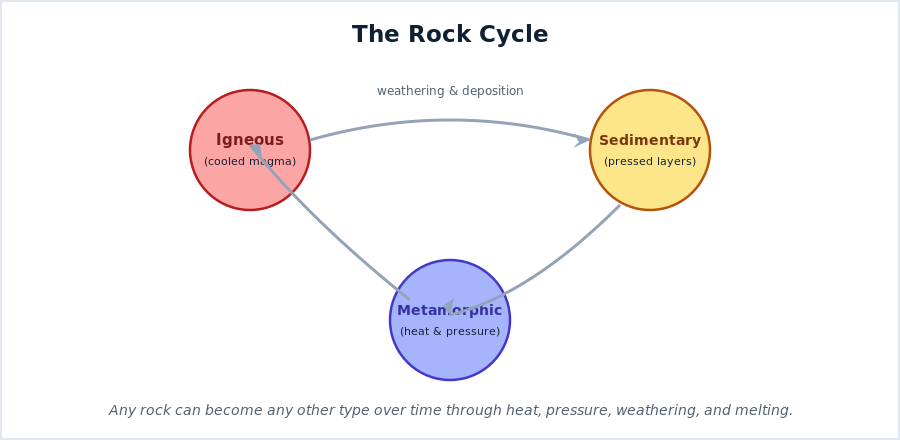
Igneous rock forms when molten rock (magma or lava) cools and hardens — granite and basalt are examples. Sedimentary rock forms when small pieces of rock, sand, or shells settle in layers and get pressed together over time — sandstone and limestone are examples. Metamorphic rock forms when an existing rock is changed by intense heat and pressure deep underground — marble and slate are examples.
How Rocks Change
The cycle connects all three. Weathering breaks rocks into sediment, which can form sedimentary rock. Heat and pressure can turn any rock into metamorphic rock. Melting turns rock into magma, which cools into igneous rock. Because there is no fixed starting point, any type can eventually become any other — that is why it is called a cycle.
Matching Rock to Process
A common test task is to match a rock type to how it formed. If a rock formed from cooled lava, it is igneous. If it formed from pressed layers of sediment (and might contain fossils), it is sedimentary. If it formed from an older rock changed by heat and pressure, it is metamorphic. Keep the three formation stories straight and these questions become quick.
Watch: A Short Video Lesson
Mike Sammartano walks through this skill clearly in a few minutes. It is a helpful companion to the reading above:
A Routine for Rock Cycle Questions
- Igneous = cooled magma or lava.
- Sedimentary = pressed layers of sediment (often has fossils).
- Metamorphic = rock changed by heat and pressure.
- Any rock can become any other over time through the cycle.
Practice
- Which rock type forms from cooled lava?
- Which rock type forms from pressed layers of sediment?
- Which rock type forms from heat and pressure?
- Which rock type is most likely to contain fossils?
- What process turns rock into magma?
- Why is it called a cycle?
Answers
- Igneous.
- Sedimentary.
- Metamorphic.
- Sedimentary.
- Melting.
- Any rock type can become any other, with no fixed start or end.
Where This Fits in Your Science Prep
The rock cycle builds on Earth’s layers and plate tectonics (heat and pressure come from inside Earth) and connects to how we read rock layers to find Earth’s age. See all topics on the Science Topics Hub.

Related to This Article
More math articles
- Aviator Crash Game Math: The Multiplier Distribution Explained
- 6th Grade OST Math FREE Sample Practice Questions
- Top 10 Tips to Overcome HSPT Math Anxiety
- Communication, Service Recovery, HIPAA, and DEI
- 5th Grade Common Core Math FREE Sample Practice Questions
- How to Find Volume by Spinning: Shell Method
- The Best Grade 4 Math Book for North Dakota Students
- Pennsylvania PSSA Grade 3 Math: 49 Free Single-Page Printables, One Skill Each, Answer Keys Included
- How to Learn Properties of Logarithms
- The Best Grade 2 English Worksheets for Missouri Kids





















What people say about "Rocks and the Rock Cycle"?
No one replied yet.