How to Compare Two Linear Functions? (+FREE Worksheet!)
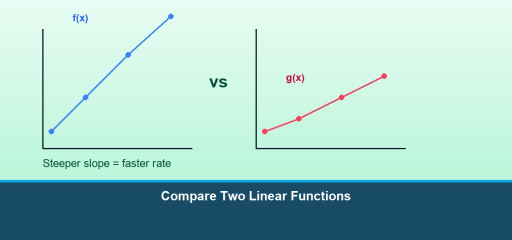
When two linear functions are presented in different forms, one as an equation, another as a table, and a third as a graph, how do you decide which one grows faster or starts higher? The answer comes down to two key features: the rate of change (slope) and the initial value (y-intercept). Mastering how to extract and compare these features is an essential 8th-grade algebra skill.
Compare Two Linear Functions: what to notice and how to work it
What to notice first
Common student mistake
Key formulas and cues
A reliable path
- Identify the inputFind the x-value, expression, or inner function being used.
- Apply the ruleSubstitute with parentheses so signs and powers stay clear.
- Interpret the outputState the value, point, interval, domain, range, or inverse relationship.
Worked examples
Evaluate a function
- Replace x with 2.
- Compute 4(2) – 3.
- Simplify.
Compose functions
- Find g(3) = 6.
- Use that as the input for f.
- f(6) = 7.
Try one before moving on
Compare Two Linear Functions: pop-up practice
In this lesson you will learn how to read slope and y-intercept from equations, tables, and graphs, compare functions side by side, find intersection points, and work through practice problems with full solutions.
Key Concepts for Comparing Functions
- Rate of change (slope): \(m = \dfrac{\Delta y}{\Delta x} = \dfrac{y_{2} – y_{1}}{x_{2} – x_{1}}\). A larger absolute value means the function changes faster.
- Initial value (y-intercept): The value of \(y\) when \(x = 0\). In the equation \(y = mx + b\), it is \(b\).
- Two functions are equal where their graphs intersect, set the expressions equal and solve for \(x\).
Reading Slope and Intercept from Different Representations
From an Equation
If the equation is already in slope-intercept form \(y = mx + b\), read \(m\) (slope) and \(b\) (y-intercept) directly. If it is in standard form \(Ax + By = C\), convert: \(y = -\frac{A}{B}x + \frac{C}{B}\).
From a Table
Pick any two rows. The slope is \(m = \frac{y_{2}-y_{1}}{x_{2}-x_{1}}\). To find \(b\), substitute a known \((x, y)\) pair into \(y = mx + b\) and solve for \(b\). If the table includes \(x = 0\), the corresponding \(y\)-value is the y-intercept.
From a Graph
Identify two clear lattice points. Calculate rise over run: \(m = \frac{\text{rise}}{\text{run}}\). The point where the line crosses the \(y\)-axis gives \(b\).
Step-by-Step Guide to Comparing Two Functions
- Convert every function to slope-intercept form \(y = mx + b\).
- Compare slopes. The function with the greater slope increases faster. If one slope is positive and the other is negative, the positive slope increases while the other decreases.
- Compare y-intercepts. The function with the greater \(b\) starts higher on the \(y\)-axis.
- Determine which function is greater in a given interval by evaluating both at a specific \(x\)-value, or by finding their intersection point.
Worked Examples
Example 1, Equation vs. Table
Function A: \(y = 3x + 1\)
Function B (table):
| \(x\) | \(y\) |
|---|---|
| 0 | 5 |
| 1 | 7 |
| 2 | 9 |
Solution: Function B has slope \(\frac{7-5}{1-0} = 2\) and y-intercept \(5\). So Function B: \(y = 2x + 5\).
- Function A has a greater slope (\(3 > 2\)), so it grows faster.
- Function B has a greater y-intercept (\(5 > 1\)), so it starts higher.
Intersection: \(3x + 1 = 2x + 5 \Rightarrow x = 4\). Before \(x = 4\), Function B is larger; after \(x = 4\), Function A takes over.
Example 2, Two Equations
Function C: \(y = -x + 6\) Function D: \(y = 2x – 3\)
- Slope of C: \(-1\) (decreasing); Slope of D: \(2\) (increasing).
- Intercept of C: \(6\); Intercept of D: \(-3\).
- Function C starts higher but decreases, while D starts lower and increases.
Intersection: \(-x + 6 = 2x – 3 \Rightarrow 9 = 3x \Rightarrow x = 3\). At \(x = 3\), both equal \(3\). For \(x < 3\), C is greater; for \(x > 3\), D is greater.
Example 3, Comparing from a Word Problem
Gym A charges a \$50 sign-up fee and \$20 per month. Gym B charges no sign-up fee and \$30 per month.
Gym A: \(y = 20x + 50\); Gym B: \(y = 30x\).
- Gym B has the higher rate of change (\$30/month vs. \$20/month).
- Gym A has the higher initial cost (\$50 vs. \$0).
- They cost the same at \(20x + 50 = 30x \Rightarrow x = 5\) months. After 5 months, Gym B is more expensive.
Video Lesson
Watch this video for additional examples and a step-by-step walkthrough:
Practice Problems
- Function F: \(y = 4x – 2\). Function G has a slope of 4 and passes through \((1, 6)\). Which has a greater y-intercept?
- Function H: \(y = -2x + 10\). Function J: a table with points \((0, 3)\) and \((2, 9)\). Which function has a greater rate of change?
- Function K: \(y = 5x + 1\). Function L: \(y = 3x + 7\). At what \(x\)-value are they equal?
- Plumber A charges \$40 per hour plus a \$25 trip fee. Plumber B charges \$55 per hour with no trip fee. Write equations and determine when they cost the same.
- A table shows points \((0, 8)\) and \((4, 0)\). Write the equation and compare its slope with \(y = -3x + 8\).
- Function M: \(y = \frac{1}{2}x + 4\). Function N: \(y = x + 1\). Which is greater at \(x = 10\)?
- Two functions have the same slope of 3. Function P passes through \((0, 2)\) and Function Q passes through \((0, -1)\). Which is always greater?
- Function R: \(2x + y = 8\). Function S: \(y = -2x + 5\). Compare slopes and intercepts.
Solutions
- G: \(y = 4x + b\); plug in \((1,6)\): \(6=4+b \Rightarrow b=2\). F has \(b = -2\), G has \(b = 2\). G has the greater y-intercept.
- J: slope \(= \frac{9-3}{2-0} = 3\). H: slope \(= -2\). J has the greater rate of change (\(3 > -2\)).
- \(5x + 1 = 3x + 7 \Rightarrow 2x = 6 \Rightarrow x = 3\).
- A: \(y = 40x + 25\); B: \(y = 55x\). Equal when \(40x + 25 = 55x \Rightarrow x = \frac{25}{15} = \frac{5}{3} \approx 1.67\) hours.
- Slope \(= \frac{0-8}{4-0} = -2\), equation: \(y = -2x + 8\). Comparing: \(-2 > -3\), so the table’s function decreases less steeply.
- M at \(x = 10\): \(\frac{1}{2}(10)+4 = 9\). N at \(x = 10\): \(10+1 = 11\). N is greater at \(x = 10\).
- Same slope, P has the higher intercept (\(2 > -1\)), so P is always greater.
- R: \(y = -2x + 8\), slope \(-2\), intercept 8. S: slope \(-2\), intercept 5. Same slope; R has the greater y-intercept.
Common Mistakes to Avoid
- Comparing slopes without signs. A slope of \(-5\) is not greater than \(3\). Always consider the sign when comparing rates of change.
- Reading the wrong intercept from a table. The y-intercept is the \(y\)-value when \(x = 0\), make sure the table includes that row or calculate it.
- Assuming the larger intercept “wins” forever. A higher starting value does not mean the function stays larger. Always check slopes and find the intersection.
Frequently Asked Questions
What if two functions have the same slope?
If two linear functions share the same slope, their graphs are parallel lines. They never intersect, and the one with the larger y-intercept is always greater.
How do I compare a graph to an equation?
Extract the slope and y-intercept from the graph (using two lattice points and the y-axis crossing), convert to \(y = mx + b\), and compare directly.

Related to This Article
More math articles
- Completing a Table and Make a Graph of Ratios and Rates
- 49 Printable Tennessee TCAP Grade 3 Math Worksheets — Free Download with Step-by-Step Keys
- How to Solve the Frequency Distribution Table?
- Best tools for Online teachers
- The Ultimate 7th Grade KAP Math Course (+FREE Worksheets)
- Enhanced ACT Math Four Answer Choices: Change Your Practice Habits (2027 Prep)
- Chapter 30: Campaigns and Nominations
- AP Cybersecurity Risk Assessment: Threat, Vulnerability and Impact (2027 Prep)
- 4 Perfect Tablets for Note-Taking in 2026
- Top 10 6th Grade SBAC Math Practice Questions


What people say about "How to Compare Two Linear Functions"?
No one replied yet.