The Baby Boom, Marriage, Family Ideals, and Women’s Paid Work
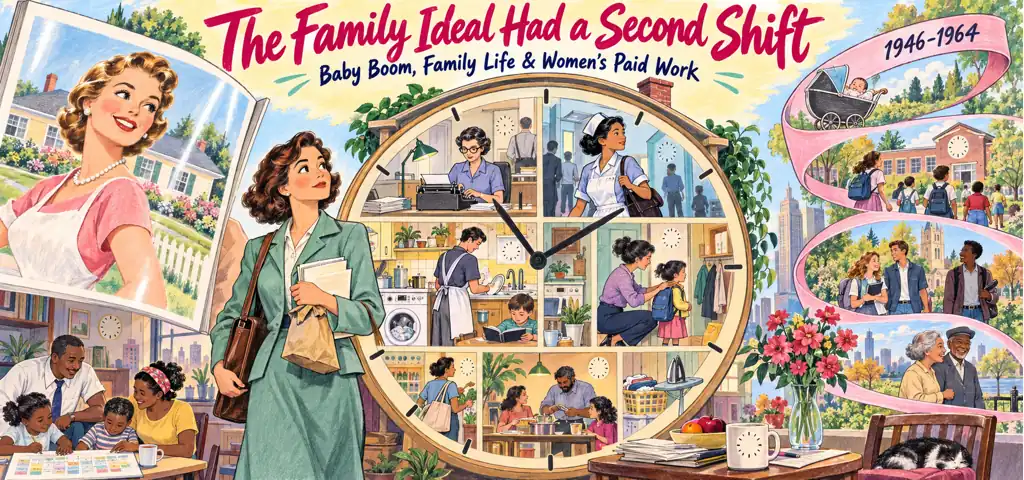
Chapter 12 of the CLEP History of the United States II study guide on Effortless Math covers The Baby Boom, Marriage, Family Ideals, and Women’s Paid Work: the key terms, the core ideas, and worked examples showing how this topic is tested on the exam.
CLEP History of the United States II, Chapter 12
Demobilization compressed household formation
Veterans returned rapidly after 1945, and many couples married or reunited while builders had not yet supplied enough homes. The armed forces fell from more than twelve million personnel in 1945 to roughly one and a half million by mid-1947. New households competed for apartments, doubled with relatives, and moved into temporary units. The 1946 divorce surge also reflected wartime marriages that did not survive separation and reunion. Marriage, housing, and demobilization formed one adjustment process rather than independent trends.
The baby boom was a bounded demographic wave
Birth rates rose sharply after the war and remained high through the 1950s before falling in the 1960s. The conventional baby-boom cohort spans births from 1946 through 1964. By 1965 the crude birth rate had returned near its 1940 level. The boom was not an uninterrupted twentieth-century rise in fertility. It followed Depression-era postponement and wartime disruption, then ended as marriage age, education, contraception, and expectations changed. Cohort size continued to reshape institutions long after births fell.
A large cohort moves through institutions on a schedule
Babies first increase demand for maternity care and elementary schools, later for high schools, colleges, entry-level jobs, housing, and eventually retirement support. Local governments built classrooms years before states expanded campuses for the same cohort. Median age can fall when a large young cohort enters the population, then rise as that cohort grows older and fertility declines. A demographic effect must be attached to the cohort's age at a particular date rather than to the label "baby boom" alone.
The domestic ideal was culturally powerful but descriptively incomplete
Magazines, television programs, advertisers, and advice literature celebrated early marriage, suburban domesticity, male breadwinning, and full-time motherhood. Cold War rhetoric sometimes made the stable private family a symbol of American abundance and order. The ideal influenced aspiration and judgment, but it did not describe all families. Black women, working-class women, farm women, single adults, and families unable to purchase suburban homes lived different economic realities. A cultural prescription is evidence about values, not a census table.
Women's paid employment rose during the homemaker decade
The share of adult women in the labor force increased through the 1950s and continued rising afterward. Married women, including mothers, increasingly worked in clerical, retail, education, health, and service occupations. Employers often reserved jobs by sex and paid women less, while professional and supervisory paths remained restricted. Growth in women's employment therefore coexisted with occupational segregation. The decade's ideology and its labor-market trend moved in different directions without either being imaginary.
Appliances changed tasks more clearly than total domestic time
Electricity, running water, refrigerators, washing machines, and vacuum cleaners reduced physical effort and altered household routines. Yet time studies often show that full-time homemakers did not gain a proportional reduction in total housework. Standards of cleanliness rose, clothing and child care received more attention, and work formerly hired out moved inside the household. Technology changes the productivity and expected quality of unpaid labor; it does not automatically decide how much labor a family will perform.
Paid work did not eliminate the second shift
As married women's employment expanded, husbands' time in housework and child care rose only modestly while employed wives reduced their domestic hours somewhat. Women commonly carried longer combined paid and unpaid workdays. Household bargaining, gender norms, job schedules, and access to child care shaped the division. A labor-force statistic measures paid participation, not the disappearance of unpaid work. To assess equality, historians need time-use evidence as well as wage data.
Fertility fell through several interacting changes
The oral contraceptive pill, approved for birth control in 1960, allowed more reliable separation of sex from childbearing and helped women plan births around education and employment. Later marriage, expanded college attendance, changing aspirations, and the rising cost of children also contributed to the steep fertility decline from the late 1950s into the 1970s. No single invention explains the entire transition. Access, legal rules, culture, work, and education conditioned the pill's effect.
Two earners changed both living standards and risk
As productivity growth slowed and many male production wages stagnated after 1973, a second income became increasingly important to family living standards. Two-earner households could also retain some wages if one worker lost a job, though child care and schedule costs offset part of the gain. The change was not simply consumer preference for luxuries. It reflected occupational opportunity, family strategy, inflation, wage trends, and changing expectations about women's autonomy.
Household forms diversified after the midcentury low marriage age
Americans married unusually young around 1950 and 1960, then median age at first marriage rose. One-person households became more common, while married couples with children declined as a share of all households. No-fault divorce laws spread after California acted in 1969, and divorce peaked in the early 1980s before later falling. These changes do not mean marriage vanished. They show that the breadwinner-homemaker household ceased to be a statistical norm for all adults.
Long-run fertility decline preceded the baby boom
American fertility had fallen from roughly seven births per woman around 1800 to fewer than four by 1900. Scarcer free farmland, urban living, falling child mortality, education, and deliberate birth limitation made smaller families practical before modern contraception. The baby boom interrupted that long decline without reversing its structural foundations. Comparing 1957 only with 1940 exaggerates discontinuity; comparing two centuries shows both a temporary surge and a durable transition.
compare image and behavior without canceling either
A magazine praises full-time motherhood in 1956, while labor data show married women's employment rising.
Family history joins demography, culture, policy, and work
Housing finance encouraged household formation, schools absorbed a large cohort, employers drew married women into expanding service work, and contraception altered timing. Families also reproduced unequal access to income, property, education, and unpaid care. The strongest interpretation does not choose between the family as private affection and public institution. It traces how demographic timing and social rules structured private decisions.
Watch the history in motion
This short lesson adds voices, images, and chronology to the ideas you just studied.
Video: Postwar ECONOMIC Prosperity, Causes & Effects [APUSH Review], Heimler's History.
Try four CLEP-style questions
- Which evidence would best test the claim that the postwar baby boom interrupted, rather than reversed, a much longer fertility decline?
- Median age at first marriage during the years surrounding the postwar birth peak
- Magazine advertising for houses and appliances between 1945 and 1960
- Labor-force participation among married women during the postwar decades
- Elementary and college enrollment counts for cohorts born during the baby boom
- Comparable fertility rates from the nineteenth century through the boom and later decline
- Women's paid employment rises, yet workers remain concentrated in clerical, retail, health, and education jobs and seldom reach senior positions. Which interpretation is best supported?
- Paid-work entry expanded more rapidly than occupational integration or access to promotion.
- Service-sector growth accounts for the pattern without evidence about women's choices or barriers.
- Concentration within several fields indicates comparable advancement inside each of those fields.
- Shorter average tenure among new entrants accounts for their low senior representation.
- Participation rates approximate wage and authority once workers are grouped by sector.
- A household is considering whether a second adult should take a paid job. Which calculation best estimates the job's immediate effect on household resources?
- Compare the second worker's gross wage with the cost of paid child care alone.
- Compare added after-tax pay with major new child-care, commuting, and schedule-related expenses.
- Compare the new wage with the market value of household tasks shifted to others.
- Compare annual household income before and after, adjusting only for general inflation.
- Compare household take-home income before and after, without subtracting new work expenses.
- Which evidence best tests whether paid employment equalized the total workload between spouses?
- Annual earnings records for husbands and wives in the same occupation
- Labor-force participation rates classified by sex, age, and marital status
- Time diaries recording each spouse's paid work, housework, and caregiving
- Household counts divided among married couples, single adults, and families
- Surveys asking respondents whether they approve of mothers holding paid jobs
Check your answers and reasoning
Independent preparation. CLEP is a registered trademark of the College Board, which does not endorse this lesson.

Related to This Article
More math articles
- Best Back-to-School Math Apps for Students
- The Best Grade 3 ELA Practice Tests for Maryland Students
- Advanced Vocabulary Words: Chasm to Concoct
- How to Solve Absolute Value Equations?
- Comparative Advantage, Specialization, and Trade
- 5 Skills You Need to Study Mathematics in College
- Free Grade 6 English Worksheets for Arkansas Students
- Compare the world price with the domestic equilibrium
- How to Buy the Right Laptop: A Step-by-Step Guide
- How to Find Arc Length and Sector Area? (+FREE Worksheet!)





















What people say about "The Baby Boom, Family Ideals and Women's Work"?
No one replied yet.