CLEP U.S. History I 068: Second Great Awakening and Moral Agency
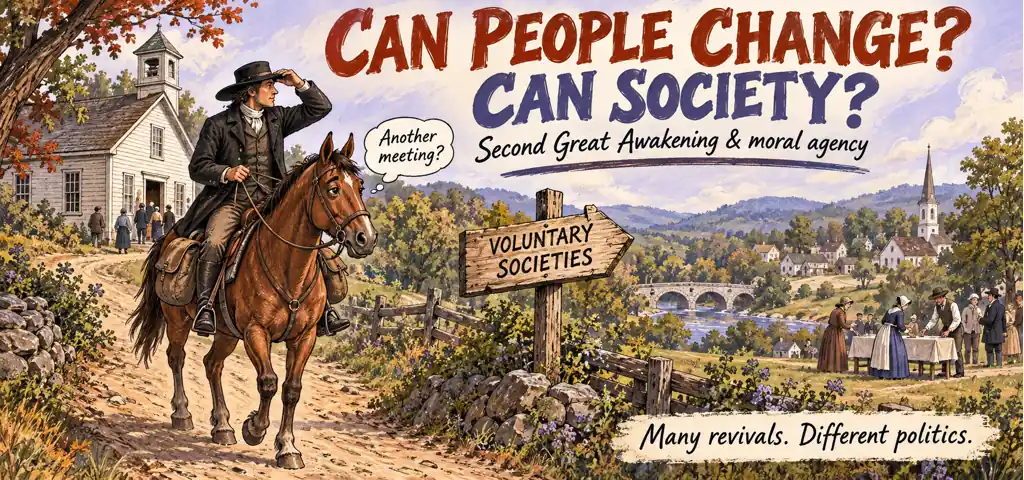
Lesson 13.1 of Chapter 13 of the U.S. History to 1877 study guide on Effortless Math covers CLEP U.S. History I 068: Second Great Awakening and Moral Agency: the key terms, the core ideas, and worked examples showing how this topic is tested on the exam.
U.S. History to 1877 | Chapter 13 | Lesson 13.1
The Second Great Awakening was a diverse evangelical revival extending from the late eighteenth century through the antebellum decades. On the Kentucky frontier, large meetings such as Cane Ridge drew crowds for emotional conversion. In the Northeast, Charles Grandison Finney used planned revivals, direct preaching, an “anxious bench,” and invitations to immediate decision. Methodists and Baptists expanded through itinerant preachers and local congregations. The movement challenged older Calvinist emphasis on human inability by stressing that individuals could accept grace and pursue holy living.
That emphasis on moral agency supported reform: if sinners could change, communities might change institutions. Voluntary societies distributed Bibles, supported missions, promoted temperance, observed the Sabbath, and attacked slavery. Women supplied much of the membership, fundraising, teaching, and petitioning. Reform offered public influence while churches and law still denied women equal formal authority.
Revival did not produce one politics. Some evangelicals became radical abolitionists. Others defended slavery or concentrated on personal conduct. Black Christians built independent churches that joined worship to education, mutual aid, and antislavery activism. Joseph Smith’s Church of Jesus Christ of Latter-day Saints emerged in the same religiously inventive environment, though its new scripture, communal strength, and claims to authority provoked persecution and migration. Shakers, Millerites, and other groups show that antebellum religion cannot be reduced to one denomination.
Disestablishment helped produce competition. Without a national established church, denominations and societies recruited supporters in a religious marketplace. Market mobility and social disruption also made conversion communities attractive. Yet revival discipline could enforce conformity. Moral reformers sometimes treated poverty or addiction primarily as personal failure.
Watch the topic in context
Watch this account from Heimler's History with one question in mind: which evidence makes the lesson's strongest claim hold up?
Video: The SECOND Great Awakening [APUSH Review Unit 4 Topic 10] Period 4: 1800-1848, Heimler's History.
Check your understanding
- Finney’s revival methods most strongly emphasized
- waiting passively for evidence of predestination
- immediate moral choice and conversion
- obedience to a legally established church
- sacramental authority controlled only by clergy
- withdrawal from organized moral action
- Revivalism most directly encouraged voluntary reform by emphasizing
- permanent inherited differences in moral capacity
- the inability of institutions to change conduct
- reform through state coercion alone
- capacity for individual and social change
- rejection of organized associations
- Deep Practice: select all that apply. Awakening-era religion included
- itinerant preaching
- voluntary societies
- Black churches
- new religious movements
- one uniform politics
- Deep Practice: open response. Explain how moral agency could inspire reform and moral coercion.
Write a brief response using a named fact from the lesson.
Open the answers and reasoning
Independent preparation. CLEP is a registered trademark of the College Board, which does not endorse this lesson.

Related to This Article
More math articles
- Can the CBEST Test be Waived?
- 3rd Grade MCAS Math Worksheets: FREE & Printable
- The Best Grade 8 ELA Practice Tests for Rhode Island Students
- Texas STAAR Grade 8 Math Free Worksheets: 72 Printable TEKS-Aligned PDFs with Answer Keys
- Calculators Recommended for Math Courses
- How to Perform Similarity Transformations: Step-by-Step Guide
- 5 Best Headsets for Online Math Classes in 2026
- How to Add and Subtract Polynomials? (+FREE Worksheet!)
- The Ultimate Accuplacer Math Course (+FREE Worksheets)
- CSET Mathematics Flashcards

















What people say about "The Second Great Awakening and Moral Agency"?
No one replied yet.