CLEP U.S. History I 069: Temperance, Schools, Prisons, and Asylums
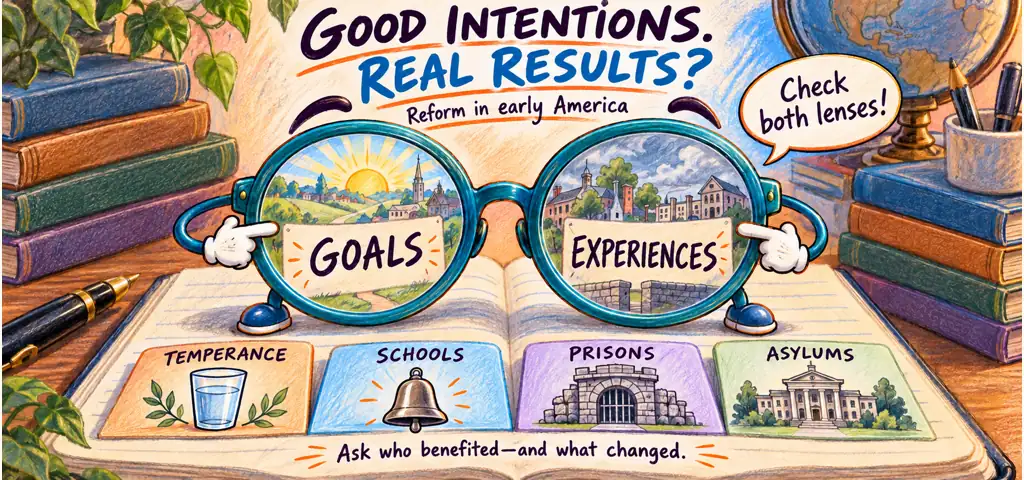
Lesson 13.2 of Chapter 13 of the U.S. History to 1877 study guide on Effortless Math covers CLEP U.S. History I 069: Temperance, Schools, Prisons, and Asylums: the key terms, the core ideas, and worked examples showing how this topic is tested on the exam.
U.S. History to 1877 | Chapter 13 | Lesson 13.2
Temperance changed in purpose and constituency over time. Early national societies often urged moderation, but by the 1830s many reformers demanded total abstinence from distilled alcohol. Evangelical organizers linked sobriety to self-command. Employers valued punctual labor. Women connected drinking to lost wages and household violence. The Washingtonian movement of the 1840s centered public testimony and mutual aid among working men who described recovery from alcohol dependence. Yet reformers could blame individuals for poverty and portray Irish and German immigrant customs as moral failure. Later legal prohibition campaigns therefore combined voluntary support, class discipline, nativism, and state coercion in proportions that varied by community.
The common-school movement likewise developed through states and localities, not a federal school system. As Massachusetts secretary of its board of education from 1837, Horace Mann promoted tax-supported elementary schools, longer terms, trained teachers, graded classes, and buildings designed for instruction. New York, Pennsylvania, and emerging western states followed different paths. Rural districts often resisted taxes, consolidation, or professional supervision. Schools could widen literacy and civic access, including for many girls, while local attendance and quality remained unequal. Protestant Bible reading and moral instruction provoked Catholic resistance, and Black families fought exclusion or segregation in northern as well as southern communities. “Common” named an aspiration whose reach must be tested against enrollment, funding, race, sex, and location.
Penitentiary reform replaced whipping, fines, and public punishment with an institution intended to produce disciplined reflection. Pennsylvania’s separate system isolated prisoners in individual cells. New York’s Auburn system combined solitary nights with silent group labor by day. Supporters called these rational alternatives to inherited brutality. In practice, forced silence, corporal punishment, labor contracts, overcrowding, and psychological harm exposed the coercive power inside rehabilitation. State choice mattered: no single model governed every prison, and institutional records reveal administration more readily than prisoners’ own voices.
The asylum campaign addressed a related problem: people with mental illness were often confined in jails, poorhouses, or family settings without specialized care. Dorothea Dix visited local institutions, recorded conditions, and presented memorials to legislatures beginning with Massachusetts in 1843. She asked states to finance hospitals organized around treatment, order, and a protected environment. Legislatures did expand institutions, but funding, staffing, diagnosis, race, sex, and class shaped admission and experience. Over time, large hospitals could become custodial and overcrowded. The historical achievement is movement away from neglect in jails. The interpretive limit is assuming that confinement itself guaranteed autonomy or cure.
Women exercised public influence through investigation, fundraising, petitioning, teaching, and moral authority even while excluded from most offices and voting. Black churches, mutual-aid societies, educators, and abolitionists built institutions that did not simply wait for white-led reform, while discriminatory public systems constrained their work. Reform therefore moved along two tracks: voluntary associations mobilized people and information, then statutes and taxes expanded state responsibility. Both could deliver services. Both could impose dominant Protestant, middle-class definitions of order.
A focused video lesson
This Apt Observations lesson supplies a second explanation of the same period. Note where chronology, cause, and perspective connect.
Video: Reforming America, Temperance, Schools, and Asylums | Part 3, Apt Observations.
Check your understanding
- A Massachusetts district adopts local taxation, lengthens its school term, and hires a teacher trained at a normal school. Which program does this most closely reflect?
- the Lancasterian charity-school model without public taxation
- a denominational academy restricted to church members
- Horace Mann’s common-school program
- a federal curriculum administered by the Department of Education
- the Auburn prison system’s silent instruction
- Dix’s 1843 memorial used observations from jails and almshouses primarily to argue for
- replacing incarceration with debtor relief courts
- transferring all care to temperance societies
- applying Auburn prison labor to every patient
- leaving relief to unregulated town charity
- state-supported institutions for people with mental illness
- Deep Practice: select all that apply. Evidence needed to evaluate an antebellum reform institution includes
- access to services
- curriculum or discipline imposed
- public authority and funding
- testimony from people subject to the institution
- the reformer’s stated intention alone
- Deep Practice: open response. Give one achievement and one limit of the common-school movement.
Write a brief response using a named fact from the lesson.
Open the answers and reasoning
Independent preparation. CLEP is a registered trademark of the College Board, which does not endorse this lesson.

Related to This Article
More math articles
- Total cost separates into fixed and variable cost
- The History of Math Development in the USA
- 8th Grade Wisconsin Forward Math Worksheets: FREE & Printable
- How to Decompose Fractions into Unit Fractions?
- Decimal Dynamics: How to Evaluating Numerical Expressions with Decimals
- How to Write a Math-Based Analytical Paper Step by Step
- 7th Grade FSA Math Worksheets: FREE & Printable
- Figurative Language, Imagery, and Symbolism
- What is the Highest ASVAB Score?
- The Ultimate OAE Elementary Education Math (018-019) Course (+FREE Worksheets & Tests)



















What people say about "Temperance, Schools, Prisons and Asylums"?
No one replied yet.