Scientific Reasoning in Chemistry: Observations, Models, and Fair Tests
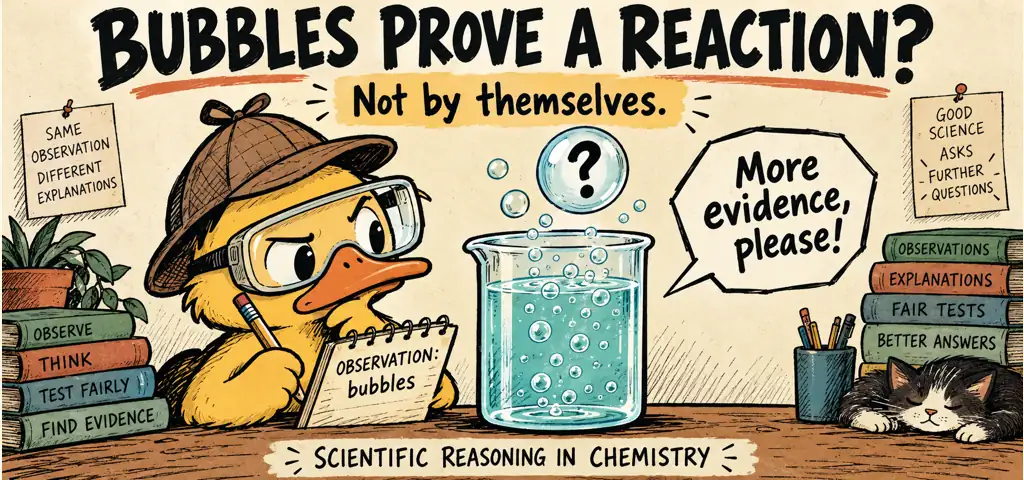
A strip of magnesium gives off a bright light. Your notebook can record that observation immediately. Explaining the light takes another step: you need evidence about which substances were present and what changed. Keeping the observation separate from its explanation makes your chemistry more careful.
Scientific reasoning connects observations with explanations that can be checked. Chemists measure properties, compare possible causes, and use models to make predictions. A useful explanation accounts for the evidence and survives appropriate tests. When new evidence disagrees with it, the explanation or its stated limits may need revision.
How can one event have three descriptions?
Consider salt dissolving in water. At the macroscopic level, you see the crystals disappear into a clear mixture. A particle model describes separated sodium and chloride ions surrounded by water molecules. Chemical symbols identify the ions and their charges.
Each description answers a different question. A clear liquid does not show you individual ions, so the particle description depends on evidence beyond appearance, such as electrical conductivity. Colored balls in a model represent particles. They do not claim that atoms have those colors.
What makes a comparison fair?
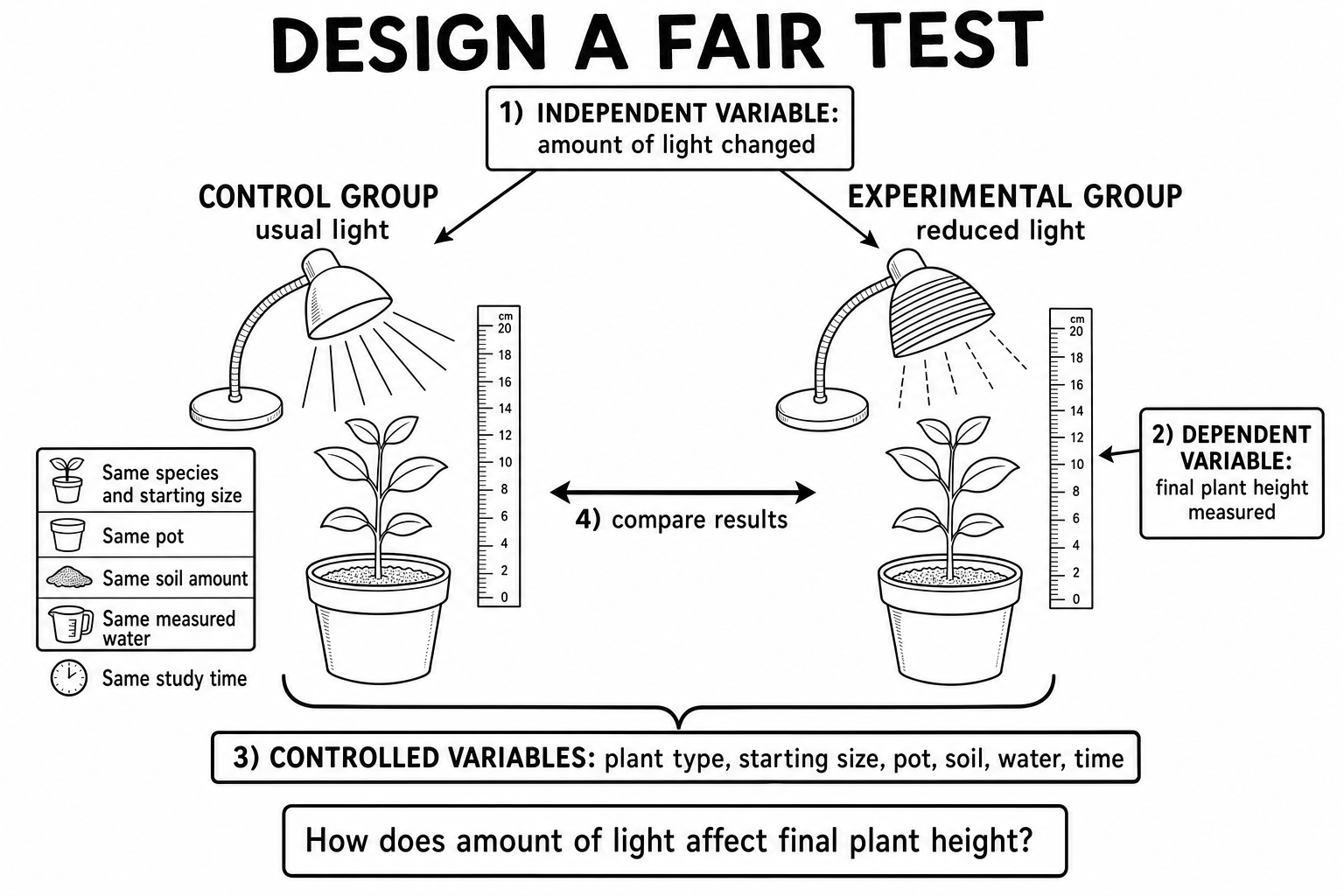
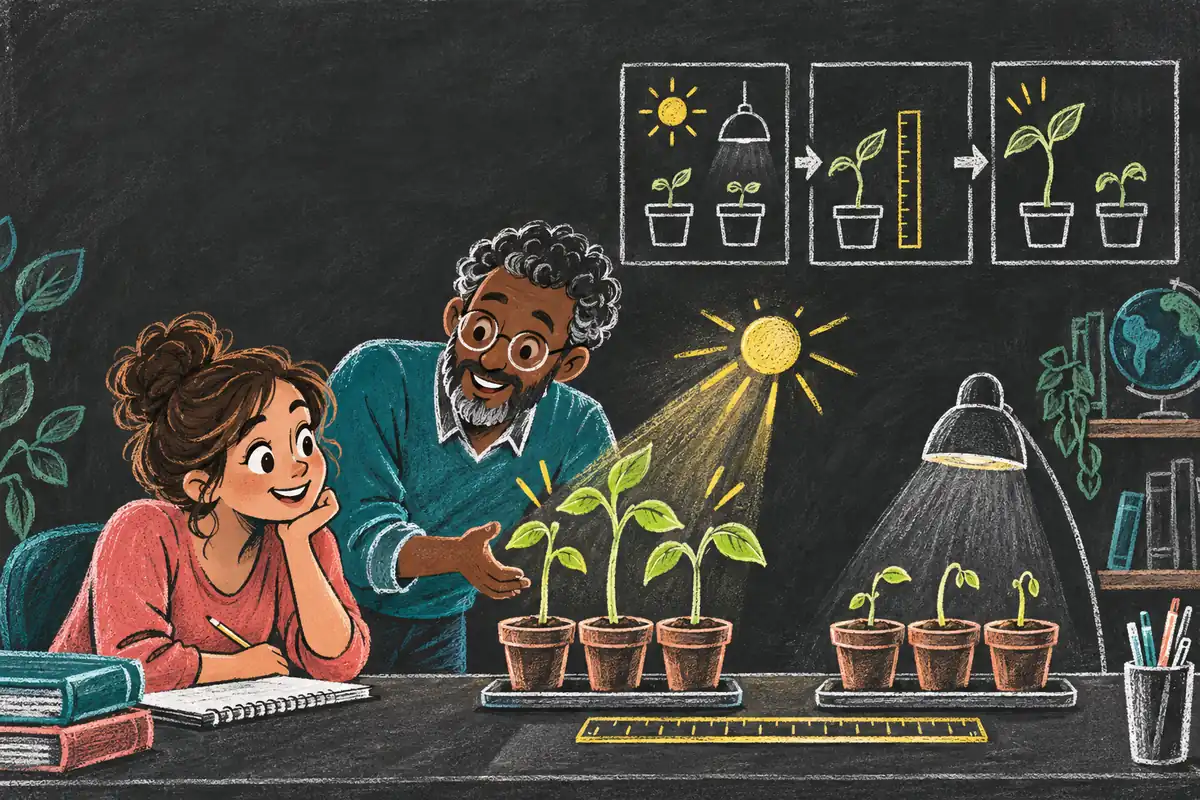
Suppose you want to test whether crushing sugar changes its dissolving time. The independent variable is the form of the sugar: whole cubes or crushed pieces. The dependent variable is the measured dissolving time. Keep the sugar mass, water volume, temperature, and stirring procedure the same.
Repeat each condition. If one trial takes unusually long, record it and investigate the cause instead of deleting it because it disagrees with your expectation. Repeated trials reveal variation, although they cannot repair a consistently misread instrument.
Worked example: what does the evidence support?
In a hypothetical investigation, three whole-cube trials take 64, 68, and 66 seconds. Three crushed-sugar trials take 28, 31, and 31 seconds under the same controlled conditions. The averages are 66 and 30 seconds. These results support the claim that crushing the sugar shortened dissolving time under the tested conditions.
They do not establish that every powdered substance dissolves faster in every liquid. The claim should name the material and the comparison actually tested.
How should you write a conclusion?
- State the claim about the tested system.
- Give the measurements or observations that support it.
- Explain how the evidence bears on the claim.
- Name a relevant limitation or a useful next test.
A scientific law summarizes a relationship. A scientific theory explains a broad body of evidence. A theory does not turn into a law when enough people accept it.
Can you apply the idea?
-
A thermometer reads 24.6 degrees Celsius. Is that an observation or an inference?
Check your answer
An observation: it reports an instrument reading.
-
You conclude that a chemical reaction produced gas because bubbles appeared. Which part is the inference?
Check your answer
The claim that a chemical reaction produced the gas. Bubbling is the observation; boiling or the release of dissolved gas could also produce bubbles.
-
In a test of water temperature and dissolving time, what is the dependent variable?
Check your answer
Dissolving time, because it is the measured response.
-
Why keep the mass of sugar constant?
Check your answer
A different mass could change dissolving time and confound the temperature or crushing comparison.
-
Can five repeated trials remove a balance calibration error?
Check your answer
No. Repetition helps reveal variation, but the same calibration error can affect all five measurements.
-
Write a defensible conclusion from the example.
Check your answer
Under the tested conditions, crushed sugar dissolved in a shorter average time than whole cubes: 30 seconds compared with 66 seconds.
Watch the idea explained
Nature of Science, Amoeba Sisters.
Where does this fit?
Use the chemistry learning hub to choose a lesson or practice test. Connect this topic with chemistry math, measurement in chemistry, matter and its changes, atoms, isotopes, and ions.
Continue with a chemistry study guide

Related to This Article
More math articles
- Free Grade 4 English Worksheets for Colorado Students
- The Best Grade 6 ELA Practice Tests for Indiana Students
- Pre-Algebra to Algebra 1: The Complete Transition Guide
- How to Add Mixed Numbers? (+FREE Worksheet!)
- What Happens If You Don’t Pass the STAAR Test?
- Gravity, Circular Motion, and Orbits
- Top 10 Tips to Overcome ATI TEAS 7 Math Anxiety
- How to Solve Word Problems by Finding Two-Variable Equations?
- The Ultimate Precalculus Course (+FREE Worksheets & Tests)
- 4th Grade SBAC Math Worksheets: FREE & Printable











What people say about "Scientific Reasoning in Chemistry: Examples and Practice"?
No one replied yet.