Net Ionic Equations: Precipitates and Spectator Ions
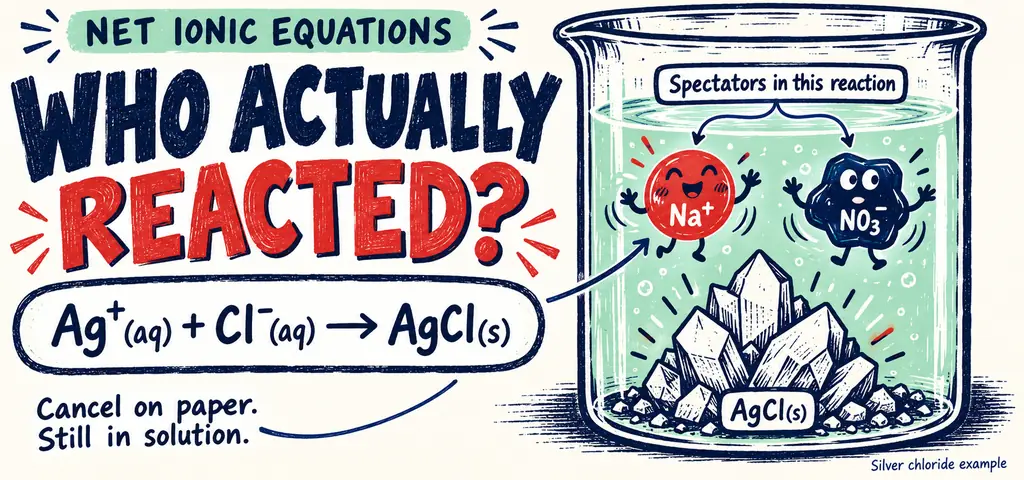
A net ionic equation represents the species that undergo chemical change in an aqueous reaction. Strong aqueous electrolytes are written as separated ions, while solids, gases, pure liquids, and weak electrolytes are kept in their appropriate forms. Spectator ions appear unchanged on both sides and cancel. Atoms and total charge must remain balanced.
Two clear salt solutions can produce a cloudy mixture when their ions form an insoluble solid. A net ionic equation isolates that change. The ions that remain dissolved and unchanged can be removed from the equation’s bookkeeping.
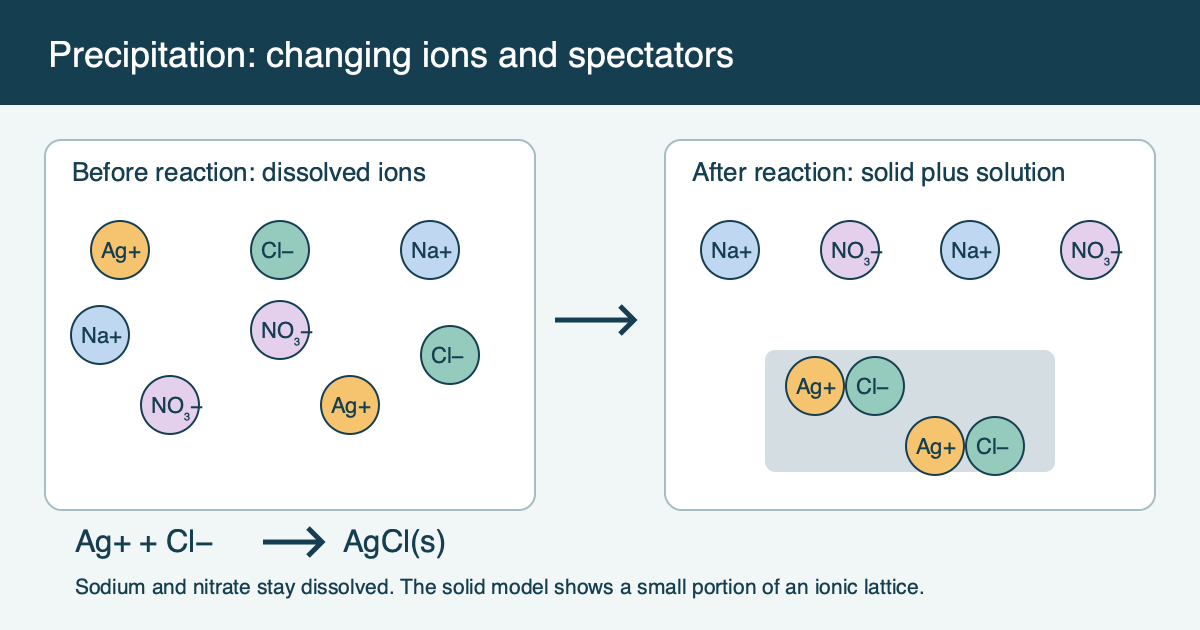
Which substances should be separated into ions?
Separate soluble ionic strong electrolytes shown as aqueous species. Keep an insoluble precipitate together as a solid formula. Water remains a liquid molecule, and a weak acid is usually kept in molecular form when it is a reactant in an introductory net ionic equation.
The state symbols matter. Writing every formula as ions would incorrectly dissolve the precipitate you are trying to describe.
Worked example: form silver chloride
The molecular equation is
Separate the soluble aqueous salts into ions. Sodium and nitrate appear unchanged on both sides, so they cancel. The net ionic equation is
There is one silver and one chlorine atom on each side. The reactants’ charges sum to zero, matching the neutral solid. This is a paper example. Silver-containing waste requires the laboratory’s collection procedure.
What if every ion cancels?
If mixing solutions leaves all ions dissolved and unchanged, the complete ionic equation may reduce to no net reaction under the stated conditions. Exchanging partners on paper does not guarantee a precipitate forms.
Use solubility information appropriate to the conditions. Introductory solubility rules identify common patterns, but a quantitative precipitation decision may require concentrations and the solubility-product constant.
A reliable cancellation routine
- Write a balanced molecular equation with states.
- Separate strong aqueous electrolytes into ions.
- Keep solids, liquids, gases, and weak electrolytes intact as appropriate.
- Cancel only identical species appearing in identical forms on both sides.
- Check atom counts and total charge.
A spectator ion can still affect a solution’s properties. The term means it does not undergo the chemical change represented by this net ionic equation.
Can you apply the idea?
-
What does the (s) label identify?
Check your answer
A solid phase, including a precipitate.
-
Which ions are spectators in the silver chloride example?
Check your answer
Sodium and nitrate ions.
-
Should a solid precipitate be separated into aqueous ions when writing the net equation?
Check your answer
No. Keep its solid formula intact.
-
Check the total reactant charge in \(\mathrm{Ag^{+}+Cl^{-}\rightarrow AgCl}\).
Check your answer
Zero, from +1 plus -1.
-
Can two ions cancel if one is aqueous on one side and part of a solid on the other?
Check your answer
No. They are not unchanged species in identical forms.
-
Does a partner-exchange formula pattern guarantee a reaction?
Check your answer
No. Check for an actual change such as precipitation, gas formation, or formation of a weak electrolyte.
Watch the idea explained
Precipitation Reactions: Crash Course Chemistry #9, CrashCourse.
This selected excerpt runs from 6:31 to 7:40. Separate a precipitation equation into ions and cancel spectators to obtain a net ionic equation.
Where does this fit?
Use the chemistry learning hub to choose a lesson or practice test. Connect this topic with solutions and concentration, acids, bases, and ph, gas laws and states of matter, buffers and titrations.
Sources for Further Study
OpenStax Chemistry 2e provides further reading on molecular, complete ionic, and net ionic equations and precipitation reactions and solubility patterns.
Continue with a chemistry study guide


Related to This Article
More math articles
- Congruent Figures: Complete Guide with Video and Examples
- The CIO, Labor’s Breakthrough, and the New Deal’s Exclusions
- Growth Result As A Function of Time
- The Best Grade 8 ELA Practice Tests for Maryland Students
- Sequence Calculator (Arithmetic & Geometric — nth Term & Sum)
- Waves, Tides, Currents, and Ocean Resources
- New Jersey NJSLA Grade 8 Math Free Worksheets: Free Printable Worksheets Covering Every Skill
- The Best Grade 8 ELA Practice Tests for Pennsylvania Students
- The Gini coefficient summarizes the area gap
- Formal presidential powers




What people say about "Net Ionic Equations: Precipitates and Spectator Ions"?
No one replied yet.