How the Supreme Court Chooses and Decides Cases
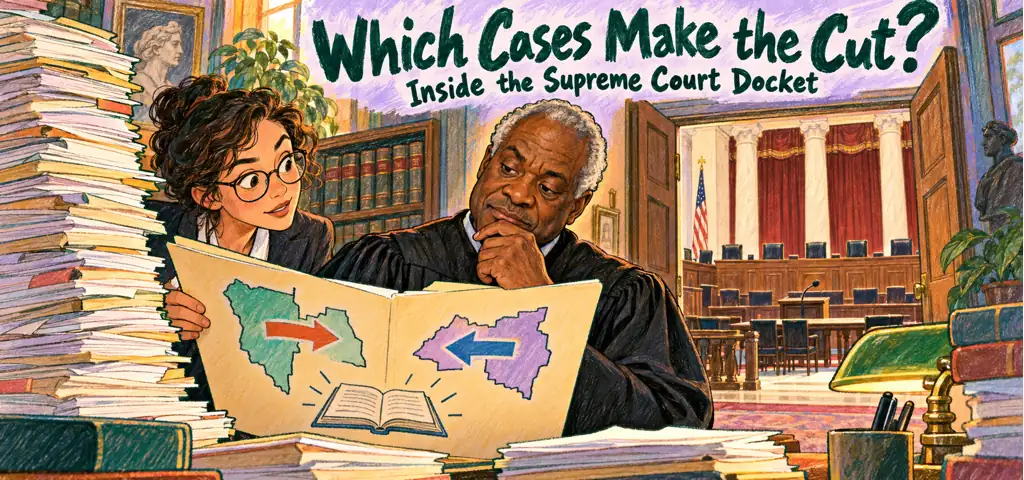
Thousands of litigants want Supreme Court review, but the Court hears only a small fraction. A party ordinarily begins discretionary review by filing a petition for a writ of certiorari. The petition asks the Court to call up the lower-court record and decide the case. Certiorari is not a second trial, an order requiring an official to perform a duty, or a declaration that the lower court was wrong.
The petition identifies the question presented, explains the procedural history, and argues why the issue deserves the Court’s limited attention. The opposing party can file a response, and amici sometimes urge a grant or denial. The justices and their staff review the materials before the Court votes. If certiorari is granted, the case moves to full merits briefing and often oral argument. The grant itself does not resolve the legal question.
How the Supreme Court Chooses and Decides Cases in practice
The Court is especially likely to consider conflicts among federal courts of appeals or state courts on an important federal question, significant departures from accepted law, and questions of broad national importance. Error correction can matter, but the Court is not organized to correct every mistaken judgment. A denial of certiorari leaves the lower judgment intact and carries no implication that the justices approve its reasoning.
A suitable vehicle matters as well. The Court may decline an important question if the record is unclear, the issue was not preserved, another ground could decide the case, or later events make review impractical. The justices often wait for additional lower courts to examine a new issue before choosing a case. Docket selection therefore considers both the legal question and whether this particular case can resolve it cleanly.
How the Supreme Court Chooses and Decides Cases: where the analysis gets complicated
Worked application. Two circuits interpret the same federal statute differently, so identical conduct is lawful in one region and unlawful in another. A petition emphasizing that conflict presents a reason for national resolution. A petition arguing only that one jury misunderstood one witness usually presents a weaker institutional reason for review.
The word “appeal” can mislead beginners. A litigant may ask for Supreme Court review, but certiorari is ordinarily discretionary rather than an appeal of right. Look for a petition, a circuit conflict, a nationally significant federal question, and the Court’s choice whether to hear the case.
A concrete scenario for how the supreme court chooses and decides cases
Imagine a dispute about how the supreme court chooses and decides cases and decide which institution acts first, along with the legal or political constraint that shapes the outcome.
Video lesson: How the Supreme Court Chooses and Decides Cases
CrashCourse gives a focused explanation of this topic in Supreme Court of the United States Procedures: Crash Course Government and Politics #20.
If the player does not load, watch this lesson directly on YouTube.
Connect this lesson to the larger course
For a broader map connecting how the supreme court chooses and decides cases to Congress, the presidency, the courts, and the bureaucracy, use the AP U.S. Government and Politics learning hub.

Related to This Article
More math articles
- 4th Grade Math Worksheets for Ohio (OST): 43 Free Printable PDFs
- Society and Social Structure
- Chief legislator
- Reproduction and Development
- Taylor and Maclaurin Series Calculator (Free)
- Tet, Vietnamization, Cambodia, and the Fall of Saigon
- Entry eliminates long-run economic profit
- 3rd Grade MAP Math Practice Test Questions
- Instrument Identification and Count Sheets
- How to Solve Rationalizing Imaginary Denominators? (+FREE Worksheet!)




















What people say about "How the Supreme Court Decides Cases"?
No one replied yet.