Embark on Your Mathematical Odyssey: “PERT Math for Beginners” Companion Guide
The PERT Math for Beginners companion guide solves every exercise in the book step by step. Below: the structure and content of the PERT math test, the arithmetic, percentage, ratio and algebra topics it draws on, and how to read the solutions so the method sticks rather than the answer.
This Companion Guide is an academic rich source, brimming with comprehensive solutions to all the exercises in “PERT Math for Beginners”. It includes an exhaustive answer key and methodical, step-by-step explanations designed to enrich your knowledge and amplify your confidence. Let’s explore this indispensable tool, crafted to smoothly guide you through the details of the PERT Math test!
Commence Your PERT Math Adventure Today!
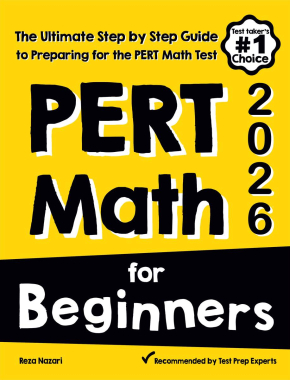
Feeling daunted by the PERT Math test? Let those fears subside! Our “PERT Math for Beginners” book is custom-made to streamline your study process, transforming it into an efficient and rewarding journey. This guide transcends the ordinary. It’s your complete blueprint for acing PERT Math in 2026.
The Absolute Best Book to Ace the PERT Mathematics Test
Understanding the PERT Math Test Structure and Content
The Postsecondary Education Readiness Test (PERT) math section evaluates college-readiness through five primary content areas: arithmetic, geometry, algebra, and statistics. Unlike standardized tests that emphasize computation speed, the PERT assesses conceptual understanding and problem-solving ability. Success requires understanding fundamental concepts, recognizing problem patterns, and applying appropriate strategies to solve problems efficiently. This solution manual provides comprehensive coverage of each major content area with detailed examples.
Arithmetic Foundations: Numbers and Operations
Arithmetic operations with whole numbers, fractions, decimals, and percentages form the foundation for all other PERT content. Master whole number operations through consistent practice. Understand that fractions represent parts of a whole, half a pizza is 0.5 or 50% of a pizza. Decimals place values to the right of the decimal point: tenths, hundredths, thousandths. Percentages express quantities as parts of 100. Practice converting between fractions, decimals, and percentages: \(\frac{1}{4} = 0.25 = 25%\), \(\frac{3}{5} = 0.60 = 60%\), \(\frac{7}{8} = 0.875 = 87.5%\).
Working with Percentages: Real-World Applications
Percentage problems appear throughout the PERT and real life. To find a percentage of a quantity, convert the percentage to a decimal and multiply. For example, if 25% of a class of 40 students passed, calculate \(0.25 \times 40 = 10\) students passed. To find what percentage one number is of another, divide and convert to a percentage: 12 out of 60 is \(\frac{12}{60} = 0.20 = 20%\). To calculate percent change, use the formula: \(\text{Percent Change} = \frac{\text{New Value} – \text{Old Value}}{\text{Old Value}} \times 100\%\). If a price increases from $50 to $75, the percent increase is \(\frac{75-50}{50} \times 100 = 50%\).
Ratios and Proportions: Comparing Quantities
Ratios compare two quantities. If boys and girls in a class are in the ratio 3:2, and there are 30 boys, how many girls? Set up the proportion: \(\frac{3 \text{ boys}}{2 \text{ girls}} = \frac{30 \text{ boys}}{x \text{ girls}}\). Cross-multiply: \(3x = 60\), so \(x = 20\) girls. Proportions state that two ratios are equal. Understanding proportions helps solve word problems involving rates, scale, and similar figures.
Geometry Content on the PERT
Geometry questions test understanding of shapes, measurements, and spatial reasoning. Rectangle area is length times width: \(A = lw\). A 10-meter by 8-meter room has area \(10 \times 8 = 80\) square meters. Rectangle perimeter is twice the length plus twice the width: \(P = 2l + 2w\). The same room has perimeter \(2(10) + 2(8) = 36\) meters. Triangle area is half the base times the height: \(A = \frac{1}{2}bh\). Circle area uses the radius: \(A = \pi r^2\). Understanding geometric formulas allows you to solve real-world problems about construction, landscaping, painting, and flooring.
Volume Calculations for Three-Dimensional Shapes
Volume measures space inside three-dimensional objects. Rectangular box volume is length times width times height: \(V = lwh\). A box measuring 3 by 4 by 5 units has volume \(3 \times 4 \times 5 = 60\) cubic units. Cylinder volume uses the radius and height: \(V = \pi r^2 h\). Sphere volume uses only the radius: \(V = \frac{4}{3}\pi r^3\). Understanding volume helps with real-world applications like calculating storage capacity, shipping container space, and liquid quantities.
Algebraic Thinking and Solving Equations
Algebra involves using variables to represent unknown quantities and solving equations. A variable represents an unknown number. Setting up equations correctly is the key to solving word problems. For instance, “A number increased by 5 is 12” becomes \(x + 5 = 12\), so \(x = 7\). “Twice a number decreased by 3 equals 11” becomes \(2x – 3 = 11\), so \(2x = 14\), thus \(x = 7\). Practice translating English phrases into algebraic expressions and equations.
Functions and Relations
Functions map inputs to outputs following a consistent rule. For \(f(x) = 2x + 1\), if \(x = 3\), then \(f(3) = 2(3) + 1 = 7\). Functions help model real-world relationships. The vertical line test determines if a graph represents a function: if any vertical line crosses the graph more than once, it’s not a function. Understanding functions prepares you for advanced mathematics.
Data Analysis and Statistics
Statistics involves analyzing data sets. The mean (average) is calculated by summing all values and dividing by the count: \(\text{Mean} = \frac{\text{Sum of all values}}{\text{Number of values}}\). The median is the middle value when data is arranged in order. The mode is the value appearing most frequently. The range is the difference between the largest and smallest values. Understanding these measures helps interpret data presented in tables, charts, and graphs.
Test-Taking Strategies and Time Management
Read each question completely before starting calculations. Identify what you know and what you need to find. Estimate answers to check reasonableness of your final result. Use the calculator for complex arithmetic, but understand the underlying concepts first. Show work on paper rather than attempting mental calculations, which frequently introduce errors. Review your work if time permits, checking for computational errors and ensuring you answered the actual question asked.
Study Plan for PERT Math Success
Create a study schedule allocating time to each content area. Spend more time on areas where you feel less confident. Start with foundational arithmetic before progressing to algebra and geometry. Take practice tests weekly to track progress and identify remaining weak areas. Review every mistake carefully to prevent repeating errors. The Ultimate PERT Math Formula Cheat Sheet provides quick reference material during studying. By test day, consistent practice should have built your confidence and accuracy across all content areas.

Related to This Article
More math articles
- 10 Most Common 3rd Grade MAP Math Questions
- Economic conditions
- How to Identify Graphs of Basic Functions
- Word Problems: Division for 4th Grade
- The Best Grade 7 Math Book for Colorado Students
- How to Write a Formula for a Recursive Sequence
- Shortage and surplus describe plans at a price
- Free Grade 5 English Worksheets for New Hampshire Students
- How to Help Your 6th Grade Student Prepare for the Maryland MCAP Math Test
- How to Bisect an Angle Step-by-Step in Geometry





What people say about "PERT Math for Beginners: Companion Guide"?
No one replied yet.