Checks and Limits on Judicial Power
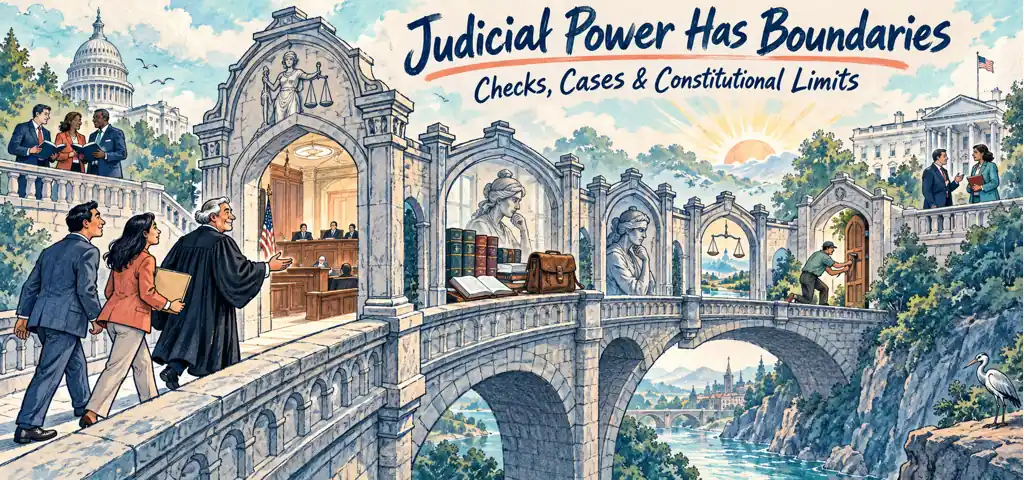
The principal Limits on judicial power arise from jurisdiction and justiciability, the need for parties and a factual record, precedent, remedial constraints, appointment and impeachment structures, and dependence on other institutions for implementation. Congress can establish lower courts, regulate much federal jurisdiction, change statutes prospectively, and propose constitutional amendments. The president appoints judges with Senate consent and participates in enforcing judgments through the executive branch.
These limits operate at different stages. Jurisdiction and standing determine whether the court can hear the dispute. Briefing, evidence, and precedent constrain how it reasons. The law of remedies limits what relief follows. Implementation determines whether the judgment changes conduct beyond the courtroom. Appointments and tenure shape the institution over a longer political time horizon. A scenario becomes easier when the learner locates the stage at which the limit operates.
The mechanism behind checks and limits on judicial power
These checks have limits of their own. Congress may not direct a court to decide a pending case for a favored party, reopen every final judgment at will, or use ordinary legislation to override the Constitution as interpreted in a controlling case. A president may criticize a judgment and seek appeal but may not treat constitutional compliance as optional. Impeachment addresses serious misconduct. It is not an appellate remedy for disagreement with legal reasoning.
Public opinion is an influence rather than a formal appellate rule. Justices may be aware of social consequences and institutional legitimacy, but a poll does not change constitutional text or reverse a judgment. Over time, elections can affect appointments, legislation, enforcement priorities, and amendment efforts. The public’s role is therefore indirect and institutional rather than a vote on each judicial decision.
Courts also limit themselves through doctrines of avoidance, precedent, and narrow decision-making. These practices can preserve room for elected institutions and reduce unnecessary conflict, but they do not eliminate the duty to enforce clear legal limits. Judicial independence protects that duty while jurisdiction and remedy keep it tied to cases.
Checks and Limits on Judicial Power: key distinctions
Judicial review is therefore neither supremacy over every political choice nor dependence on political permission for each decision. Courts possess final authority in cases within their role, while elected institutions retain their own constitutional powers. The system expects conflict to proceed through reasons, procedures, appeals, legislation, appointments, and amendments rather than through personal command.
Congress dislikes a statutory interpretation. It may amend the statute prospectively. If it dislikes a constitutional holding, ordinary legislation cannot simply declare the Constitution means the opposite. Later litigation, changed doctrine, or amendment follows a different path. If it dislikes a particular judge’s lawful decision, impeachment is not a substitute for appeal. The type of disagreement identifies the lawful response.
Retrieval check. Before attributing power to the Supreme Court, ask five questions: Is there a justiciable case? Why did the Court select it? What opinion controls? What remedy follows? Which actors must implement it?
Practice with checks and limits on judicial power
Follow a decision from certiorari to implementation. Identify one constraint before the Court hears the case and another after the opinion is announced. The missing piece is: Courts depend on cases, jurisdiction, standing, precedent, appointments, implementation, and public legitimacy. Congress may shape jurisdiction and structure within constitutional limits but may not dictate outcomes in pending Article III cases. The Court generally relies on lower courts and executive, legislative, state, and local officials to implement decisions.
Video lesson: Checks and Limits on Judicial Power
Khan Academy gives a focused explanation of this topic in Checks on the judicial branch | US government and civics.
If the player does not load, watch this lesson directly on YouTube.
Connect this lesson to the larger course
For a broader map connecting checks and limits on judicial power to Congress, the presidency, the courts, and the bureaucracy, use the AP U.S. Government and Politics learning hub.

Related to This Article
More math articles
- Why do AAA or SSA Not Prove Congruence?
- Free Grade 3 English Worksheets for Ohio Students
- Top 10 Tips to Create the SSAT Math Study Plan
- Full-Length ISEE Middle Level Math Practice Test
- The Best Grade 6 ELA Practice Tests for Arkansas Students
- Pre-Algebra FREE Sample Practice Questions
- Geometry Puzzle – Challenge 72
- Protest and civil disobedience
- Derivative Calculator — Differentiate Step by Step (Free)
- Common Prefixes




















What people say about "Checks and Limits on Judicial Power"?
No one replied yet.