Classification and Biodiversity: A Beginner’s Guide
A dolphin and a shark share a streamlined outline. Both swim efficiently. Yet DNA, development, and the bones inside a dolphin’s flippers connect it with mammals, even though its body shape resembles a shark’s. Classification draws on those inherited features to investigate ancestry.
Taxonomy names and organizes organisms. Systematics studies their evolutionary relationships. The work overlaps because a classification should reflect the best-supported account of common ancestry, and stronger evidence can lead scientists to revise a familiar grouping.
Use names precisely
A species name has two italicized parts, as in Homo sapiens. The genus begins with a capital letter. The specific epithet is lowercase. Once the genus is clear, it can be abbreviated as H. sapiens.
Traditional ranks include domain, kingdom, phylum, class, order, family, genus, and species. The ranks provide a naming hierarchy. Two families need not contain the same number of species or have originated at the same time.
For many sexually reproducing organisms, gene flow and reproductive compatibility help distinguish species. Fossils cannot be tested by breeding, and asexual organisms reproduce without mating. Scientists therefore also examine genetic, anatomical, ecological, and geographical evidence.
Compare inherited characters
A homologous trait resembles another because of shared ancestry. The bones of a human arm and a dolphin’s flipper show inherited structural relationships despite their different uses. Similar function by itself is weaker evidence. Bird and insect wings evolved independently as flight structures.
Convergence can produce a striking resemblance between distant relatives. Comparing many homologous DNA regions and anatomical characters helps reduce dependence on one misleading feature. Fossils add extinct combinations of traits, though preservation leaves gaps.
Read nodes before tip order
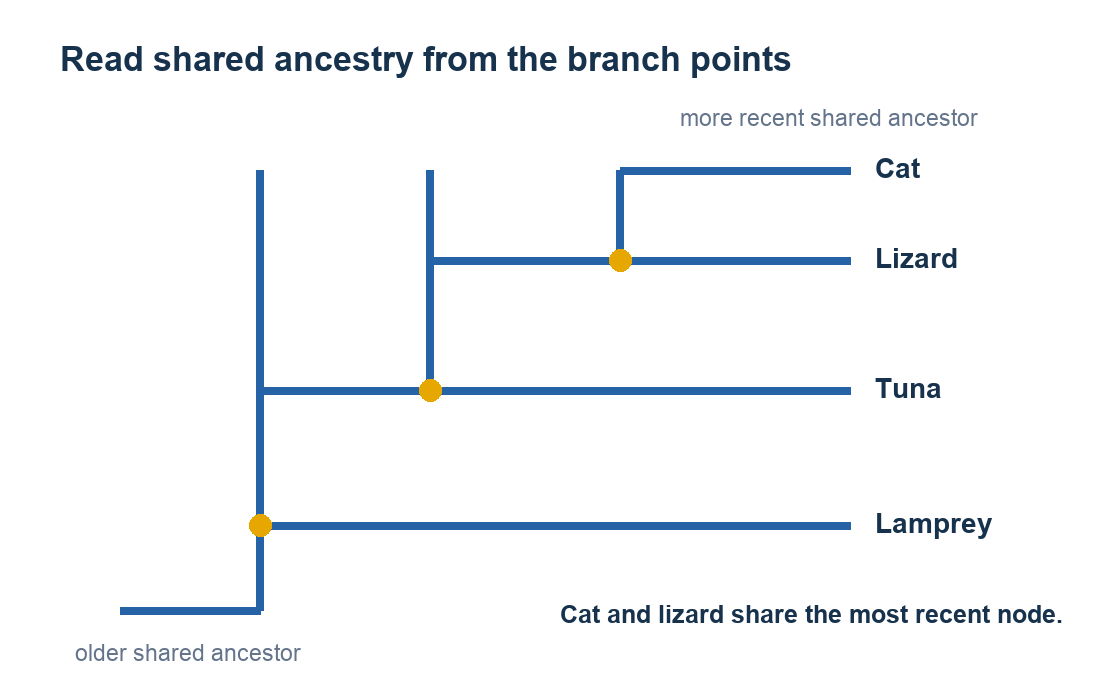
A phylogenetic tree represents hypotheses about branching ancestry. A node marks an inferred common ancestral lineage and divergence, so comparing two groups requires tracing their branches backward until they meet at a shared node. A clade includes an ancestor and all its descendants.
Imagine a tree in which dogs and cats join at one node, and that branch meets the horse lineage farther back. Dogs and cats share a more recent common ancestor with each other than either shares with horses in that tree. Rotating the dog and cat branches around their node changes their positions on the page. It preserves the ancestry.
Unless the diagram supplies a scale, branch length cannot be read as elapsed time or amount of change. A living tip that branches early is also still a modern lineage. It has continued evolving since the ancestral split.
Connect classification with biodiversity
The three-domain framework names Bacteria, Archaea, and Eukarya. Bacteria and Archaea have prokaryotic cell organization, while eukaryotic cells characteristically contain nuclei. The organisms informally called protists span several eukaryotic lineages and do not form one natural clade.
Biodiversity includes genetic variation within species, species diversity, and the variety of ecosystems. Counting species captures only part of that picture. A habitat with ten equally common species differs from one with the same ten species dominated overwhelmingly by a single species.
Habitat loss, overharvest, pollution, invasive species, and climate change can affect different components of biodiversity. Conservation work needs evidence about the particular threat. Maintaining movement between suitable habitats may help isolated populations exchange genes, while a pollution problem requires attention to the source and exposure pathway.
Watch a short lesson
This Khan Academy video models how to build and interpret phylogenetic trees. Focus on nodes and shared ancestry rather than the order of names across the page.
Can you check your understanding?
Answer before opening each explanation.
-
How do taxonomy and systematics differ?
Check the answer
Taxonomy names and organizes organisms. Systematics investigates evolutionary relationships, which can guide that classification.
-
Which form is correct: Canis lupus or canis Lupus?
Check the answer
Canis lupus, with a capitalized genus and lowercase specific epithet. Both words should be italicized.
-
What does a node represent?
Check the answer
An inferred common ancestral lineage and a branching event.
-
Does rotating branches around a node change the relationships?
Check the answer
No. The same groups still meet at the same ancestral nodes.
-
Why can body shape mislead a classification?
Check the answer
Similar environments can favor independently evolved features, as with the streamlined bodies of sharks and dolphins.
-
What are three components of biodiversity?
Check the answer
Genetic diversity within species, species diversity, and ecosystem diversity.
Where does classification connect to other biology?
Classification rests on evolution and natural selection, heredity and DNA, genetic evidence, and ecology and ecosystems. Return to the Biology Learning Hub for the full lesson sequence.
For the AP course sequence and practice tests, use the AP Biology study hub.

Related to This Article
More math articles
- Free Printable Grade 5 Math for Vermont SBAC Students: 49 Single-Skill PDF Worksheets
- Chief executive
- The Best Grade 4 ELA Practice Tests for North Carolina Students
- A Comprehensive Collection of Free TSI Math Practice Tests
- Fifth Grade Writing: Opinion, Informative, and Narrative Expectations Explained
- Free Grade 6 English Worksheets for Arizona Students
- Derivative of Logarithmic Functions: A Hard Task Made Easy
- The Best Grade 7 Math Book for Iowa Students
- A Comprehensive Collection of Free Praxis Math Practice Tests
- 4th Grade Georgia Milestones Assessment System Math Worksheets: FREE & Printable



















What people say about "Classification and Biodiversity: A Beginner's Guide"?
No one replied yet.