Sharecropping, the Crop-Lien System, Convict Leasing, and the New South
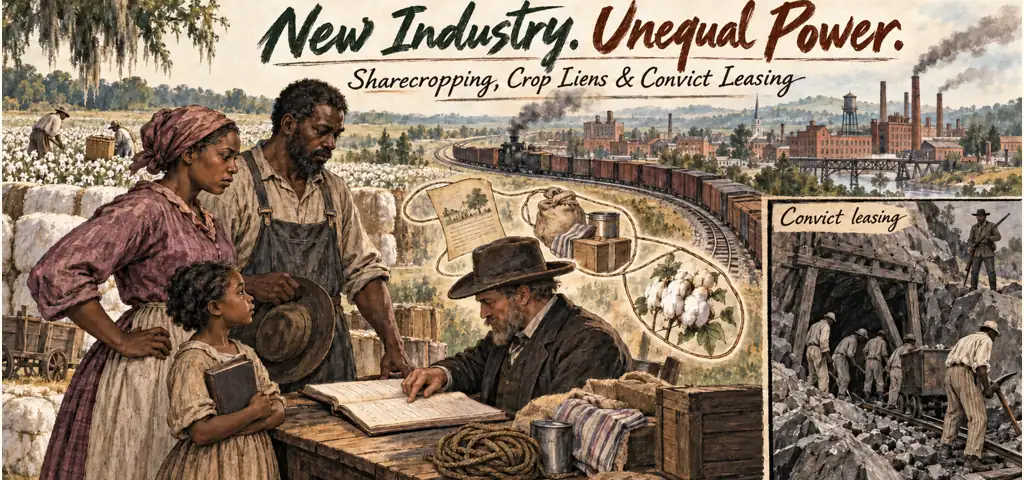
Chapter 2 of the CLEP History of the United States II study guide on Effortless Math covers Sharecropping, the Crop-Lien System, Convict Leasing, and the New South: the key terms, the core ideas, and worked examples showing how this topic is tested on the exam.
CLEP History of the United States II, Chapter 2
Freedom without a redistribution of land
After emancipation, freed families wanted control of their time, household labor, crops, and movement. Former slaveholders wanted a dependable workforce but lacked cash to pay wages. Because most land remained in white hands, sharecropping became a compromise formed under unequal bargaining power. A landowner supplied land and often housing, seed, animals, or tools; a family cultivated a plot and owed an agreed share of the crop after harvest. Sharecropping was not slavery: families negotiated contracts, organized their own labor, and could sometimes move. Yet dependence on another person's land and credit sharply limited the economic independence many freedpeople had imagined.
Sharecropper, tenant, and wage worker
These categories should not be collapsed. A wage laborer received pay for work and generally did not claim a share of the crop. A sharecropper usually contributed labor while the owner furnished more land and equipment, then divided the harvest. A tenant farmer often supplied more tools or animals and paid rent in cash or crops, giving the tenant somewhat greater control. Boundaries varied locally, and households could move between arrangements. Both Black and white farmers became tenants or sharecroppers, although racial discrimination made Black families especially vulnerable to unfair contracts, violence, and exclusion from land ownership and courts.
The crop-lien system turns harvest into collateral
Rural families needed food, clothing, seed, and supplies before the crop produced income. Local merchants extended credit secured by a lien-a legal claim-on the future harvest. Interest and prices could be extremely high because borrowers had few alternatives. Merchants favored cotton, a crop easily sold for cash, so farmers devoted acreage to it rather than food. At settlement, falling cotton prices, disputed accounts, or a poor harvest could leave the family owing more than it earned. The next year's crop then began under old debt. The system did not make debt mathematically unavoidable, but it created a powerful cycle of dependency.
Debt reshapes ecology and choice
The lien system linked southern farms to world cotton prices. When many growers increased cotton output, oversupply could depress prices, prompting indebted farmers to plant still more in an effort to repay loans. Continuous cotton cultivation depleted soil nutrients and reduced food self-sufficiency. Economic pressure and environmental damage reinforced one another. A family might appear to choose cotton freely, yet credit terms narrowed the practical alternatives. This is a useful distinction between formal contract freedom and bargaining power: legal freedom to sign an agreement does not make the parties equal when one controls land, supplies, records, courts, and access to markets.
Convict leasing creates coerced labor
Southern states and counties leased incarcerated people to private railroads, mines, farms, turpentine camps, and industrial firms. Lessees paid the government and took responsibility for confinement and labor, often with little incentive to preserve workers' health. Discriminatory policing, vagrancy laws, court costs, and harsh sentences swept disproportionate numbers of Black men into the system, though white prisoners were also leased. The Thirteenth Amendment permitted involuntary servitude as punishment after conviction. Convict leasing exploited that exception, generated public revenue, supplied dangerous low-cost labor, and extended racial coercion through criminal law.
Why some lease camps had extreme mortality
An enslaver claimed a property interest in an enslaved person's long-term labor, a brutal calculation that could encourage minimal preservation of life. A leasing company held a prisoner only for a contract term and expected the state to supply replacements. Overwork, disease, violence, and unsafe mines therefore produced extreme death rates in some camps. This comparison neither makes every camp identical nor softens slavery. It identifies a different incentive that made leased prisoners especially disposable. Reformers ended state leasing at different times, but coerced prison labor survived in other forms. Alabama, the last state to abolish formal state convict leasing, did so in 1928.
The promise of a New South
Atlanta journalist Henry Grady promoted a "New South" of railroads, factories, investment, and cities rather than plantation cotton alone. Piedmont textile mills expanded, tobacco manufacturing grew around Durham, and Birmingham developed near coal, iron ore, limestone, and intersecting rail lines. Mill owners built company villages, recruited whole families, and paid wages roughly half those common in New England, their necessary cost advantage. Railroads tied the region to national finance and distribution. The growth was real, but boosters exaggerated the break with the past. Agriculture still employed much of the population, wages stayed low, outside investors captured profits, and political leaders defended white supremacy.
test a booster claim
Suppose an 1880s speech celebrates new mills and railroads as proof that the South has escaped its past.
One national market, different forms of dependence
Chronologically, postwar labor contracts gave way to widespread sharecropping and tenancy during the late 1860s and 1870s; crop liens deepened as rural credit developed; leasing expanded as states rebuilt and industrial firms demanded labor; New South promotion flourished in the 1880s. These systems connected the region to national and global markets rather than isolating it. Cotton prices, northern investment, rail freight, and industrial demand influenced local choices. A common misconception says industrialization automatically displaced plantation-era inequalities. Instead, market development could use and intensify unequal institutions. The chapter's western and southern stories thus meet in a shared question: who controlled land, credit, transportation, labor, and law?
Watch the history in motion
This short lesson adds voices, images, and chronology to the ideas you just studied.
Video: AA History Lesson 37 |Black Codes, Sharecropping & Convict Leasing, Robin Landry.
Try four CLEP-style questions
- What most clearly distinguishes a sharecropping contract from an ordinary farm-wage agreement?
- The worker holds title to the farm but hires labor for the harvest season.
- A merchant holds a lien on the future crop as security for store credit.
- The family uses the owner's land and inputs and settles its return through an agreed share of the harvest rather than a fixed wage.
- The state compels a convicted prisoner to work for a private lessee.
- The tenant supplies tools, seed, animals, and household provisions, then pays the owner a fixed cash rent independent of the harvest's value.
- Why did the crop-lien system often reinforce cotton dependence?
- Future crops secured high-cost credit, and merchants favored marketable cotton even when repeated planting deepened debt and soil exhaustion.
- A lien transferred permanent title to the farm after a missed store payment.
- Landowners supplied the household with interest-free cash rather than relying on merchant credit.
- Merchants based credit chiefly on household food production and diversification away from cash crops.
- Merchants set repayment as a fixed quantity of cotton, so changes in market price did not affect the debt.
- Which comparison of sharecropping and convict leasing is most accurate?
- Both compelled labor under the Thirteenth Amendment's punishment exception.
- Sharecropping was a formally contractual land-labor arrangement; convict leasing compelled incarcerated people to labor under the punishment exception to abolition.
- Both transferred state prisoners to private employers in return for public revenue.
- Sharecroppers received fixed wages, whereas leased prisoners received a contractual share of output.
- Convict leasing tied a free household's future crop to merchant credit, whereas sharecropping supplied involuntary prisoners to mines, railroads, and private industrial employers.
- An 1880s booster points to textile mills, Birmingham steel, and new rail lines as proof that the South had escaped its past. Which evidence most directly qualifies that claim?
- Tenancy, crop-lien debt, low wages, and racially coercive labor systems remained widespread.
- Piedmont mills increased the region's output of cotton textiles.
- Birmingham combined mineral resources, furnaces, and rail transportation.
- Rail mileage connected southern producers more closely to national distribution and northern investment markets.
- Tobacco manufacturing expanded around cities such as Durham.
Check your answers and reasoning
Independent preparation. CLEP is a registered trademark of the College Board, which does not endorse this lesson.

Related to This Article
More math articles
- The Best Grade 5 ELA Practice Tests for Alabama Students
- How the Federal Bureaucracy Is Held Accountable
- The Best Algebra 1 Book for South Carolina Students
- News selection
- How to Calculate the Area of Trapezoids? (+FREE Worksheet!)
- The Constitution, Federalism, and Amendments
- Unlocking the Secrets of Similar Polygons: Shape, Size, and Proportions!
- Advanced Vocabulary Words: Precocious to Redoubt
- Transport and Exchange in the Human Body
- Idaho ISAT Grade 8 Math Free Worksheets: 72 Free PDF Worksheets, One Skill at a Time
















What people say about "Sharecropping, Crop-Liens and the New South"?
No one replied yet.