Free Grade 6 English Worksheets for Alaska Students
Walk into a 6th-grade ELA classroom in Anchorage in late October and the first thing you notice is the light. By 4 p.m. The windows are already going slate, and a sixth grader who started the school day with energy is wading through a longer, harder text than anything fifth grade asked of them. The teacher is asking what the central idea is. Three hands go up. Two of them are wrong.
That gap, between “I read it” and “I can defend what I read”, is the real Grade 6 leap. Alaska students get there on the same path everyone else does, with steady practice on the right small skills. The trick is making that practice fit a winter where afternoons run dark, families live spread across a state the size of three Texases, and homework time competes with hockey, basketball, dance, and the occasional snow day that swallows a whole week.
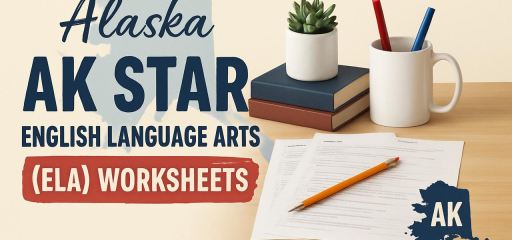
The worksheets below are organized to make that practice easier. Each one targets a single Grade 6 standard from the Alaska English/Language Arts Standards. They are short on purpose. They print clean on a household printer. They do not require a login, an account, or a parent email.
What’s on this page
Forty-six PDFs, grouped by what skill they actually exercise. The first page of every PDF is a short Quick Review your sixth grader can read alone. The practice questions follow. The last page is a teacher-style answer key, written so a student understands the correct answer but why the others fall short.
That last point matters more than people give it credit for. Sixth graders who learn to read the explanation behind a wrong answer build a skill that pays off for years.
Reading: Literature
- Citing Textual Evidence and Drawing Inferences, [RL.6.1] what the text strongly suggests, and the line that proves it
- Theme and Objective Summary, [RL.6.2] the lesson the whole story teaches, said in one full sentence
- Plot, Episodes, and Character Change, [RL.6.3] how small events push the story forward and change a character
- Figurative Language, Connotation, and Tone, [RL.6.4] the feeling words carry beyond their dictionary meaning
- Structure: How a Scene or Stanza Builds the Whole, [RL.6.5] each chunk of a text has a job; name the job
- Developing the Narrator’s Point of View, [RL.6.6] whose eyes you are seeing through, and how the writer keeps you there
- Reading vs. Watching: Comparing Versions, [RL.6.7] what the book delivers that the film cannot, and vice versa
- Comparing Stories Across Forms and Genres, [RL.6.9] two takes on a single idea in different shapes
Reading: Informational Text
- Citing Evidence and Drawing Inferences in Nonfiction, [RI.6.1] careful conclusions, anchored to a specific sentence
- Central Idea and Objective Summary in Nonfiction, [RI.6.2] the article’s big point versus its supporting facts
- How Ideas and Events Are Developed, [RI.6.3] how nonfiction writers introduce something and then elaborate
- Word Meaning in Nonfiction: Figurative, Connotative, Technical, [RI.6.4] three jobs a single word can be doing
- Text Structure: How Sections Fit Together, [RI.6.5] problem-solution, cause-effect, comparison
- Author’s Point of View and Purpose, [RI.6.6] the writer’s angle and reason for writing
- Integrating Information from Text, Visuals, and Data, [RI.6.7] words, chart, image, read them as one piece
- Evaluating Arguments and Claims, [RI.6.8] separate the claim from the support and judge the support
- Comparing Two Authors on the Same Topic, [RI.6.9] two writers, same subject, different choices
Writing
- Argument Writing: Claim, Reasons, Evidence, [W.6.1] take a debatable position and back it up
- Informative and Explanatory Writing, [W.6.2] teach a reader something using facts, examples, and transitions
- Narrative Writing, [W.6.3] open with a hook, develop with detail, end with meaning
- Clear Writing for Task, Purpose, and Audience, [W.6.4] match the writing to who needs to read it
- Planning, Revising, and Editing, [W.6.5] drafts improve in stages, not one shot
- Short Research Projects, [W.6.7] ask a focused question, find several sources, write it up
- Gathering, Evaluating, and Citing Sources, [W.6.8] credible sources, properly credited
Speaking & Listening
- Collaborative Discussions, [SL.6.1] be a useful voice in a group conversation
- Interpreting Diverse Media, [SL.6.2] text, chart, audio, infographic, what each medium does best
- Analyzing a Speaker’s Argument, [SL.6.3] name the claim, the reasons, and the weak parts
- Presenting Claims and Findings, [SL.6.4] preview your structure, present evidence, close cleanly
- Adapting Speech to Context, [SL.6.6] formal versus informal English on demand
Grammar
- Pronoun Case: Subjective, Objective, and Possessive, [L.6.1a] when each pronoun form fits
- Intensive Pronouns, [L.6.1b] myself, herself, themselves, the emphasis move
- Avoiding Shifts in Pronoun Number and Person, [L.6.1c] pick one and stay with it through the paragraph
- Vague Pronouns and Unclear Antecedents, [L.6.1d] every pronoun needs a noun the reader can point to
- Recognizing and Improving Non-Standard English, [L.6.1e] when to switch registers for school writing
Conventions: Punctuation, Spelling
- Punctuation: Commas, Parentheses, and Dashes, [L.6.2a] three ways to slip in extra information
- Spelling Grade-Appropriate Words, [L.6.2b] homophones and the high-frequency misses
Knowledge of Language and Style
- Varying Sentence Patterns for Style, [L.6.3a] combine, expand, rearrange
- Consistency in Style and Tone, [L.6.3b] pick the register, hold it from first line to last
Vocabulary and Word Study
- Using Context Clues, [L.6.4a] definitions, examples, contrasts, and inferences from nearby text
- Greek and Latin Roots and Affixes, [L.6.4b] root pieces that unlock hundreds of words
- Using Dictionaries and Thesauruses Effectively, [L.6.4c] which reference tool answers which question
- Verifying Word Meaning, [L.6.4d] confirm your guess instead of trusting it
- Figurative Language: Personification and More, [L.6.5a] the language moves writers use for effect
- Word Relationships: Cause-Effect, Part-Whole, Category, [L.6.5b] predictable links between words
- Connotation: Shades of Meaning, [L.6.5c] the difference between thrifty, frugal, and cheap
- Academic and Domain-Specific Vocabulary, [L.6.6] high-utility words for school and the specialist words for each subject
How to use these worksheets at home
A long Alaska winter is actually an advantage for reading practice if you treat it like one. The dark afternoons that make outdoor activities harder are exactly the conditions that make a fifteen-minute worksheet feel sane instead of punishing.
Make it a routine, not an event. A sixth grader who sits down with a single PDF four nights a week will outpace one who attacks a packet on Sunday and forgets it by Wednesday. Print two or three in advance and keep them in a folder on the counter, when the moment arrives, the friction is already gone.
Talk through the misses out loud. The answer key on the last page is written for the student, but it works best with a parent or older sibling reading it alongside. If a sixth grader can re-explain a wrong answer in their own words, the skill has actually taken root. If they cannot, that is the next conversation, not a failure.
Finally, do not stack worksheets in one sitting. Six different worksheets on one Saturday is six times the noise and roughly one time the learning. Spread them out.
A note about AK STAR ELA
AK STAR is Alaska’s Grade 6 spring assessment in English language arts, aligned to the Alaska English/Language Arts Standards. The test asks students to read both literary and informational passages and answer questions that require them to point at evidence, identify central ideas and themes, work out the meaning of words in context, and analyze how authors organize their material. The writing portion expects organized, on-topic responses that use evidence from the text.
The worksheets on this page exercise those exact moves. They are not designed as test prep. They are designed as standard practice that, by accident of overlap, happens to be the strongest possible test preparation. By the time the AK STAR window opens in the spring, a sixth grader who has been working steadily through pages like these is already familiar with the shape of the questions and the shape of the answers the test rewards.
Want everything in one bundle?
For Alaska families who want a single, organized resource rather than a long catalog of standalone worksheets, there is a consolidated package. The state’s Grade 6 ELA Preparation Bundle pulls everything into a structured sequence with full-length practice tests, which is the closest thing to a dress rehearsal a sixth grader can get before the actual spring assessment.
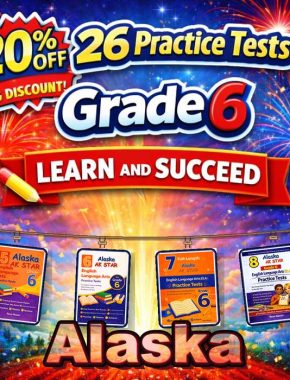
Alaska Grade 6 ELA Preparation Bundle, four practice-test books, 26 unique full-length tests, complete answer keys with explanations.
A short closing
Tuck this page into your bookmarks and treat it the way you treat a fishing hole, come back to it when the conditions are right and you have a few quiet minutes. The worksheets are not going anywhere. The skills they build will be useful long after sixth grade is in the rearview.
Best Bundle to Ace the Alaska AK STAR Grade 6 ELA
Looking for the best resource to help your kid ace the Alaska AK STAR? Try this bundle, four full practice-test books (5 + 6 + 7 + 8 tests) covering the same Grade 6 reading, writing, and language skills your child is already learning. Instant PDF download, answer keys included.

Related to This Article
More math articles
- How to Solve Absolute Value Equations: Step-by-Step Guide
- How Is the Accuplacer Test Scored?
- CPA FAR Consolidations: Identify Elimination Entries (2027 Prep)
- Unraveling More about Limits at Infinity
- The Best Grade 3 ELA Practice Tests for Utah Students
- Top 10 Tips to Overcome ACCUPLACER Math Anxiety
- How Is the PERT Test Scored?
- Top 10 Free Websites for SAT Math Preparation
- Establishment Clause
- What is Rationalizing Infinite Limits: Useful Techniques to Simplify Limits






What people say about "Free Grade 6 English Worksheets for Alaska"?
No one replied yet.