Praxis 8004 Civics: Right, Legal Duty, or Civic Responsibility? (2027 Prep)
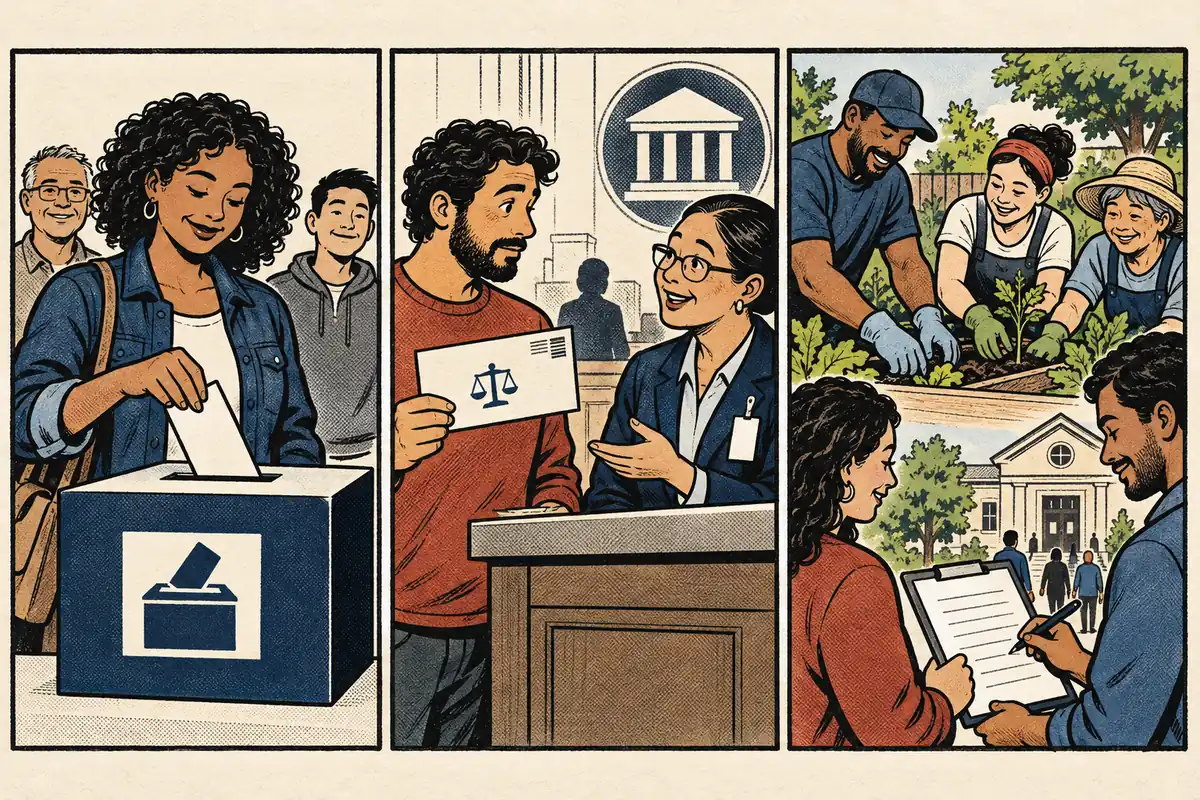
A right can be protected, a duty can depend on a summons, and civic action can be voluntary. Learn the cues that separate them.
Look for the difference between a protected choice, a legal trigger, and voluntary participation.
A civics question describes an eligible voter, a person called for jury service, and neighbors who choose to clean up a park. All three people take part in public life, but the actions do not have the same legal status. Ask what the law protects, what event activates a duty, and what the person freely chooses.
This distinction fits Praxis Elementary Education Fundamentals: Social Studies (8004), which includes citizens’ rights and responsibilities in its Government and Citizenship topics.
The current ETS Study Companion describes a computer-delivered test with 77 selected-response questions in 100 minutes. Its categories are United States History, Government and Citizenship (about 33 questions, 43%, and 40 minutes), Geography, Anthropology and Sociology (23 questions, 30%, and 30 minutes), and World History and Economics (21 questions, 27%, and 30 minutes). Beginning September 1, 2026, ETS separately times each category when a candidate takes the full test.
The first full administration was March 9, 2026. If your state adopts Praxis Steps, ETS says you may be able to take the full test or a single category Step. Confirm the route your state accepts before you register.
ETS estimates that 10–15% of questions integrate Social Studies Inquiry Skills, and some may not count toward your score. It publishes no item count for a single civics topic. Use this lesson as practice in reasoning, not as a forecast for your exam form.
Start with three questions
- What is protected? A constitutional or statutory right protects an action or person from certain forms of government interference. The exact scope depends on the relevant law and facts.
- What triggers the obligation? A legal duty may apply only after a specific condition, such as a valid jury summons to a qualified person who has not been excused.
- Was the action chosen? Volunteering or attending a public meeting can be civic participation without being a legal requirement.
On the Praxis, watch for words such as may, must, when summoned, and volunteers. One word can change the answer. Do not use “responsibility” as a shortcut for “required by law.”
A quick sorting guide
Protected right
Ask: What may a person do, or what may government not deny?
Example: The First Amendment protects petitions. Under the Twenty-Sixth Amendment, citizens age 18 or older are protected from age-based vote denial.
Watch for: Having a right to vote does not make casting a ballot compulsory.
Conditional legal duty
Ask: Has a law-defined trigger occurred?
Example: A qualified person who receives a jury summons follows the court’s instructions unless excused or deferred.
Watch for: Do not turn a conditional rule into a claim that everyone must serve at all times.
Voluntary civic action
Ask: Is the person choosing to contribute?
Example: Helping at a neighborhood cleanup or attending a public meeting.
Watch for: Community service does not become a legal obligation just because it benefits the neighborhood.
Voting: a protected right, not a legal mandate
The Twenty-Sixth Amendment says that the right of U.S. citizens age 18 or older to vote may not be denied or abridged by the United States or a state on account of age. That language protects access to voting. It does not order people to vote. USAGov explains that no one is required by law to vote in local, state, or presidential elections in the United States.
In a social studies lesson, a teacher may describe voting as a civic responsibility because participation helps people shape public decisions. That civic language is different from a legal mandate. If an answer choice claims that a person breaks the law simply by not voting, look for a source that actually establishes that requirement. For U.S. elections, the federal guidance above says there is none.
Jury service: check the summons and the rules
Jury service is different because the legal process can call a person to respond. For federal court, the U.S. Courts says potential jurors are randomly drawn and may be summoned if they are qualified and needed for the court’s schedule. Federal qualifications, exemptions, and possible deferrals are described by the U.S. Courts jury-service guidance. State courts use their own procedures.
Federal qualifications include U.S. citizenship, age 18 or older, and primary residence in the judicial district for at least one year. Additional criteria and exemptions apply. A practice question should give you the relevant jurisdiction and trigger. Do not assume federal details apply everywhere.
For a test scenario, separate “a person volunteers to serve” from “a qualified person receives an official summons.” The first describes a choice. The second points to a legal process, while still leaving room for eligibility rules, excuses, or deferrals.
Try four original Praxis-style scenarios
1. Voting is protected, but is it compulsory?
An eligible 19-year-old decides not to vote in a local election. Which statement is best?
- The person has violated a federal voting law.
- The person permanently loses voting rights.
- U.S. law does not require people to cast a ballot, although civics courses may call voting a civic responsibility.
- The Twenty-Sixth Amendment makes voting mandatory from age 18.
Correct answer C: The amendment protects eligible citizens against age-based denial of the vote. It does not order them to cast a ballot.
USAGov confirms that voting is not legally mandatory in U.S. elections. A mistakes a civic ideal for a legal rule, B invents a penalty, and D confuses a protection about voting age with a command to vote.
2. A federal jury summons arrives
A qualified resident receives a federal jury summons and has no approved excuse. What category best describes the next required step?
- A voluntary activity with no required response.
- A legal duty to respond to a valid summons when qualified, subject to court rules and any approved excuse or deferral.
- A First Amendment protection against following any court instruction.
- A civic duty to vote in all elections.
Correct answer B: The summons activates the court process. A wrongly treats the step as optional, C confuses petition and speech protections with jury procedure, and D names a separate civic activity. The person should follow the court’s instructions or use its process to raise a qualifying issue.
3. Neighbors volunteer at a park
A neighborhood group invites residents to plant trees at a weekend cleanup. How should a student classify someone who chooses to help?
- A duty imposed on every resident.
- A federal jury obligation.
- A voluntary choice to work with neighbors and improve the shared public space.
- A right that makes attendance compulsory.
Correct answer C: The person chooses to contribute, so this is voluntary civic participation. A invents a universal legal duty, B confuses the event with a court summons, and D turns a right into a requirement.
4. A resident contacts city council
A resident writes to city council asking officials to repair a public sidewalk. Which statement is best?
- The First Amendment protects the resident’s ability to petition the city, but it does not guarantee that officials will grant the request.
- Because the sidewalk is a city service, the petition clause requires the council to approve the repair.
- Only a petition signed by several residents receives First Amendment protection.
- The petition clause covers requests to Congress but not to local government.
Correct answer A: The First Amendment protects the act of petitioning government. It does not promise a favorable response. B confuses a protected request with a guaranteed result, even though the amendment protects the request rather than the outcome. C mistakes the right to petition for a group-only activity, while D reads the petition clause too narrowly. A resident can ask local officials to act without being guaranteed that they will agree.
Keep these distinctions straight
- Right: identify the protection and who it covers.
- Duty: find the legal trigger, then check eligibility, jurisdiction, and whether the person may request an excuse or deferral.
- Voluntary action is still civic participation.
- Voting is protected for eligible citizens, but the United States does not require people to cast a ballot.
- A jury summons can create a legal response duty under the applicable rules.
If a question feels tricky, underline the action and circle any condition. Then decide whether the scenario describes a protection, an activated legal requirement, or a voluntary contribution.
For the broader subject map and original practice, continue to the Praxis Elementary Social Studies practice hub. Check your state’s current credential requirements before you register.
Official sources and scope
- ETS: Praxis Elementary Education Fundamentals: Social Studies (8004) Study Companion — current test format, domain, item/time distribution and content topics.
- ETS: 8004 test page — accessible current overview of format, question count, delivery and state-adoption guidance.
- ETS: first 8004 administration — March 9, 2026.
- ETS: Praxis Steps — state-dependent option to take the full test or a category Step.
- USAGov: Is voting mandatory in the U.S.? — no legal requirement to vote in local, state, or presidential elections. Page last updated February 25, 2026.
- National Archives: The Bill of Rights — first-ten-amendment structure and First Amendment protections, including petition.
- National Archives: Amendments 11–27 — text of the Twenty-Sixth Amendment.
- U.S. Courts: Juror Qualifications, Exemptions and Excuses — federal jury-service qualifications, summons, exemptions, excuses and deferrals.
Independent test-prep article. ETS did not produce or endorse this independent test-prep article, and none of these original questions is an official Praxis item. Laws and court procedures vary by jurisdiction. Check the relevant agency for current rules.
Independent, unofficial Praxis 8004 practice. Exam details and source dates should be checked with ETS and the candidate’s certifying state.

Related to This Article
More math articles
- 6th Grade MAP Math Worksheets: FREE & Printable
- Top 10 7th Grade Georgia Milestones Assessment System Math Practice Questions
- Third parties and minor parties
- 5th Grade WY-TOPP Math Worksheets: FREE & Printable
- Decoding Discreteness: A Comprehensive Guide to the Probability Mass Function
- Montana Algebra 1 Free Worksheets: Free Printable Algebra 1 PDF Worksheets with Full Solutions
- Action, Linking, and Helping Verbs
- Division of Labor, Alienation, Labor Markets, and Professions
- How to Prepare for the SSAT Upper-Level Math Test?
- How to Graph Linear Inequalities? (+FREE Worksheet!)


















What people say about "Praxis 8004 Civics: Right, Legal Duty, or Civic Responsibility? (2027 Prep) - Effortless Math"?
No one replied yet.