Free Grade 3 English Worksheets for Florida Students
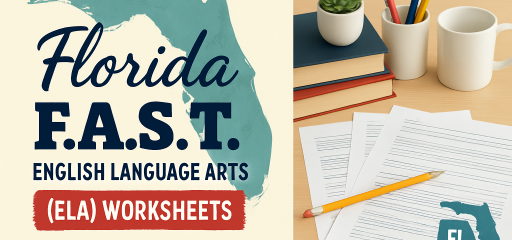
Here’s a thing Florida parents already know: third grade is the big one. The retention conversation is real, the FAST checkpoints land in the fall and don’t stop until spring, and somewhere in the middle of all that, the kid still has to learn what an abstract noun is. It’s a lot of pressure on a year that’s also supposed to be fun.
This page is a quiet shelf of free worksheets for that long year. They line up with Florida’s B.E.S.T. ELA standards for Grade 3, and they’re built around one idea: do the work in small, focused pieces, and the bigger reading tests take care of themselves. Each worksheet is one skill, one PDF, with an answer key written for the kid, not just the grader.
Everything is free to print. No login screens. No “join our list.” Click, open, print. If you want to send the same worksheet home with three different kids tomorrow, that’s fine too.
What’s in here
Florida moved to the B.E.S.T. Standards a few years back, and the worksheet list reflects that. It’s a little tighter than what you’d see in a Common Core state, with some skills bundled together rather than split out. That’s by design. The standards Florida pulled forward are the ones that matter most for early-elementary reading and writing, and the practice below targets exactly those.
If you’re new to this kind of practice, start with one worksheet a week, not one a day. Twelve quiet minutes on Main Idea will outperform an hour-long packet that turns into a fight.
Reading: Literature
- Parts of Stories, Dramas, and Poems, [ELA.3.R.1.3] chapters, scenes, and stanzas, and what they’re each for
- Point of View in Stories, [ELA.3.R.3.3] figuring out who’s telling the story and why it matters
Reading: Nonfiction
- Main Idea and Key Details, [ELA.3.R.2.2] what’s this article mostly about, and what facts hold it up
- Sequence, Steps, and Cause & Effect, [ELA.3.R.2.3] first, next, because, so
- Text Features in Nonfiction, [ELA.3.R.2.1] headings, sidebars, captions, the stuff that isn’t a paragraph
- Author’s Point of View in Nonfiction, [ELA.3.R.3.3] fact vs. What the writer thinks
- Comparing Two Texts on the Same Topic, [ELA.3.R.3.2] two articles, same subject, different angles
Foundational Reading Skills
- Prefixes and Suffixes, [ELA.3.F.1.3] un-, re-, -ful, -less
- Words with Latin Suffixes, [ELA.3.F.1.3] the -tion and -sion words that pile up in third grade
- Decoding Multisyllable Words, [ELA.3.F.1.3] break long words into syllables that make sense
- Irregularly Spelled Words (Sight Words), [ELA.3.F.1.3] the ones that just have to live in memory
- Reading Fluency: Rate and Expression, [ELA.3.F.1.4] reading aloud like a person, not a robot
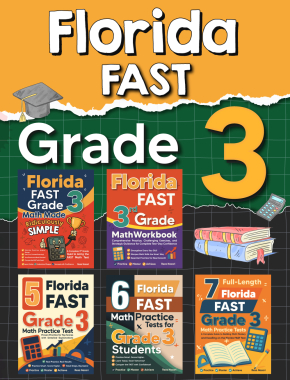
Working on Math Too? Try the Florida FAST Grade 3 Math Bundle
Many third graders are getting ready for the FAST in both subjects. If your child also needs math practice that matches the same standards, this companion bundle is the shortest path, workbook, study guide, and full practice tests in one download.
Writing
- Opinion Writing, [ELA.3.C.1.3] say what you think and back it up
- Informative / Explanatory Writing, [ELA.3.C.1.4] teach someone something new
- Narrative Writing, [ELA.3.C.1.2] tell a story in order, with the good details
- Editing and Revising, [ELA.3.C.5.1] improve a draft on a second pass
- Short Research Project, [ELA.3.C.4.1] ask a real question, go find some real answers
Listening and Speaking
- Listening for Main Idea (Read-Aloud), getting the big idea from your ears
- Reporting on a Topic, telling a class about something clearly
Grammar
- Parts of Speech
- Regular and Irregular Plural Nouns
- Abstract Nouns
- Regular and Irregular Verbs
- Simple Verb Tenses
- Subject, Verb and Pronoun, Antecedent Agreement
- Comparative and Superlative Adjectives and Adverbs
- Coordinating and Subordinating Conjunctions
- Simple, Compound, and Complex Sentences
Capitalization, Punctuation, and Spelling
- Capitalizing Words in Titles
- Commas in Addresses and Dates
- Commas and Quotation Marks in Dialogue
- Possessives
- Conventional Spelling
- Spelling Patterns and Generalizations
- Using Reference Materials to Check Spelling
Vocabulary and Word Study
- Context Clues, [ELA.3.V.1.3] use the surrounding sentence to figure a word out
- Root Words, [ELA.3.V.1.2] the base word inside the long one
- Figurative Language: Similes, Metaphors, and Idioms, [ELA.3.R.3.1] the phrases that don’t mean what they say
How to actually use these
A short honest section, because Florida parents have heard a lot of test-prep promises by March.
Don’t print a stack of ten. Print one. Sit down with it. The worksheet at the top of a packet is the one that gets done well; everything underneath gets skipped or scribbled. If you only print one a week, your kid will actually read it.
Use the Quick Review like a five-minute lesson. Every worksheet starts with a small explanation box. Read it together, out loud is better. Then hand the pencil over.
Answer-key time is the real lesson. Skip nothing. The explanations are written for the third grader sitting there, and they’re often the moment something clicks. Even the questions your kid got right deserve a “wait, why?”, “I guessed” is a totally honest answer, and it points to what to practice next.
Give a tough skill a week to rest. Don’t redo a hard worksheet the same night. Try a different worksheet on the same skill in five or six days. Spacing beats grinding, every time.
A note about FAST
Florida’s FAST is different from the old FSA, because it runs three times a year, fall, winter, and spring. That changes the rhythm of Grade 3. You’re not preparing for one big event; you’re keeping reading and writing skills warm all year.
The good news: this kind of steady, single-skill practice is exactly what the FAST is built to reward. It’s an adaptive computer-based check, not a memory test. Kids who read carefully and answer carefully do well. Kids who rush through don’t. If you’re looking for two skills that move the needle, start with Main Idea and Key Details and Context Clues. Those two carry the heaviest weight on the reading portion.
Questions Florida parents tend to ask
Are these aligned with the B.E.S.T. Standards? Yes. Florida’s B.E.S.T. ELA standards for Grade 3 emphasize close reading, foundational skills, and clear writing, every worksheet here targets one of those.
Is this enough for FAST prep on its own? It’s enough for skill prep, which is the better long-term play. Pair it with regular reading at home (any books your kid likes) and you’ve covered most of the ground.
My kid is reading way ahead. Now what? Try Comparing Two Texts on the Same Topic and Figurative Language. Both stretch strong readers in fair ways.
My kid is behind in reading. Start with Decoding Multisyllable Words and Context Clues. They’re the two skills that quietly unlock a lot of other reading problems.
Can I use these in my classroom or co-op? Of course. Print as many as you need. They’re free for a reason.
One last thing
If you print a worksheet tonight and your kid scowls at it, that’s allowed. Try a different one tomorrow. Try a shorter one this weekend. The point isn’t to finish every page. It’s to spend fifteen minutes thinking carefully about words. Stop in whenever you want a fresh one.
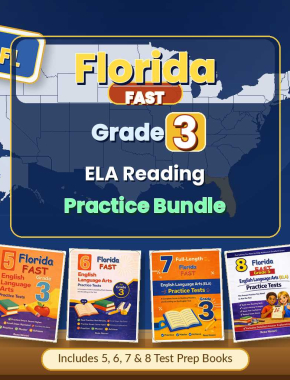
Best Bundle to Ace the Florida FAST Grade 3 ELA
Looking for the best resource to help your kid ace the Florida FAST? Try this bundle, four full practice-test books (5 + 6 + 7 + 8 tests) covering the same Grade 3 reading, writing, and language skills your child is already learning. Instant PDF download, answer keys included.

Related to This Article
More math articles
- Integer Operations Practice — Add, Subtract, Multiply & Divide
- How to Overcome Praxis Core Math Anxiety?
- Barriers protect the single seller
- The Best Grade 5 Math Book for North Carolina Students
- A Guided, Timed Response
- In-Depth Analysis of Vector Function Derivatives: Theory and Practical Applications
- Free Kentucky KSA Grade 5 Math Worksheets: 49 Printable PDFs with Friendly Answer Keys
- Presidential Communication and the Bully Pulpit
- How to Graph Lines by Using Standard Form? (+FREE Worksheet!)
- How to Use Number Lines for Multiplication by a Negative Integer?






What people say about "Free Grade 3 English Worksheets for Florida"?
No one replied yet.