Free ACT Aspire Grade 5 Math Worksheets: 49 Printable PDFs with Friendly Answer Keys
TL;DR: 49 free printable ACT Aspire Grade 5 math worksheets with friendly answer keys – decimals, fractions, volume, coordinate plane, expressions, and multi-step word problems aligned with the grade-5 College and Career Readiness expectations.
Key takeaways:
- ACT Aspire grade 5 math weights fractions, decimals, and multi-step problems heavily.
- 49 single-skill worksheets cover every grade-5 strand the test draws from.
- All pages are free PDFs with friendly step-by-step answer keys.
- Aligned with the grade-5 ACT College and Career Readiness Standards (Common Core based).
- Daily practice (20-30 minutes) over 6-8 weeks builds ACT Aspire-ready fluency.
Fifth grade is where math quietly shifts. A student who has spent years adding, subtracting, and memorizing facts is now asked to make sense of decimals to the thousandths, find common denominators on the fly, multiply and divide fractions, measure volume with stacked unit cubes, and plot ordered pairs on a coordinate plane. None of those moves are arithmetic, they are ideas about numbers, and they reward steady, single-skill practice more than long packets.
These 49 worksheets were built to make fifth-grade math walkable, one skill at a time. Whether your fifth grader is in member states and districts, each PDF gives them a single idea, a clear example, and enough practice to make it feel ordinary.
What’s on this page
Forty-nine single-skill PDFs, each aligned to the ACT College and Career Readiness Standards (CCSS-aligned). Every file does one job. A student practicing decimal division is not also being quizzed on volume, and a student working through line plots is not getting pulled sideways into fractions. One skill, one page of practice, one clear focus.
Each PDF opens with a one-page Quick Review that explains the skill in plain language and walks through a fully worked example. Then come around 14-17 practice problems that build from easy to genuinely challenging, followed by word problems that put the skill in a real situation. The last page is a student-facing answer key, not bare answers, but short, friendly explanations a fifth grader can read alone and actually learn from.
Place Value and Number Sense
- Understanding Place Value, [5.NBT.A.1] name the value of every digit in a multi-digit number
- Multiplying and Dividing by Powers of 10, [5.NBT.A.2] shift the decimal point by 10, 100, or 1,000
- Reading and Writing Decimals to Thousandths, [5.NBT.A.3.A] say and write decimals out to the thousandths place
- Comparing and Ordering Decimals, [5.NBT.A.3.B] line up the place values to compare and order decimals
- Rounding Decimals, [5.NBT.A.4] round to the nearest whole, tenth, hundredth, or thousandth
Operations with Whole Numbers
- Multiplying Multi-Digit Whole Numbers, [5.NBT.B.5] the standard algorithm for multiplying large whole numbers
- Dividing by One-Digit Divisors, [5.NBT.B.6] long division with single-digit divisors
- Dividing by Two-Digit Divisors, [5.NBT.B.6] long division when the divisor has two digits
- Word Problems: Multiplication and Division, [5.NBT.B.6] turn a real situation into a multiplication or division problem
Numerical Expressions and Patterns
- Order of Operations, [5.OA.A.1] PEMDAS, the order that makes every expression have one answer
- Parentheses, Brackets, and Braces, [5.OA.A.1] grouping symbols and how they change the order of work
- Writing and Interpreting Numerical Expressions, [5.OA.A.2] turn a sentence into an expression, and read one back
- Prime Factorization, [4.OA.B.4] break a number down into a product of primes
- Numerical Patterns and Relationships, [5.OA.B.3] spot the rule and continue the pattern
Adding and Subtracting Fractions
- Finding Common Denominators, [5.NF.A.1] rewrite fractions so they share a denominator
- Adding Fractions with Unlike Denominators, [5.NF.A.1] find a common denominator, then add
- Subtracting Fractions with Unlike Denominators, [5.NF.A.1] find a common denominator, then subtract
- Adding and Subtracting Mixed Numbers, [5.NF.A.1] work with the whole and fraction parts, including regrouping
- Estimating with Benchmark Fractions, [5.NF.A.2] use 0, 1/2, and 1 to estimate a fraction sum or difference
- Word Problems: Adding and Subtracting Fractions, [5.NF.A.2] fraction word problems with realistic numbers
Multiplying Fractions
- Fractions as Division, [5.NF.B.3] a fraction is the numerator divided by the denominator
- Multiplying Fractions by Whole Numbers, [5.NF.B.4.A] scale a fraction up using a whole-number multiplier
- Multiplying Fractions by Fractions, [5.NF.B.4.A] multiply across the numerators and across the denominators
- Multiplying Mixed Numbers, [5.NF.B.4] rename as improper fractions, then multiply
- Multiplication as Scaling (Resizing), [5.NF.B.5] multiplying by less than 1 makes a number smaller, and why
- Word Problems: Multiplying Fractions, [5.NF.B.6] fraction-of-a-whole stories you have to set up
Dividing with Unit Fractions
- Dividing Unit Fractions by Whole Numbers, [5.NF.B.7.A] split a unit fraction into a whole number of equal pieces
- Dividing Whole Numbers by Unit Fractions, [5.NF.B.7.B] how many halves, thirds, or fourths fit in a whole number
- Word Problems: Dividing with Unit Fractions, [5.NF.B.7.C] set up a division word problem with unit fractions
Decimal Operations
- Adding Decimals, [5.NBT.B.7] line up the decimal points and add by place value
- Subtracting Decimals, [5.NBT.B.7] line up the decimal points and subtract, regrouping when needed
- Multiplying Decimals, [5.NBT.B.7] multiply like whole numbers, then count decimal places
- Dividing Decimals by Whole Numbers, [5.NBT.B.7] long division when the dividend has a decimal point
- Dividing Decimals by Decimals, [5.NBT.B.7] shift both decimals so the divisor becomes a whole number
- Word Problems with Decimals, [5.NBT.B.7] money, measurement, and other decimal word problems
Measurement and Data
- Converting Customary Units of Length, [5.MD.A.1] inches, feet, yards, miles, and how to switch between them
- Converting Customary Units of Weight and Capacity, [5.MD.A.1] ounces, pounds, cups, pints, quarts, gallons
- Converting Metric Units, [5.MD.A.1] millimeters, centimeters, meters, kilometers, same idea for grams and liters
- Line Plots with Fractions, [5.MD.B.2] graph fractional measurements and read the data
Volume
- Understanding Volume and Unit Cubes, [5.MD.C.3] what volume measures, and how unit cubes fill a solid
- Measuring Volume by Counting Unit Cubes, [5.MD.C.4] count the cubes in layers to find a solid’s volume
- Volume of Rectangular Prisms, [5.MD.C.5.B] length × width × height, and base × height
- Additive Volume (Composite Figures), [5.MD.C.5.C] break a complicated solid into prisms and add the volumes
- Word Problems with Volume, [5.MD.C.5] real-world volume problems with boxes, tanks, and rooms
Geometry and Coordinate Graphing
- Understanding the Coordinate Plane, [5.G.A.1] the x-axis, the y-axis, and how an ordered pair locates a point
- Graphing Points in the First Quadrant, [5.G.A.2] plot points and read coordinates in the first quadrant
- Properties of Two-Dimensional Figures, [5.G.B.3] name the properties that make a shape a shape
- Classifying Two-Dimensional Figures, [5.G.B.4] sort polygons into categories and subcategories
- Graphing Patterns on the Coordinate Plane, [5.OA.B.3] graph two related patterns and compare the lines
How to use these worksheets at home
The trick with fifth-grade math is sequence. Skills here come in families, and a worksheet lands much softer when the one before it set it up. Try Finding Common Denominators before Adding Fractions with Unlike Denominators, once a student is fluent at making the denominators match, the addition page feels like the same problem with one more step. Do Understanding Volume and Unit Cubes before Volume of Rectangular Prisms; the formula stops feeling like a rule to memorize and starts feeling like a description of what’s already happening in the box.
Keep the sessions short. Most of these PDFs take fifteen or twenty minutes, which is about as long as a fifth grader’s full attention lasts on a school night. Two afternoons a week, done steadily, will move a student further than a long Saturday session that nobody enjoys. Let them keep a pencil and scratch paper handy and resist the urge to correct mid-problem, the answer key is there for after.
One more habit worth building: when a worksheet goes well, do the next skill in the same family the following session, while the idea is still warm. When one goes badly, don’t pile on, set it aside and come back to that single page in a few days. A skill that felt impossible on Tuesday often feels merely tricky by Friday, and a fifth grader who experiences that shift a few times starts to trust the process. That trust is worth as much as any single skill on the list.
A note about ACT Aspire at Grade 5
ACT Aspire Grade 5 Mathematics samples from the same Grade 5 math topic list every state uses, place value through the thousandths, the four operations with whole numbers and decimals, fractions including unit-fraction division, measurement conversions, line plots, volume, and the coordinate plane. Each PDF on this page targets exactly one of those topics, so the test window doubles as a checklist: solid on volume but shaky on dividing decimals? Spend your time only where it is needed.
A short closing
Fifth-grade math is a year of new ideas, but it is not a year a student has to face all at once. Bookmark this page, print one PDF tonight, and let your fifth grader start with a single skill. ACT Aspire kids handle hard things well when the next step is clear, and a worksheet on the table is about as clear as it gets.
Best Bundle for Grade 5 Math Practice
Want the fastest path through Grade 5 math? This pick pulls it together, practice tests with complete, step-by-step answer keys, instant PDF download.
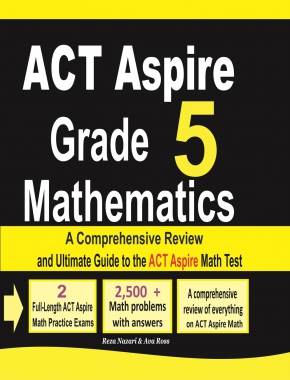
ACT Aspire Grade 5 Mathematics A Comprehensive Review and Ultimate Guide to the ACT Aspire Math Test
Recommended EffortlessMath Books
For a workbook to pair with these printable practice pages, Mastering Grade 5 Math covers every fifth-grade topic with worked examples and practice sets. For the multi-step word problems and fraction work that fifth graders find hardest, see Mastering Grade 5 Math Word Problems.
Frequently Asked Questions
What is ACT Aspire?
ACT Aspire is a set of tests from ACT that measures progress in English, reading, math, science and writing from grade 3 through early high school. Schools use it to see whether students are on track toward college and career readiness. The grade 5 math test covers skills such as fractions, decimals, volume, the coordinate plane and multi-step word problems. Ask your school which format it uses.
What is a good ACT Aspire score?
A good ACT Aspire score is one at or above the Ready benchmark for your child’s grade and subject. Score reports place students in four readiness levels: Exceeding, Ready, Close, and In Need of Support. Because the benchmark changes by grade, compare your fifth grader’s math score with the benchmark printed on their own report rather than with an older sibling’s score.
What is the ACT Aspire score range?
ACT Aspire uses scale scores that rise from grade to grade, so a grade 5 math score sits on the same scale as later years and shows growth over time. The exact range and the Ready benchmark for grade 5 math appear on the student score report and on ACT’s website. Look at the skill breakdown too, since it shows which math areas need more work.
What is on the ACT Aspire math test?
At grade 5, ACT Aspire math draws on skills fifth graders learn in class: place value to thousandths, operations with decimals and fractions, volume of rectangular prisms, graphing points, and writing numerical expressions. Some questions are multiple choice and others ask students to show or justify their reasoning. A typical item might ask how many 1/4-cup servings are in 3 cups (answer: 12).
How can my child practice for ACT Aspire math?
Practice one skill at a time first, then mix topics. Spend about 20 to 30 minutes a day on a single worksheet, such as fraction multiplication, and have your child explain one answer aloud, since ACT Aspire rewards reasoning. In the last few weeks, try a timed mixed set to build pacing. ACT’s official practice materials are useful for getting used to the test format.
Is ACT Aspire given by grade level?
Yes. ACT Aspire has a separate test for each grade from 3 through 8, plus early high school, so a fifth grader takes the grade 5 math test built on grade 5 standards. Because scores connect across grades, families can track growth from year to year. These worksheets stick to grade 5 skills, the level your child will see on test day.
Related EffortlessMath Lessons
If a topic on this page feels rusty, these short lessons go deeper:
- How to multiply and divide decimals
- Adding and subtracting fractions with unlike denominators
- How to find the volume of a rectangular prism
- Order of operations (PEMDAS)
- How to solve word problems

Related to This Article
More math articles
- 4th Grade SBAC Math Practice Test Questions
- The Best Grade 5 Math Book for Washington Students
- 5 Best CHSPE Math Study Guides
- How to Model and Solve Equations Using Algebra Tiles
- Masonry and Plumbing Tools: Shapes and Jobs
- Idaho Algebra 1 Free Worksheets: 64 Free Algebra 1 PDF Worksheets, One Skill at a Time
- Using Distributive Property to Factor Variable Expressions
- The Best Grade 8 Math Book for Michigan Students
- What Kind of Math Is on the ATI TEAS 7 Test?
- Free Grade 3 English Worksheets for Oklahoma Students










What people say about "Free ACT Aspire Grade 5 Math: Free Worksheets"?
No one replied yet.