How Do You Prove Angles Are Congruent?
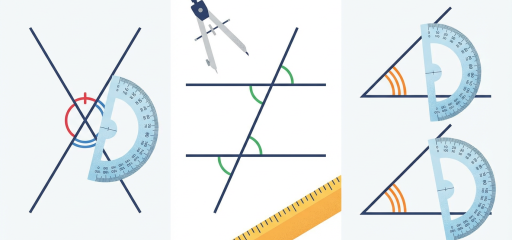
Proving that angles are congruent is a core skill in geometry. Two angles are congruent when they have the same measure (in degrees). Unlike measuring with a protractor, a proof uses definitions, postulates, and theorems to show that angles must be equal. Here’s how to prove angles are congruent.
The Absolute Best Book to Ace Your Math Test
Our Featured Products

Key Theorems for Proving Angle Congruence
1. Vertical Angles Theorem
When two lines intersect, the angles opposite each other (vertical angles) are congruent. If lines AB and CD intersect at E, then ∠AEC ≅ ∠BED and ∠AED ≅ ∠BEC. No measurement needed. It follows from the definition of vertical angles. For more geometry practice, visit our math worksheets.
2. Corresponding Angles (Parallel Lines)
If a transversal crosses two parallel lines, corresponding angles are congruent. Same position (e.g., both top-left) means equal measure. This is one of the most useful tools for proofs involving parallel lines.
3. Alternate Interior Angles
When a transversal crosses parallel lines, alternate interior angles (on opposite sides of the transversal, inside the parallels) are congruent. Same for alternate exterior angles.
4. Angle Bisector
If a ray bisects an angle, it creates two congruent angles. Definition of bisector.
5. Congruent Triangles Imply Congruent Angles
If two triangles are congruent (by SSS, SAS, ASA, AAS, or HL), then corresponding angles are congruent. So proving triangle congruence can prove angle congruence. Explore Effortless Math for more.
Proof Structure
Start with given information. List what you know (parallel lines, equal sides, etc.). State the theorem or definition that applies. Conclude that the angles are congruent. Be explicit about which theorem you use.
Frequently Asked Questions
How do you prove two angles are congruent?
Show that they must have the same measure using definitions, postulates and theorems rather than a protractor. Common tools are the Vertical Angles Theorem, the angle pairs formed by parallel lines and a transversal, angle bisectors, and corresponding parts of congruent triangles (CPCTC). Start from the given facts, name the reason for every step, and finish with a statement such as ∠A ≅ ∠B.
How do you prove vertical angles are congruent?
Use linear pairs. When lines AB and CD meet at E, ∠AEC and ∠CEB form a straight angle, so they add to 180°. ∠CEB and ∠BED also add to 180°. Since both sums equal 180°, subtracting ∠CEB from each gives ∠AEC = ∠BED. That argument, using the Linear Pair Postulate and the subtraction property, proves the Vertical Angles Theorem.
What theorem proves right angles are congruent?
The Right Angles Congruence Theorem states that all right angles are congruent. Its proof is short: by definition every right angle measures 90°, so any two right angles have equal measures, and angles with equal measures are congruent. You can cite it in a proof whenever you know two angles are right angles, for example where two pairs of lines are perpendicular.
How do you prove angles are congruent with parallel lines?
When a transversal crosses two parallel lines, corresponding angles, alternate interior angles and alternate exterior angles are congruent. Identify which pair your angles form, then cite the matching postulate or theorem. For example, if lines m and n are parallel and ∠1 and ∠5 sit in the same position at each intersection, they are congruent by the Corresponding Angles Postulate.
How do you prove opposite angles are congruent in a parallelogram?
Draw a diagonal to split the parallelogram into two triangles. In parallelogram ABCD, diagonal AC forms triangles ABC and CDA. Because opposite sides are parallel, alternate interior angles give ∠BAC ≅ ∠DCA and ∠BCA ≅ ∠DAC, and AC is shared. The triangles are congruent by ASA, so ∠B ≅ ∠D by CPCTC. Diagonal BD proves ∠A ≅ ∠C the same way.
Can you prove triangles congruent by angle-angle-angle?
No. If all three angles of two triangles match, the triangles have the same shape but can be different sizes, so AAA proves similarity, not congruence. A triangle with angles of 30°, 60° and 90° could have a hypotenuse of 2 cm or 20 cm. To prove congruence you need at least one pair of matching sides, as in ASA or AAS.
Recommended Resources
What’s the difference between equal and congruent angles?
For angles, “congruent” and “equal” are used interchangeably, both mean the same measure. “Congruent” is the formal geometric term.
Can you prove angles congruent without parallel lines?
Yes. Vertical angles, angles in congruent triangles, and angles formed by bisectors can all be proven congruent without parallel lines.

Related to This Article
More math articles
- Family autonomy
- Price Discrimination: Resale, Elasticity and Welfare
- 6th Grade FSA Math Worksheets: FREE & Printable
- What Kind of Math Needed for Owning Your Own Business?
- 5th Grade WY-TOPP Math Worksheets: FREE & Printable
- The Best Grade 7 Math Book for Colorado Students
- AP Calculus Prep Roadmap: A 4-Year Plan to Ace the Exam in 2026
- How to Find Composite Numbers?
- 8th Grade K-PREP Math Worksheets: FREE & Printable
- Understanding Science Vocabulary From Context









What people say about "How Do You Prove Angles Are Congruent?"?
No one replied yet.