The Best Algebra 2 Book for Students Who Want It to Click

The Best Algebra 2 Book for Students Who Want It to Click

TL;DR: Algebra 2 isn’t actually harder than Algebra 1 – it’s wider. More topics, more abstraction, more moving parts to hold in your head at once. The right book keeps you organized as the subject grows. Here’s the Algebra 2 book we recommend for students.

Key takeaways:

  • Algebra 2 is the course where functions stop being simple lines and exponents grow into logarithms.
  • It’s not harder than Algebra 1 – just wider, with more to hold in your head at once.
  • The best Algebra 2 book constantly connects new topics back to what you already know.
  • Look for plain explanations, fully worked examples, and practice with full answer keys.
  • Algebra II for Beginners is the book we recommend.

Algebra 2 has a reputation, and it is mostly deserved. It is the course where math suddenly gets tall — more topics, more abstraction, more moving parts. Functions stop being simple lines. Exponents grow into logarithms. Polynomials get long. And a lot of students who did fine in Algebra 1 hit Algebra 2 and feel, for the first time, genuinely lost.

Here is the thing, though: Algebra 2 is not actually harder than Algebra 1. It is wider. There is more to hold in your head at once. And that means the book you learn from matters even more — because a good Algebra 2 book is not just explaining topics, it is keeping you organized.

Original price was: $109.99.Current price is: $54.99.

This is the Algebra 2 book we recommend to students who want it to finally click.

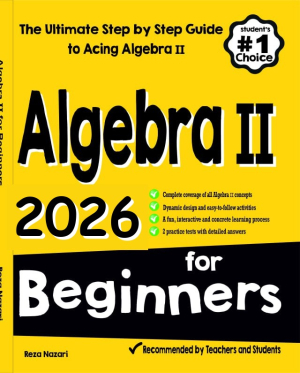
Our pick: Algebra II for Beginners

Algebra II for Beginners takes the most feared course in high school math and makes it feel manageable. It does that with the same approach that works at every level — clear explanations, fully worked examples, and steady practice — but it adds something Algebra 2 specifically needs: it constantly connects new topics back to what you already know.

Original price was: $27.99.Current price is: $17.99.
Satisfied 1 Students

When the book introduces quadratic functions, it reminds you what you learned about quadratic equations. When it reaches logarithms, it shows you they are simply the reverse of the exponents you already understand. That threading is what keeps Algebra 2 from feeling like forty unrelated topics. It is one subject, and this book never lets you forget it.

Why Algebra 2 feels so hard — and what fixes it

Students rarely struggle in Algebra 2 because a single topic is impossible. They struggle because of three things:

  • Volume. Algebra 2 covers a lot. Without a clear structure, it feels like drinking from a firehose.
  • Shaky Algebra 1 skills. Algebra 2 assumes you can factor, solve equations, and work with exponents fluently. Any weakness from Algebra 1 gets exposed immediately.
  • Abstraction. Functions, transformations, and complex numbers ask you to think about math in a more general way than before.

The right book handles all three. It gives Algebra 2 a clear spine so the volume feels ordered. It quietly reinforces Algebra 1 skills as it goes, so old gaps get patched. And it introduces abstract ideas slowly, with concrete examples first. Algebra II for Beginners does each of these on purpose.

What is inside the book

The book covers the full Algebra 2 course:

  • Equations and inequalities — a deliberate review and extension of Algebra 1
  • Linear functions and systems — including systems in three variables
  • Quadratic functions — graphing, the quadratic formula, and the discriminant
  • Polynomials — operations, factoring, and finding roots
  • Rational and radical expressions and equations
  • Exponential and logarithmic functions
  • Complex numbers
  • Sequences and series
  • Probability, statistics, and an introduction to trigonometry

Every section keeps the same rhythm — explanation, worked examples, practice, answer key — so a student studying alone always has worked solutions to compare against and immediate feedback on whether an idea has landed.

A look at one topic done right

Logarithms are the classic Algebra 2 wall. Most books define a logarithm, show the change-of-base formula, and start solving equations — and students nod along without ever understanding what a logarithm is.

This book starts somewhere better. It reminds you that you already know exponents: 2³ = 8. Then it simply asks the reverse question — “2 raised to what power gives 8?” — and shows that a logarithm is just the name for that answer. From there, every logarithm rule becomes an exponent rule you already trust. The topic stops being memorization and becomes recognition. That is the difference a well-built book makes.

Who this book is for

  • High school students in Algebra 2 whose class textbook is not explaining things clearly
  • Homeschoolers who need a complete, self-contained Algebra 2 course
  • Students retaking the course or catching up over the summer
  • Students heading toward pre-calculus who want a solid Algebra 2 base first
  • Adult learners who need Algebra 2 for college or a career change

How to study with it

Algebra 2’s volume means a plan is essential. What works for most students:

  • Study 4 to 5 times a week — Algebra 2 is too big for a twice-a-week pace.
  • Start with the equations-and-inequalities review even if it looks familiar. It patches Algebra 1 gaps before they bite.
  • Keep a running list of formulas and key rules as you go. Algebra 2 has many, and a personal reference sheet is worth its weight.
  • After each chapter, redo two or three problems from the chapter before. The volume makes review non-negotiable.
  • Do not move on from a shaky section. In Algebra 2, weaknesses compound fast.

If your Algebra 1 feels uncertain, it is worth a quick detour first — our guide to the best Algebra 1 book will get you solid. And if you want one resource that runs the whole sequence with a single consistent method, the Ultimate Algebra Bundle covers Pre-Algebra through Algebra 2 together.

Original price was: $109.99.Current price is: $54.99.

Common mistakes to avoid

  • Assuming your Algebra 1 is good enough. Algebra 2 will find every weak spot. Review first; it saves time later.
  • Trying to memorize instead of understand. There is simply too much in Algebra 2 to survive on memory alone.
  • Skipping the graphs. Graphing a function shows you what it actually does. Skipping graphs keeps everything abstract and fragile.
  • Studying in rare marathon sessions. Algebra 2 demands consistency more than intensity.

Frequently asked questions

Is Algebra 2 harder than Algebra 1?

It is broader rather than fundamentally harder. There are more topics and more abstraction, but each individual idea is learnable. A well-organized book is what keeps the volume from becoming overwhelming.

Can I self-study Algebra 2?

Yes. Algebra II for Beginners is written for independent learners, with clear explanations, full worked examples, and an answer key. A consistent study schedule is the main ingredient for success.

What should I know before Algebra 2?

You should be able to solve linear and quadratic equations, factor comfortably, work with exponents, and graph lines. If any of that is shaky, shore up Algebra 1 first.

Does this book prepare me for pre-calculus?

Yes. A strong Algebra 2 foundation — especially functions, logarithms, and the introduction to trigonometry — is exactly what pre-calculus builds on.

How long does Algebra 2 take to self-study?

Most students need 12 to 16 weeks of steady study, given how much the course covers. Build in regular review time.

The bottom line

Algebra 2 is not the impossible course its reputation suggests. It is a wide course, and wide courses need a book that keeps you organized and keeps connecting the pieces. Algebra II for Beginners does both — turning a sprawling, intimidating subject into a clear, climbable path.

Get a good book, make a real schedule, and review as you go. Algebra 2 can absolutely click — for far more students than its reputation would have you believe.

Recommended EffortlessMath Books

The book we recommend for Algebra 2 is Algebra II for Beginners, which connects every new topic back to what you already know. If Algebra 1 still feels shaky first, start with Algebra I for Beginners.

Frequently Asked Questions

Is Algebra 2 actually harder than Algebra 1?

Not really – it’s wider, not harder. The individual skills aren’t any tougher than late Algebra 1, but there are more of them, and they’re more abstract. Functions, polynomials, exponentials, logarithms, rationals, radicals, conic sections, sequences – it’s a lot to keep straight at once. The struggle is mostly volume, not depth.

What topics are usually in an Algebra 2 course?

Linear and quadratic functions (review and extension), polynomial functions of higher degree, rational functions, radical functions, exponential and logarithmic functions, systems of equations and inequalities, sequences and series, probability and statistics, and often conic sections and an introduction to trigonometry.

Why do students who did fine in Algebra 1 hit a wall in Algebra 2?

Because Algebra 2 keeps adding new function types, and most textbooks treat each one in isolation. The student loses track of how the new stuff connects to what they already know. A good Algebra 2 book keeps building those connections explicitly so each new chapter feels like an extension, not a new universe.

Which book do you recommend for Algebra 2?

Algebra II for Beginners. It uses the same clear-explanation, worked-example, steady-practice approach that works at every level, but it adds something Algebra 2 specifically needs: it constantly connects new topics back to what you’ve already learned.

Is Algebra II for Beginners good for self-study?

Yes. It’s built to be usable by a student working alone – plain explanations, fully worked examples, practice problems right after each concept, and a complete answer key with full solutions. Homeschoolers, summer-prep students, and adult learners use it the same way.

How long does it take to work through?

A motivated student doing 30-45 minutes a day usually finishes the book in 5-7 months. A slower pace (15-20 minutes a day) takes 9-12 months. The book is divided into clear topic chapters, so you can pace it however fits your schedule.

Does Algebra 2 prep help with the SAT or ACT?

Yes – significantly. The SAT and ACT both include Algebra 2 content (especially functions, exponentials, and quadratics). A student who knows the material in Algebra II for Beginners well has covered a real chunk of the advanced math on both tests. For test-specific timed practice, follow it with SAT Math or ACT Math for Beginners.

What if my child is struggling with Algebra 1 first?

Start there. Algebra II for Beginners assumes solid Algebra 1 foundations. If your child is shaky on linear equations, slope, factoring, or basic quadratics, work through Algebra I for Beginners first. Trying to do Algebra 2 over Algebra 1 gaps is the most common reason students hit a wall.

Is Algebra 2 required for college?

For most four-year colleges, yes – either three or four years of high school math are required, and Algebra 2 is typically the third. STEM majors usually need it for placement into calculus tracks. Community colleges have more flexibility, but Algebra 2 still shows up on most placement tests.

What comes after Algebra 2?

Usually Pre-Calculus (which extends Algebra 2 with deeper function work, trig, and limits) and then Calculus. Some students go from Algebra 2 directly to Statistics if their plan doesn’t include calculus. The natural EffortlessMath follow-up is Pre-Calculus for Beginners.

Related EffortlessMath Lessons

If a topic on this page feels rusty, these short lessons go deeper:

Original price was: $109.99.Current price is: $54.99.

Related to This Article

What people say about "The Best Algebra 2 Book for Students Who Want It to Click - Effortless Math"?

No one replied yet.

Leave a Reply

X
51% OFF

Limited time only!

Save Over 51%

Take It Now!

SAVE $55

It was $109.99 now it is $54.99

The Ultimate Algebra Bundle 2026: From Pre-Algebra to Algebra II