How to Self-Study Algebra: The Complete Step-by-Step Path
You can absolutely teach yourself algebra. People do it every year — homeschoolers, adults returning to school, students getting ahead over the summer, and learners who simply were not served well the first time around. What stops most people is not the math. It is the lack of a plan.
Algebra self-study fails for predictable reasons: starting in the wrong place, using a book that assumes a teacher, skipping the boring foundations, or having no idea what “finished” looks like. This guide fixes all of that. Here is the complete path — the right order, the right materials, and a realistic schedule — to take yourself from “I do not really get algebra” to genuinely confident.
First, understand what “algebra” actually is
“Algebra” is not one course. For self-study purposes it is three connected stages, and they must be done in order:
- Pre-Algebra — the number skills algebra is built on: fractions, decimals, percents, integers, exponents, ratios, and order of operations.
- Algebra 1 — expressions, equations, inequalities, linear functions, systems, polynomials, factoring, and quadratics.
- Algebra 2 — deeper functions, polynomials, rational and radical expressions, exponentials, logarithms, complex numbers, and sequences.
The single most common self-study mistake is jumping straight to Algebra 1 because Pre-Algebra “sounds basic.” It is basic — and it is also exactly where the cracks form. Respect the order and the whole journey gets easier.
Choose materials built for learning alone
A classroom textbook is designed to support a teacher. A self-study book has to be the teacher. Look for four things: explanations in plain language, fully worked examples, plenty of practice on each idea, and an answer key for instant feedback. Without that last one, a self-studying learner is flying blind.
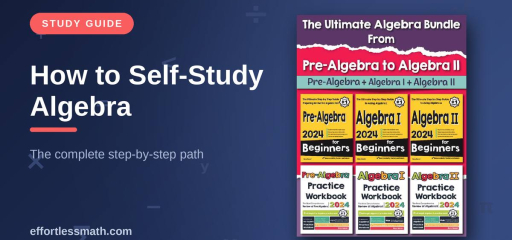
The most efficient option is to use one consistent series across all three stages, so the teaching style, notation, and structure never change under your feet. That is exactly why we built the Ultimate Algebra Bundle — it carries Pre-Algebra, Algebra 1, and Algebra 2 in a single, consistent, step-by-step method.

One method from start to finish removes a hidden tax on self-study: every time you switch books, you spend energy relearning how the new book is organized instead of learning math. A consistent series lets all of that energy go straight into the work.
The complete self-study schedule
Here is a realistic plan for a learner studying most days of the week. Adjust the pace to your life — the order matters more than the speed.
Stage 1: Pre-Algebra (about 8–10 weeks)
- Weeks 1–2: Integers and operations with negative numbers
- Weeks 3–4: Fractions and mixed numbers — spend real time here
- Week 5: Decimals
- Week 6: Ratios, rates, and proportions
- Week 7: Percents
- Week 8: Exponents, roots, order of operations, and a first look at expressions
Stage 2: Algebra 1 (about 10–12 weeks)
- Weeks 1–2: Expressions and the distributive property
- Weeks 3–4: Equations and inequalities, including word problems
- Week 5: Linear functions, slope, and graphing
- Week 6: Systems of equations
- Week 7: Exponents and polynomials
- Week 8: Factoring
- Weeks 9–10: Quadratic equations
Stage 3: Algebra 2 (about 12–16 weeks)
- Weeks 1–2: Equations review, then systems — including three variables
- Weeks 3–4: Quadratic functions and graphing
- Weeks 5–6: Polynomials and their roots
- Weeks 7–8: Rational and radical expressions
- Weeks 9–10: Exponential and logarithmic functions
- Weeks 11–12: Complex numbers, sequences, and series
End to end, that is roughly seven to nine months of steady, part-time study to cover all of algebra. That may sound long — but most students spend three school years on the same material. Done well, self-study is faster, not slower.
How to actually study so it sticks
The plan above is the skeleton. These habits are what make it work:
- Short and frequent beats long and rare. Four 40-minute sessions a week build far more than one Saturday marathon. Algebra rewards consistency.
- Always write it out. Reading a worked example is not learning. Re-solving it yourself, with a pencil, is.
- Check answers immediately. Practicing a mistake just makes the mistake permanent. Check after every few problems.
- Master, then move. Never start a new section while the current one feels shaky. In algebra, weak spots do not disappear — they compound.
- Review weekly. Spend the first ten minutes of each week redoing a few problems from the week before.
How to know when you are ready to move up
Do not move from one stage to the next based on the calendar. Use this test: can you do a mixed practice set from the end of the stage — problems jumbled together, not grouped by topic — and get them right without looking anything up? If yes, move on. If not, the book just told you exactly what to review. That self-check is the closest thing self-study has to a teacher, and it is genuinely reliable.
Common self-study mistakes
- Skipping Pre-Algebra. The number-one cause of algebra struggles. Do not do it.
- Switching books mid-stream. Every switch costs you re-orientation time. Pick one consistent series and finish it.
- Confusing progress with page count. Finishing a chapter you did not master is not progress — it is debt.
- Studying without a schedule. “I will do some algebra this week” quietly becomes no algebra. Put it on specific days.
- Avoiding word problems. They feel hard, so people skip them — but they teach the reasoning algebra exists for.
Frequently asked questions
Can I really learn algebra on my own?
Yes — thousands of people do it every year. You need a book built for self-study, a clear order to follow, and a consistent schedule. Ability is rarely the limiting factor; structure is.
Where should I start if I do not know my level?
Start with Pre-Algebra. If the early chapters are genuinely easy, you will move through them quickly and lose nothing. If they are not easy, you just found the exact gaps that would have sunk you later.
How long does it take to self-study all of algebra?
About seven to nine months of steady, part-time study from Pre-Algebra through Algebra 2. Studying more days per week shortens it; the order should not change.
Do I need separate books for each level?
You need coverage of all three stages. Using one consistent series — like the Ultimate Algebra Bundle — is the most efficient approach, because the teaching style and notation never change on you.
What comes after Algebra 2?
Usually pre-calculus, and then calculus or statistics. A strong, genuinely understood algebra foundation makes every one of those courses dramatically easier.
The bottom line
Self-studying algebra is not a matter of talent. It is a matter of doing the right things in the right order: start with Pre-Algebra, use materials built for independent learners, follow a real schedule, and master each stage before climbing to the next.
Want the specifics on each stage? Our guides to the best Pre-Algebra book, the best Algebra 1 book, and the best Algebra 2 book go deeper on each one. Follow the path, do the work, and algebra will give itself up to you — one solid step at a time.

Related to This Article
More math articles
- How a Science Passage Is Built
- How to Simplify Complex Fractions? (+FREE Worksheet!)
- Bridging the Gap: From Basic Math to Algebra with “Pre-Algebra for Beginners”
- CLEP College Math Flashcards (Free Online: Formulas, Terms & Concepts)
- Generational effects
- Surface Defects, Rust, and Finish Preparation
- TExES Core Subjects Math Formulas
- Free Grade 6 English Worksheets for North Carolina Students
- Discovering the Magic of ASA and AAS Congruence in Triangles
- Chapter 23: Privacy and Personal Liberty


















What people say about "How to Self-Study Algebra: The Complete Path"?
No one replied yet.