Fractions, Decimals, and Percents: Conversion Guide
Fractions, decimals, and percents are three names for the same idea. \(\dfrac{1}{2}\), $0.5$, and \(50\%\) all describe “half.” Once your brain accepts this, every test from 5th grade to the GRE gets easier, because you can pick the form that solves the problem fastest.
Converting Rational Numbers to Decimals: what to notice and how to work it
What to notice first
Common student mistake
Key formulas and cues
A reliable path
- SimplifyEvaluate roots, fractions, or decimals when possible.
- Look for fraction formIf the number is a ratio of integers, it is rational.
- Name all setsA number can belong to more than one family.
Worked examples
Fraction to decimal
- Divide 3 by 8.
- 3.000 divided by 8 is 0.375.
- The decimal terminates.
Decimal to percent
- Percent means per 100.
- Move the decimal two places right.
- Add the percent sign.
Try one before moving on
Converting Rational Numbers to Decimals: pop-up practice
This guide gives you every conversion rule, worked examples, and the common conversions you should know cold.
The Big Idea
A fraction is a part of a whole written as \(\dfrac{a}{b}\). A decimal is a part of a whole written using place value: $0.5$, $0.25$, $0.125$. A percent is a fraction with a denominator of 100: \(50\% = \dfrac{50}{100}\).
They are interchangeable. Conversion is just translation.
The 6 Conversion Rules
Rule 1: Fraction → Decimal
Divide the numerator by the denominator.
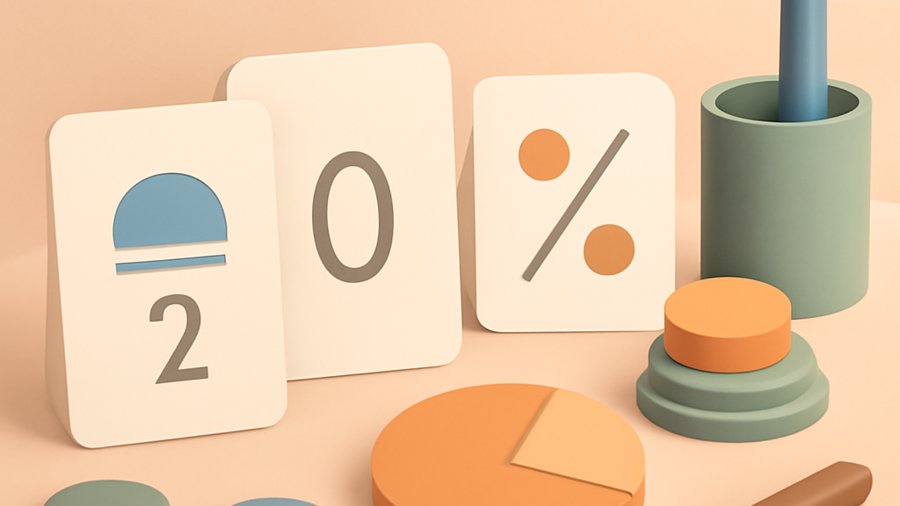
\[\dfrac{3}{4} = 3 \div 4 = 0.75\]
\[\dfrac{1}{8} = 1 \div 8 = 0.125\]
If the division terminates, you get a clean decimal. If not, you get a repeating decimal: \(\dfrac{1}{3} = 0.3333\ldots = 0.\overline{3}\).
Rule 2: Decimal → Fraction
Place the decimal over the appropriate power of 10, then simplify.
\(0.75 = \dfrac{75}{100} = \dfrac{3}{4}\) (dividing top and bottom by 25)
\(0.6 = \dfrac{6}{10} = \dfrac{3}{5}\)
\(0.125 = \dfrac{125}{1000} = \dfrac{1}{8}\)
Rule 3: Decimal → Percent
Multiply by 100 (or move the decimal point two places to the right).
\(0.75 \rightarrow 75\%\)
\(0.06 \rightarrow 6\%\)
\(1.25 \rightarrow 125\%\)
Rule 4: Percent → Decimal
Divide by 100 (or move the decimal point two places to the left).
\(60\% \rightarrow 0.60\)
\(3\% \rightarrow 0.03\)
\(125\% \rightarrow 1.25\)
Rule 5: Fraction → Percent
Either convert to a decimal first and then multiply by 100, or rewrite the fraction with a denominator of 100.
\(\dfrac{3}{4} = 0.75 = 75\%\)
\(\dfrac{2}{5} = \dfrac{40}{100} = 40\%\)
Rule 6: Percent → Fraction
Put the percent over 100 and simplify.
\(75\% = \dfrac{75}{100} = \dfrac{3}{4}\)
\(20\% = \dfrac{20}{100} = \dfrac{1}{5}\)
\(12.5\% = \dfrac{12.5}{100} = \dfrac{125}{1000} = \dfrac{1}{8}\)
The 12 Conversions to Memorize
If you memorize these, you will solve 80% of conversion problems instantly:
| Fraction | Decimal | Percent |
|---|---|---|
| \(\dfrac{1}{2}\) | 0.5 | 50% |
| \(\dfrac{1}{4}\) | 0.25 | 25% |
| \(\dfrac{3}{4}\) | 0.75 | 75% |
| \(\dfrac{1}{5}\) | 0.2 | 20% |
| \(\dfrac{2}{5}\) | 0.4 | 40% |
| \(\dfrac{3}{5}\) | 0.6 | 60% |
| \(\dfrac{4}{5}\) | 0.8 | 80% |
| \(\dfrac{1}{8}\) | 0.125 | 12.5% |
| \(\dfrac{3}{8}\) | 0.375 | 37.5% |
| \(\dfrac{5}{8}\) | 0.625 | 62.5% |
| \(\dfrac{7}{8}\) | 0.875 | 87.5% |
| \(\dfrac{1}{3}\) | \(0.\overline{3}\) | \(33.\overline{3}\%\) |
Print this table. Stick it on the wall. Reread it every day for a week. They become permanent.
Recommended Practice Resources
Worked Examples by Difficulty
Easy
Convert 0.4 to a fraction. \(0.4 = \dfrac{4}{10} = \dfrac{2}{5}\).
Medium
Convert \(\dfrac{7}{20}\) to a percent. Multiply top and bottom by 5: \(\dfrac{35}{100} = 35\%\).
Or: \(7 \div 20 = 0.35 = 35\%\).
Harder
Express 0.125 as a percent and as a fraction. – As a percent: \(0.125 \times 100 = 12.5\%\). – As a fraction: \(\dfrac{125}{1000} = \dfrac{1}{8}\).
Hardest (test-prep level)
A shirt is marked 20% off. Its sale price is \$32. What was the original price?
20% off means the customer pays 80% of the original. Let \(x\) = original price.
\(0.80x = 32\)
\(x = \dfrac{32}{0.80} = 40\).
Original price: \$40.
Common Mistakes
Confusing percent and decimal
\(6\% = 0.06\), not $0.6$. Move the decimal two places.
Forgetting to simplify
\(0.4 = \dfrac{4}{10}\), but the simplified answer is \(\dfrac{2}{5}\). Most tests want the simplest form.
Misplacing the decimal point
\(\dfrac{1}{8} = 0.125\), not $0.0125$ or $1.25$. Long division catches this.
Confusing 12.5% with \(\dfrac{1}{12}\)
\(\dfrac{1}{12} \approx 0.0833 = 8.33\%\), not 12.5%. Don’t guess.
Treating “of” wrong
“30% of 40″ means \(0.30 \times 40 = 12\), not 30% + 40.
How to Practice
- Daily conversion warm-up. Five conversions every day for 2 weeks. By day 14, the patterns are automatic.
- Flashcards with the 12 must-know conversions on each card.
- Real-world practice, every time you see a percent (tax, tip, discount), convert it to a fraction in your head.
- Free worksheets, print and practice.
- A wall chart of the 12 must-know conversions.
Free Resources
Effortless Math has a complete free conversion library:
- Fractions, Decimals, Percents Worksheets (resource currently unavailable), by topic and difficulty, with answer keys.
- Math Topics Library, every conversion topic explained.
- Elementary Math eBooks, full workbooks.
Frequently Asked Questions
Why is \(\dfrac{1}{3}\) a repeating decimal? Because \(1 \div 3\) does not terminate. \(\dfrac{1}{3} = 0.333\overline{3}\).
When should I round repeating decimals? On most tests, leave the answer as a fraction or use the repeating-bar notation \(0.\overline{3}\). For real-world calculation, round to 2 or 3 decimal places.
Is 125% a real percent? Yes, percents can be any value, including over 100%. 125% just means “more than the whole.”
What is a “percent of a percent”? Multiply. 50% of 20% = \(0.50 \times 0.20 = 0.10 = 10\%\).
How do I convert a mixed number to a decimal? Convert the fractional part separately. \(2\dfrac{3}{4} = 2 + 0.75 = 2.75\).
Should I memorize percent-to-fraction conversions? At least the 12 in this guide. They show up on every test from 5th grade through the GRE.
You’re Three Steps From Fluency
Conversion fluency comes from repetition with a small set of values. Memorize the 12 in the table. Practice the rules until they’re automatic. Watch your test scores rise across every topic that touches fractions, decimals, or percents, which is most of them.
Keep Practicing With the Right Resources

Related to This Article
More math articles
- The Best Grade 5 Math Book for Colorado Students
- 10 Most Common 8th Grade OST Math Questions
- Weighted Average & GPA Calculator (Free)
- 4th Grade Georgia Milestones Assessment System Math Worksheets: FREE & Printable
- 8th Grade STAAR Math Practice Test Questions
- Oregon OSAS Grade 6 Math Free Worksheets: Printable Grade 6 Math Practice with Answer Keys
- Top 10 Tips to Overcome CBEST Math Anxiety
- How Sudoku Helps Improve Logical Thinking and Mathematical Reasoning
- Substantive due process
- How to Determine Segment Measures in Circles
What people say about "Fractions, Decimals, and Percents: Conversion Guide"?
No one replied yet.