Grade 6 Math: Adding Fractions with Unlike Denominators
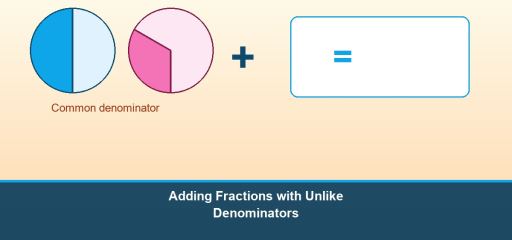
TL;DR: When the denominators don’t match, you can’t add the fractions yet, the pieces are different sizes. Find the least common denominator first, rewrite each fraction so they share that bottom number, then add the numerators and keep the denominator unchanged. Always glance at your answer and check whether it can be simplified. Once you trust this routine, unlike denominators stop being scary. They are just a small detour before the addition step you already know how to do.
Key takeaways:
- Unlike denominators means the bottom numbers are different – you can’t add until they match.
- Find the least common denominator (LCD) – the smallest number both denominators divide into.
- Rewrite each fraction with the LCD by multiplying top and bottom by the same number.
- Add the numerators; keep the common denominator unchanged.
- Simplify the result if possible. Example: \(\dfrac{1}{4} + \dfrac{1}{6} = \dfrac{3}{12} + \dfrac{2}{12} = \dfrac{5}{12}\).
Grade 6 focus: Adding fractions is straightforward when the denominators match. When they do not, you rewrite each fraction as an equivalent fraction so they share a common denominator, usually the least common denominator (LCD), which is the least common multiple (LCM) of the denominators.
Video lesson: Watch this Khan Academy tutorial to see the ideas explained step by step.
Step-by-step method
- Identify denominators. For example, in \(\frac{2}{3} + \frac{1}{4}\), the denominators are \(3\) and \(4\).
- Find the LCD. \(\mathrm{LCM}(3,4)=12\).
- Build equivalent fractions. \(\frac{2}{3} = \frac{8}{12}\) and \(\frac{1}{4} = \frac{3}{12}\).
- Add the numerators and keep the denominator: \(\frac{8}{12} + \frac{3}{12} = \frac{11}{12}\).
- Simplify if possible. Here \(\frac{11}{12}\) is already in simplest form.

Pre-Algebra for Beginners 2026 The Ultimate Step by Step Guide to Preparing for the Pre-Algebra Test
Worked example
Add \(\frac{5}{6} + \frac{1}{8}\).
\(\mathrm{LCM}(6,8)=24\). Then \(\frac{5}{6} = \frac{20}{24}\) and \(\frac{1}{8} = \frac{3}{24}\). Sum: \(\frac{23}{24}\).
Why the LCD helps
Equivalent fractions let you express both amounts using the same-sized parts, so addition means counting parts of the same whole, exactly what “common denominator” is for.
Common mistakes
- Adding numerators and denominators directly (e.g., \(\frac{1}{2} + \frac{1}{3} \neq \frac{2}{5}\)).
- Forgetting to change both fractions when rewriting.
- Stopping before simplifying (e.g., writing \(\frac{4}{8}\) instead of \(\frac{1}{2}\)).
Practice tip
Always ask: “Do my denominators match?” If not, find the LCD before you add.
Recommended EffortlessMath Books
For a workbook that pairs with this page, Mastering Grade 6 Math walks your sixth grader through every grade-6 topic with worked examples and plenty of practice. For more story-problem reps, Mastering Grade 6 Math Word Problems is the matching word-problem book.
Frequently Asked Questions
Why do fractions need a common denominator before adding?
Because fractions are pieces of different sizes when the denominators differ. \(\dfrac{1}{4}\) is a quarter; \(\dfrac{1}{6}\) is a sixth – those pieces aren’t the same size, so you can’t just count them together. Rewriting both with the same denominator gives equal-size pieces you can add up.
What’s the least common denominator?
The LCD is the smallest whole number that both denominators divide into evenly. For \(\dfrac{1}{3}\) and \(\dfrac{1}{4}\), the LCD is 12 because \(12 \div 3 = 4\) and \(12 \div 4 = 3\). One quick trick: when the two denominators share no common factor, the LCD is just their product. \(3 \times 4 = 12\).
How do I find the LCD when denominators share a factor?
Multiplying them gives a common denominator, but not always the LEAST common one. For \(\dfrac{1}{4}\) and \(\dfrac{1}{6}\), \(4 \times 6 = 24\) works but 12 is smaller. The clean method: factor each denominator (\(4 = 2^2\), \(6 = 2 \times 3\)), then take each factor to the highest power: \(2^2 \times 3 = 12\).
What if the answer is greater than 1?
Convert it to a mixed number if your teacher wants that form. \(\dfrac{7}{4} = 1\dfrac{3}{4}\) because \(7 \div 4 = 1\) remainder \(3\). Either form is mathematically correct; just match whatever the question or rubric asks for.
Can I add mixed numbers the same way?
Two paths. (1) Add whole parts and fraction parts separately, then combine. \(2\dfrac{1}{4} + 3\dfrac{1}{6} = 5 + (\dfrac{1}{4} + \dfrac{1}{6}) = 5\dfrac{5}{12}\). (2) Convert to improper fractions first: \(\dfrac{9}{4} + \dfrac{19}{6} = \dfrac{27}{12} + \dfrac{38}{12} = \dfrac{65}{12} = 5\dfrac{5}{12}\). Either works.
Walk me through an example.
Add \(\dfrac{2}{5} + \dfrac{3}{8}\). Denominators 5 and 8 share no common factor, so the LCD is \(5 \times 8 = 40\). Rewrite: \(\dfrac{2}{5} = \dfrac{16}{40}\) (multiply by \(\dfrac{8}{8}\)); \(\dfrac{3}{8} = \dfrac{15}{40}\) (multiply by \(\dfrac{5}{5}\)). Add: \(\dfrac{16}{40} + \dfrac{15}{40} = \dfrac{31}{40}\). Already in lowest terms.
What if one denominator divides the other?
The LCD is just the bigger denominator. For \(\dfrac{1}{2} + \dfrac{1}{6}\), the LCD is 6. Rewrite \(\dfrac{1}{2} = \dfrac{3}{6}\), then add: \(\dfrac{3}{6} + \dfrac{1}{6} = \dfrac{4}{6} = \dfrac{2}{3}\). This is the easiest case.
How do I check my answer is right?
Convert both starting fractions to decimals and add them. \(\dfrac{1}{4} + \dfrac{1}{6} = 0.25 + 0.1\overline{6} \approx 0.417\). Check \(\dfrac{5}{12} \approx 0.417\) – matches. The decimal method works great as a sanity check on tests.
Where does this skill show up later?
Everywhere. Pre-algebra and algebra both lean on fraction addition for solving equations like \(\dfrac{x}{3} + \dfrac{x}{4} = 7\). Geometry uses it for area calculations with fractional sides. SAT and ACT word problems include it on most tests. It’s also the foundation for adding rational expressions in Algebra II.
What’s the most common mistake?
Adding the denominators. \(\dfrac{1}{4} + \dfrac{1}{6}\) is NOT \(\dfrac{2}{10}\). Once you have a common denominator, you only add the tops. Keep the common denominator unchanged. If your answer for two positive proper fractions is smaller than one of the original fractions, you probably made this mistake.
Related EffortlessMath Lessons
If a topic on this page feels rusty, these short lessons go deeper:

Related to This Article
More math articles
- CLEP U.S. History I 030: Loyalists, Native Nations, Enslaved People, and Women
- Rumors, Fads, Fashions, and Mass Behavior
- How to Help Your 6th Grade Student Prepare for the Maryland MCAP Math Test
- Top 10 8th Grade Common Core Math Practice Questions
- How limited attention and framing affect choices
- Top 10 Tips to Overcome CHSPE Math Anxiety
- Foreign and defense policy
- Graphical Insights: How to Solve Systems of Non-linear Equations Step-by-Step
- Iowa Algebra 1 Free Worksheets: Printable Algebra 1 PDF Practice for Every Topic
- The Virtual Classroom Advantage: How Online Math Tutors Enhance Elementary Math Education
What people say about "Adding Fractions with Unlike Denominators (Grade 6)"?
No one replied yet.