How Do You Simplify Radicals with Fractions?
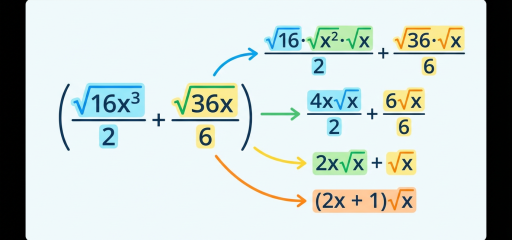
To simplify a radical that contains a fraction, split it into the root of the numerator over the root of the denominator, simplify each root, then rationalize so no radical is left in the denominator. For example, √(8/9) = √8 / √9 = 2√2 / 3, and 1/√2 = √2 / 2 after multiplying top and bottom by √2.
Simplifying radicals with fractions combines two key skills: simplifying square roots and working with rational expressions. Whether the radical is in the numerator, denominator, or both, the goal is to express the result in simplest form with a rationalized denominator.
The Absolute Best Book to Ace Your Math Test
Recommended Math Resources

Simplifying a Fraction Under a Radical
Use the Quotient Rule
√(a/b) = √a/√b (for a, b > 0). Example: √(18/50) = √18/√50. Simplify each: √18 = 3√2, √50 = 5√2. So √18/√50 = 3√2/(5√2) = 3/5. The result is 3/5 or √(9/25). For more practice, see our math worksheets.
Simplifying Radicals in the Numerator or Denominator
If you have (√12)/4, simplify √12 = 2√3 first: (2√3)/4 = √3/2. If you have 6/√8, rationalize: 6/√8 × √8/√8 = 6√8/8 = 3√8/4. Then simplify √8 = 2√2: 3(2√2)/4 = 3√2/2.
When the Fraction Has Radicals in Both
Example: √6/√15. Simplify: √6/√15 = √(6/15) = √(2/5). Rationalize: √(2/5) = √2/√5 × √5/√5 = √10/5. Alternatively, divide first: √6/√15 = √(6/15) = √(2/5), then rationalize. Explore Effortless Math for algebra help.
Common Patterns
Our Featured Products
Recommended Math Practice Resource
- √(a²/b) = a/√b → rationalize to a√b/b
- √a/√b = √(a/b) → simplify the fraction under the radical, then rationalize if needed
- Always reduce fractions and simplify radicals before finalizing
Frequently Asked Questions
How do you simplify radicals with fractions?
Split the radical into the root of the numerator over the root of the denominator, simplify each root, then rationalize if a radical is left in the denominator. For example, √(8/9) = √8/√9 = 2√2/3. If the fraction under the radical can be reduced, do that first: √(18/50) becomes √(9/25), which equals 3/5.
How do you simplify radicals with fractions and variables?
Treat variables like numbers: pull perfect-square factors out of the numerator and denominator, assuming the variables are positive. For example, √(x³/(4y²)) = √(x²·x)/√(4y²) = x√x/(2y). If a variable radical stays in the denominator, multiply the top and bottom by it, so 1/√x becomes √x/x.
How do you simplify fractions with radicals in the denominator?
Rationalize the denominator by multiplying the numerator and denominator by the radical in the denominator. For 6/√8, first simplify √8 = 2√2 to get 6/(2√2) = 3/√2, then multiply by √2/√2 to get 3√2/2. If the denominator is a sum such as 1 + √3, multiply top and bottom by the conjugate, 1 − √3, instead.
How do you simplify fractions with radicals in the numerator and denominator?
Combine them under one radical, reduce the fraction, then rationalize. For √6/√15, write √(6/15) = √(2/5), then √2/√5 × √5/√5 = √10/5. Reducing first keeps the numbers small. You could also rationalize right away: √6 × √15 = √90 = 3√10, and 3√10/15 simplifies to the same answer, √10/5.
How do you simplify radicals with fractions as exponents?
A fractional exponent is a radical in disguise: x to the m/n power means the nth root of x, raised to the m power. So 8 to the 2/3 power is (∛8)² = 2² = 4, and 25 to the 1/2 power is √25 = 5. To simplify, rewrite between radical and exponent form as needed, use exponent rules such as adding exponents when multiplying, then convert back.
Can radicals be fractions?
Yes. A radical can contain a fraction, like √(4/9), and the result can be a fraction too: √(4/9) = 2/3, because (2/3)² = 4/9. A radical can also sit inside a fraction, as in √3/2. In simplest form, a fraction with radicals has no radical in the denominator and no perfect-square factors left under any root.

Recommended Resources
Can you leave a radical in the denominator?
Technically yes, but standard form requires a rationalized denominator for clarity and consistency.
How do you simplify √(3/7)?
√(3/7) = √3/√7. Rationalize: √3/√7 × √7/√7 = √21/7.

Related to This Article
More math articles
- Top 10 3rd Grade IAR Math Practice Questions
- The Best Grade 3 ELA Practice Tests for New Mexico Students
- TASC Math – Test Day Tips
- Potential Energy Calculator
- Top 10 8th Grade SBAC Math Practice Questions
- Deviance and Social Control
- The Best Grade 7 ELA Practice Tests for New Mexico Students
- The Pacific War and the Atomic Bomb
- Algebra Puzzle – Challenge 47
- The Best Grade 5 ELA Practice Tests for Alabama Students












What people say about "How to Simplify Radicals with Fractions (Step by Step)"?
No one replied yet.