How to Simplify Algebraic Expressions: The Rules You Need
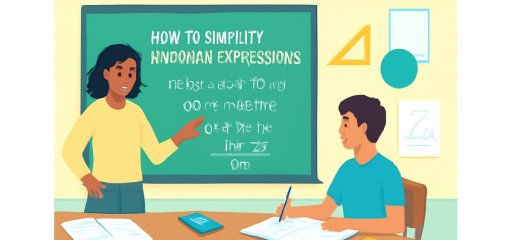
Simplifying expressions is the algebra version of cleaning up your room. Same furniture, less mess. Here’s the 4-step routine that works on every expression you’ll ever meet.
Simplify Algebraic Expressions: The Rules You Need: what to notice and how to work it
What to notice first
Common student mistake
Key formulas and cues
A reliable path
- Name the variableChoose a letter for the unknown quantity.
- Translate in chunksTurn each phrase into an operation, keeping order words attached.
- Simplify or evaluateCombine like terms or substitute the given value.
Worked examples
Translate a phrase
- Let the number be x.
- Twice the number is 2x.
- Seven more than that adds 7.
Evaluate carefully
- Replace x with 5.
- Multiply before subtracting.
- Compute 15 – 4.
Try one before moving on
Simplify Algebraic Expressions: The Rules You Need: pop-up practice
Step 1, Distribute
Anywhere you see a number (or variable) sitting outside parentheses, multiply it through:
\(3(2x + 5) = 6x + 15\).
Don’t forget the negative sign trap:
\(-(x – 4) = -x + 4\) (not \(-x – 4\)).
Step 2, Combine like terms
“Like terms” share the same variable raised to the same power.
- $3x$ and $5x$ are like terms.
- $3x$ and \(3x^2\) are not.
- $7$ and $-2$ (plain numbers) are like terms.
Add the coefficients of like terms:
\(4x + 7 – 2x + 3 = (4x – 2x) + (7 + 3) = 2x + 10\).
Step 3, Apply exponent rules
For variables multiplied:
- \(x^a \cdot x^b = x^{a+b}\).
- \((x^a)^b = x^{ab}\).
- \(\tfrac{x^a}{x^b} = x^{a-b}\).
Example: \(x^3 \cdot x^4 = x^7\).
Step 4, Check your work
Plug in a simple number for the variable in both the original and the simplified expression. They should give the same value. If they don’t, something went wrong.
Worked example
Simplify: \(2(3x – 4) + 5x – 7\).
- Distribute: \(6x – 8 + 5x – 7\).
- Combine like terms: \((6x + 5x) + (-8 – 7) = 11x – 15\).
Common mistakes
- Forgetting to distribute a negative sign across both terms.
- Combining $3x$ with \(3x^2\) (different powers, not like terms).
- Misapplying exponent rules, multiplying when you should add, or vice versa.
FAQ
What does it mean to simplify an expression?
To rewrite it in the shortest, cleanest equivalent form.
What’s a “like term”?
Terms with the same variable raised to the same power.
Do I always distribute first?
Usually yes. If parentheses don’t have a multiplier outside them, you can skip distribution.
How do I handle negative coefficients?
Treat them like signed multiplication: \(-3(x – 2) = -3x + 6\).
Is simplifying the same as solving?
No, simplifying makes an expression cleaner; solving finds a value for the variable.
How is simplifying different from evaluating?
Simplifying rewrites the expression in a cleaner form (still with variables). Evaluating substitutes a specific number for the variable to get a numeric answer.
Can a constant be a “like term” with a variable?
No. Pure numbers (constants) are only like terms with other pure numbers. \(x\) and $5$ cannot be combined into a single term.
What’s the FOIL method?
FOIL stands for First, Outer, Inner, Last, a memory aid for multiplying two binomials like \((x+3)(x+5)\). Multiply F: \(x \cdot x = x^2\). O: \(x \cdot 5 = 5x\). I: \(3 \cdot x = 3x\). L: \(3 \cdot 5 = 15\). Combine: \(x^2 + 8x + 15\).
What’s a negative exponent?
A negative exponent means “reciprocal.” \(x^{-3} = \tfrac{1}{x^3}\). Always rewrite negative exponents as positive ones in your final answer.
How do I simplify expressions with multiple variables?
Group like terms by variable. \(3x + 2y – x + 4y = 2x + 6y\). The two variables stay separate. You only combine within each variable.
Worked example with everything
Simplify: \(4(2x – 3) – 2(x + 5) + 3x – 1\).
- Distribute the 4: \(8x – 12\).
- Distribute the $-2$: \(-2x – 10\).
- Rewrite the full expression: \(8x – 12 – 2x – 10 + 3x – 1\).
- Combine like terms: \((8x – 2x + 3x) + (-12 – 10 – 1) = 9x – 23\).
- Check by plugging in \(x = 1\): original \(= 4(-1) – 2(6) + 3 – 1 = -4 – 12 + 3 – 1 = -14\). Simplified: \(9(1) – 23 = -14\). ✓
Polynomial vocabulary (for the SAT and finals)
- Term: a single piece separated by + or −. In \(3x^2 + 5x – 7\), there are 3 terms.
- Coefficient: the number multiplying a variable. In \(3x^2\), the coefficient is 3.
- Degree: the highest exponent in the expression. \(3x^2 + 5x – 7\) has degree 2.
- Monomial / binomial / trinomial: 1 / 2 / 3-term expressions.
- Standard form: terms ordered from highest exponent to lowest.
Knowing this vocab is worth real points on standardized tests, questions often say “in standard form” or “as a binomial” and assume you know what those mean.
Combining the distributive property and like terms
The distributive property and like-term combining usually appear in the same problem. The order is distribute first, then combine. Reversing them produces wrong answers.
Example: \(5(x + 2) + 3(x – 4)\). If you try to combine first, you’d write \((5 + 3)(x + 2 + x – 4)\), which is wrong. Distribute first: \(5x + 10 + 3x – 12\). Then combine: \(8x – 2\). Right.
Dividing polynomials by a monomial
When you divide a polynomial by a single term, split into separate fractions and simplify each.
\[\dfrac{6x^3 + 9x^2 – 12x}{3x} = \dfrac{6x^3}{3x} + \dfrac{9x^2}{3x} – \dfrac{12x}{3x} = 2x^2 + 3x – 4\]
For each term: divide coefficients, then subtract exponents of like variables.
Simplifying rational expressions
A rational expression is a fraction with polynomials. To simplify:
- Factor numerator and denominator completely.
- Cancel any common factors.
Example: \(\dfrac{x^2 – 9}{x^2 + 6x + 9}\). Factor: \(\dfrac{(x-3)(x+3)}{(x+3)(x+3)} = \dfrac{x-3}{x+3}\).
Fundamental rule: you can only cancel factors (things multiplied), not terms (things added). \(\dfrac{x+5}{x}\) does NOT simplify to \(5 + 1 = 6\). The \(x\) in the numerator is added to 5, not multiplied.
Practice problems
Try these. Answers below.
- Simplify: \(3(2x + 5) – 4(x – 2)\).
- Simplify: \((2x^2)(3x^3)\).
- Simplify: \(\dfrac{12x^5}{4x^2}\).
- Expand: \((x – 4)(x + 6)\).
- Simplify: \(-2(3x – 1) + 5(x + 4)\).
- Simplify: \(\dfrac{x^2 – 16}{x + 4}\).
Answers: 1) \(2x + 23\). 2) \(6x^5\). 3) \(3x^3\). 4) \(x^2 + 2x – 24\). 5) \(-x + 22\). 6) \(x – 4\).
The mindset that wins
Simplifying isn’t a single skill. It’s recognizing which rule applies and applying it carefully. The students who struggle most try to do too much in one step. The students who excel slow down and write every step.
When in doubt: distribute first, combine like terms second, factor third. That sequence handles 90% of all algebraic simplification you’ll see through Algebra 2.
Extra study tips that move the needle
Most students don’t fail because the math is too hard. They fail because their practice habits are inefficient. Here are the habits that separate the students who improve fast from those who stall.
Practice with a timer. Untimed practice teaches you to eventually get the right answer; timed practice teaches you to get it in test conditions. Set a stopwatch every time you sit down. Aim for 90 seconds per question on most standardized tests.
Keep an error log. A simple spreadsheet with three columns, Problem, My answer, Correct answer, Why I missed it, is the single most powerful study tool ever invented. Review your error log weekly. The same mistakes show up again and again until you name them.
Mix topics every session. Doing 20 problems on the same topic feels productive, but spaced and interleaved practice, mixing topics, builds retrieval skills, which is what the test actually measures. Spend 70% of your time on mixed sets and only 30% on isolated drills.
Sleep on it. Memory consolidation happens during sleep. A 30-minute session the night before a quiz, followed by 7+ hours of sleep, beats a 3-hour cram session that ends at midnight. This is settled cognitive science.
Teach the topic out loud. If you can’t explain it, you don’t fully know it. Either record yourself, write a one-paragraph “how I’d teach this” explanation, or grab a friend to listen. Teaching exposes the gaps your problem sets hid.
When to ask for help
Spinning your wheels for more than 15 minutes on a single problem is a signal, not of failure, but of a missing piece of background. Stop, mark the problem, and either ask a teacher, post in our community, or watch a video on the relevant subtopic. Resuming after gaining the missing piece is much more efficient than guessing your way forward.
A quick self-assessment
Before you close this tab, answer these three questions honestly:
- What’s the one topic in this article you understood best?
- What’s the one topic that still feels fuzzy?
- What concrete next step (a worksheet, a practice test, a video) will you take in the next 48 hours?
Writing those answers down, even just in a notes app, has been shown to roughly double the chance you actually follow through. Treat the next 48 hours as a small, doable experiment, not a marathon. Your future test-day self will thank you.
Brush up with Pre-Algebra worksheets or our Algebra Bundle.

Related to This Article
More math articles
- Number Patterns and Sequences for 4th Grade
- How to Solve Work-Rate Word Problems: Step-by-Step Guide for 2026
- Math Topics You Need to Learn in Medicine
- The Ultimate 7th Grade PARCC Math Course (+FREE Worksheets)
- Delaware Algebra 1 Free Worksheets: Printable Algebra 1 Test-Prep Worksheets with Answer Keys
- North Carolina EOG Grade 7 Math Worksheets: 95 Free Printable Skill PDFs with Keys
- Geometry Puzzle – Challenge 62
- How to Prepare for the TASC Math Test?
- Economic Crises and Economic Freedom
- Constitutional qualifications
What people say about "How to Simplify Algebraic Expressions"?
No one replied yet.