Grade 6 Math: Adding and Subtracting Mixed Numbers
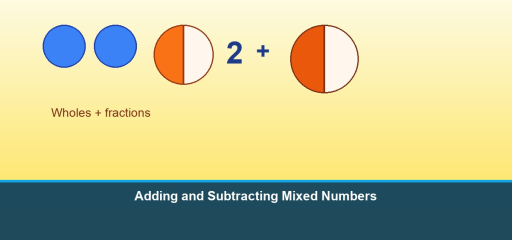
TL;DR: Mixed numbers carry two parts, and you have two solid ways to handle them. Option one: convert each mixed number into an improper fraction first, then add or subtract the way you already know. Option two: keep the whole-number parts and the fraction parts separate, work each team on its own, and regroup if the fraction part overflows or comes out negative. Pick whichever feels cleaner for the numbers in front of you and the answer comes out the same.
Key takeaways:
- A mixed number is a whole number plus a proper fraction, like \(2\tfrac{3}{4}\).
- Two methods work: (1) convert to improper fractions, or (2) add whole and fraction parts separately.
- Unlike denominators need a common denominator before adding or subtracting the fractions.
- Watch for regrouping: subtracting \(3\tfrac{1}{4} – 1\tfrac{3}{4}\) needs you to borrow from the whole.
- Always simplify your final answer and convert back to a mixed number if needed.
Grade 6 focus: Mixed numbers combine a whole number and a proper fraction (e.g., \(2\frac{1}{3}\)). To add or subtract, you can either convert to improper fractions or add/subtract whole parts and fraction parts separately, then handle regrouping if needed.
Video lesson: Watch this Math with Mr. J lesson on adding and subtracting mixed numbers when denominators differ.
Strategy A: Improper fractions
- Rewrite each mixed number as an improper fraction.
- Add or subtract using fraction rules (LCD if denominators differ).
- Convert the answer back to a mixed number if appropriate.
Strategy B: Wholes + fractions
- Add or subtract the whole-number parts.
- Add or subtract the fractional parts (common denominator).
- If the fractional part is negative or “too small,” regroup from the whole.
Worked example (addition)
\(1\frac{2}{5} + 2\frac{1}{4}\). LCD of \(5\) and \(4\) is \(20\).
Wholes: \(1 + 2 = 3\). Fractions: \(\frac{2}{5} + \frac{1}{4} = \frac{8}{20} + \frac{5}{20} = \frac{13}{20}\). Result: \(3\frac{13}{20}\).
Regrouping reminder
Subtracting \(3\frac{1}{6} – 1\frac{5}{6}\) may require borrowing: rewrite \(3\frac{1}{6}\) as \(2\frac{7}{6}\), then subtract to get \(1\frac{2}{6} = 1\frac{1}{3}\) after simplifying.
Practice tip
Show each step, especially regrouping, so errors are easy to spot.
Mixed Number Operations: Two Complete Methods
Method 1 (Improper Fractions): Convert mixed to improper, find LCD if needed, perform operation, convert back. Method 2 (Like-Denominator): Operate on whole numbers and fractions separately, then combine. Both methods work, choose based on comfort and problem structure. Detailed examples show 2 3/5 + 1 2/5 = 4 using improper fractions, and 3 1/4 – 1 1/6 = 2 1/12 with different denominators.
Subtraction with Borrowing
When subtracting a larger fraction from a smaller one, borrow 1 from the whole number. Example: 5 1/3 – 2 2/3 becomes 4 4/3 – 2 2/3 = 2 2/3. Comparison table shows when each method is most efficient.
Review improper fractions and simplifying fractions for related skills.
Two Methods for Mixed Number Operations
When adding or subtracting mixed numbers like 2 3/4 and 1 2/3, you have two effective approaches. The improper fraction method converts mixed numbers to improper fractions, finds common denominators, performs the operation, and converts back. The like-denominator method separates whole numbers from fractions, operates on each independently, then combines results. Both methods yield identical answers; choose based on the specific problem and your comfort level.
Method 1: Converting to Improper Fractions
The improper fraction method treats entire expressions uniformly. Convert 2 3/5 by multiplying 2 times 5 and adding 3, yielding 13/5. Convert 1 2/5 similarly to get 7/5. With matching denominators, simply add numerators: 13/5 plus 7/5 equals 20/5, which simplifies to 4. This method excels when denominators differ. For 3 1/4 minus 1 1/6, convert to improper fractions: 13/4 and 7/6. Find the least common denominator: 12. Convert: 13/4 becomes 39/12, and 7/6 becomes 14/12. Subtract: 39/12 minus 14/12 equals 25/12. Convert back: 25 divided by 12 equals 2 with remainder 1, so 25/12 equals 2 1/12.
Method 2: Like-Denominator Method with Separate Operations
This method preserves mixed number form throughout. For 3 1/4 minus 1 1/6, separately subtract whole numbers: 3 minus 1 equals 2. Then subtract fractions: 1/4 minus 1/6. Find the least common denominator (12): 1/4 becomes 3/12, and 1/6 becomes 2/12. Subtract: 3/12 minus 2/12 equals 1/12. Combine: 2 plus 1/12 equals 2 1/12. The answer matches the improper fraction result.
Subtraction Requiring Borrowing
Sometimes the fractional part being subtracted exceeds the fractional part you’re starting with. For 5 1/3 minus 2 2/3, you cannot subtract 2/3 from 1/3. Borrow 1 from the whole number: 5 1/3 becomes 4 plus 1 plus 1/3, which equals 4 4/3. Now subtract: 4 4/3 minus 2 2/3 equals (4 minus 2) plus (4/3 minus 2/3) equals 2 2/3. Always remember that borrowing 1 converts to a fraction with numerator equal to the denominator.
Comparing Method Advantages
Improper fractions work smoothly when denominators differ significantly. Like-denominator method feels intuitive when working with matching denominators or easily comparable numbers. For complex expressions with multiple operations, improper fractions often streamline calculations. For simple problems with like denominators, the like-denominator method minimizes computational steps.
Common Mistakes and How to Avoid Them
Forgetting to convert improper fractions back to mixed numbers leaves work incomplete. Not finding a common denominator before operating on fractions with different denominators produces incorrect sums and differences. Borrowing incorrectly (such as taking 1 without converting to the fractional form) leads to wrong answers. Failing to simplify final fractions leaves answers in non-standard form. Always double-check that your final answer is in lowest terms and proper mixed number format.
For foundational review, visit our guides on improper fractions and simplifying fractions for reinforcement of related skills.
Two Methods for Mixed Number Operations
When adding or subtracting mixed numbers like 2 3/4 and 1 2/3, you have two effective approaches. The improper fraction method converts mixed numbers to improper fractions, finds common denominators, performs the operation, and converts back. The like-denominator method separates whole numbers from fractions, operates on each independently, then combines results. Both methods yield identical answers; choose based on the specific problem and your comfort level.
Method 1: Converting to Improper Fractions
The improper fraction method treats entire expressions uniformly. Convert 2 3/5 by multiplying 2 times 5 and adding 3, yielding 13/5. Convert 1 2/5 similarly to get 7/5. With matching denominators, simply add numerators: 13/5 plus 7/5 equals 20/5, which simplifies to 4. This method excels when denominators differ. For 3 1/4 minus 1 1/6, convert to improper fractions: 13/4 and 7/6. Find the least common denominator: 12. Convert: 13/4 becomes 39/12, and 7/6 becomes 14/12. Subtract: 39/12 minus 14/12 equals 25/12. Convert back: 25 divided by 12 equals 2 with remainder 1, so 25/12 equals 2 1/12.
Method 2: Like-Denominator Method with Separate Operations
This method preserves mixed number form throughout. For 3 1/4 minus 1 1/6, separately subtract whole numbers: 3 minus 1 equals 2. Then subtract fractions: 1/4 minus 1/6. Find the least common denominator (12): 1/4 becomes 3/12, and 1/6 becomes 2/12. Subtract: 3/12 minus 2/12 equals 1/12. Combine: 2 plus 1/12 equals 2 1/12. The answer matches the improper fraction result.
Subtraction Requiring Borrowing
Sometimes the fractional part being subtracted exceeds the fractional part you’re starting with. For 5 1/3 minus 2 2/3, you cannot subtract 2/3 from 1/3. Borrow 1 from the whole number: 5 1/3 becomes 4 plus 1 plus 1/3, which equals 4 4/3. Now subtract: 4 4/3 minus 2 2/3 equals (4 minus 2) plus (4/3 minus 2/3) equals 2 2/3. Always remember that borrowing 1 converts to a fraction with numerator equal to the denominator.
Comparing Method Advantages
Improper fractions work smoothly when denominators differ significantly. Like-denominator method feels intuitive when working with matching denominators or easily comparable numbers. For complex expressions with multiple operations, improper fractions often streamline calculations. For simple problems with like denominators, the like-denominator method minimizes computational steps.
Common Mistakes and How to Avoid Them
Forgetting to convert improper fractions back to mixed numbers leaves work incomplete. Not finding a common denominator before operating on fractions with different denominators produces incorrect sums and differences. Borrowing incorrectly (such as taking 1 without converting to the fractional form) leads to wrong answers. Failing to simplify final fractions leaves answers in non-standard form. Always double-check that your final answer is in lowest terms and proper mixed number format.
For foundational review, visit our guides on improper fractions and simplifying fractions for reinforcement of related skills.
Recommended EffortlessMath Books
For a workbook that builds fraction operations from the ground up, the Mastering Grade 6 Math covers mixed numbers, common denominators, and regrouping with worked examples and practice sets. If fractions still feel shaky, Pre-Algebra for Beginners rebuilds the prerequisites with clear step-by-step explanations.
Frequently Asked Questions
What’s a mixed number?
A mixed number is a whole number plus a proper fraction, written together – like \(2\tfrac{3}{4}\) or \(5\tfrac{1}{2}\). It’s another way of writing an improper fraction. For example, \(\tfrac{11}{4}\) and \(2\tfrac{3}{4}\) are the same value: two whole units plus three quarters of another unit.
How do I add mixed numbers with like denominators?
Add the whole numbers, then add the fractions, then combine. Example: \(2\tfrac{1}{4} + 1\tfrac{2}{4}\). Whole parts: \(2 + 1 = 3\). Fraction parts: \(\tfrac{1}{4} + \tfrac{2}{4} = \tfrac{3}{4}\). Combined: \(3\tfrac{3}{4}\). If the fractions add to more than 1, regroup: \(\tfrac{3}{4} + \tfrac{2}{4} = \tfrac{5}{4} = 1\tfrac{1}{4}\), so add 1 to the whole-number total.
How do I add mixed numbers with unlike denominators?
First find a common denominator and rewrite each fraction with it. Then add the wholes and fractions as before. Example: \(1\tfrac{1}{2} + 2\tfrac{1}{3}\). Common denominator is 6: \(\tfrac{1}{2} = \tfrac{3}{6}\), \(\tfrac{1}{3} = \tfrac{2}{6}\). Now \(1\tfrac{3}{6} + 2\tfrac{2}{6} = 3\tfrac{5}{6}\).
How do I subtract mixed numbers?
Subtract the whole parts and the fraction parts separately, with the same common-denominator step if needed. If the top fraction is smaller than the bottom, borrow 1 from the whole part first. Example: \(4\tfrac{1}{5} – 2\tfrac{3}{5}\). Borrow 1: \(4\tfrac{1}{5} = 3\tfrac{6}{5}\). Now \(3\tfrac{6}{5} – 2\tfrac{3}{5} = 1\tfrac{3}{5}\).
Should I convert to improper fractions first?
It’s a valid alternative. Convert each mixed number to an improper fraction (multiply the whole part by the denominator, add the numerator, keep the denominator), then add or subtract. Example: \(2\tfrac{1}{4} = \tfrac{9}{4}\), \(1\tfrac{1}{2} = \tfrac{3}{2} = \tfrac{6}{4}\). \(\tfrac{9}{4} + \tfrac{6}{4} = \tfrac{15}{4} = 3\tfrac{3}{4}\). Either method works – pick what feels cleaner.
When do I have to regroup or borrow?
You borrow when subtracting and the top fraction is smaller than the bottom one. Take 1 from the whole part, rewrite it as a fraction (using the same denominator), and add it to the existing fraction. Example: \(5\tfrac{1}{3} – 2\tfrac{2}{3}\). Since \(\tfrac{1}{3} < \tfrac{2}{3}\), borrow: \(5\tfrac{1}{3} = 4\tfrac{4}{3}\), then subtract: \(4\tfrac{4}{3} - 2\tfrac{2}{3} = 2\tfrac{2}{3}\).
What if the fractions add up to more than 1?
Regroup the extra into the whole-number part. Example: \(2\tfrac{3}{4} + 1\tfrac{3}{4}\). Add fractions: \(\tfrac{3}{4} + \tfrac{3}{4} = \tfrac{6}{4} = 1\tfrac{1}{2}\). Add wholes: \(2 + 1 = 3\). Combine and regroup: \(3 + 1\tfrac{1}{2} = 4\tfrac{1}{2}\). Always check whether the fraction part needs to be carried into the wholes.
Do I need to simplify the final answer?
Yes – the final answer should be a mixed number in lowest terms. If your fraction can be reduced (like \(\tfrac{4}{6}\) to \(\tfrac{2}{3}\)), simplify it. If you end with an improper fraction (like \(\tfrac{15}{4}\)), convert it back to a mixed number (\(3\tfrac{3}{4}\)). Most tests grade unsimplified answers as wrong, so don’t skip this step.
What’s a worked example of subtraction with unlike denominators?
Try \(4\tfrac{1}{4} – 1\tfrac{2}{3}\). Common denominator is 12: rewrite as \(4\tfrac{3}{12} – 1\tfrac{8}{12}\). Top fraction is smaller, so borrow: \(4\tfrac{3}{12} = 3\tfrac{15}{12}\). Now subtract: \(3\tfrac{15}{12} – 1\tfrac{8}{12} = 2\tfrac{7}{12}\). Final answer: \(2\tfrac{7}{12}\).
Where does this show up in sixth-grade math?
Adding and subtracting mixed numbers shows up across the grade-6 number-system standard (especially 6.NS.1 and the broader fraction work students do before pre-algebra). You’ll see it in recipe problems, measurement problems (mixing inches and fractions of inches), and any real-world setup involving partial amounts. Most state tests at grade 6 include at least one mixed-number problem.
Related EffortlessMath Lessons
If a topic on this page feels rusty, these short lessons go deeper:
- How to add and subtract fractions with unlike denominators
- How to find equivalent fractions
- How to multiply and divide fractions
- How to convert improper fractions to mixed numbers
- How to solve multi-step word problems

Related to This Article
More math articles
- 5th Grade MCAS Math FREE Sample Practice Questions
- How to Motivate Anyone to Start Learning Algebra and Geometry
- Supply Distribution Systems Basics
- Why Most Players Misuse Poker Calculators (and How to Get It Right)
- Praxis Core Math Practice Test Questions
- 3rd Grade Math Worksheets for Washington (SBAC): 49 Free Printable PDFs
- Interpreting Cell-Cycle Experiments: Data and Worked Examples
- How Do You Simplify Radicals with Fractions?
- CLEP U.S. History I 034: Articles of Confederation and Western Lands
- Proportional Predictions: How to Use Proportions to Estimate Population Size
What people say about "Grade 6 Math: Adding and Subtracting Mixed Numbers"?
No one replied yet.