Adjectives and Adverbs
“The patient walked good today.” Something about that sentence should itch. Fix it – walked well – and you have just applied the single most tested rule about adjectives and adverbs. These two parts of speech are the describers of English, and most errors come from putting one where the other belongs.
This lesson shows you exactly what each one modifies, the handful of confusable pairs worth memorizing, and how comparisons (-er, -est, more, most) work without doubling up.
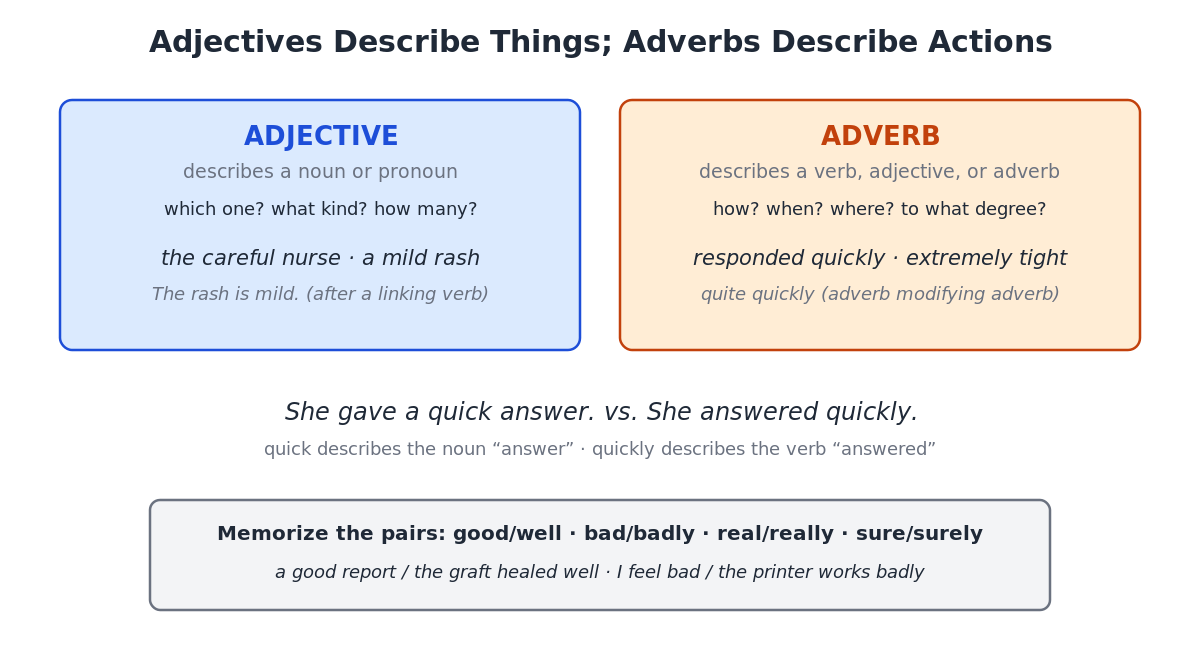
An adjective describes a noun or pronoun: a swollen ankle, a quiet ward, she is careful. An adverb describes a verb, an adjective, or another adverb, often telling how, when, where, or to what degree: walk carefully, extremely sore, very quickly. Many adverbs end in -ly, but not all.
What do adjectives actually modify?
Adjectives answer which one, what kind, or how many about a noun or pronoun:
- The second dose caused a mild rash.
- Three sterile gauze pads sat on the tray.
Adjectives usually sit right before their noun, but after a linking verb they describe the subject from a distance: The rash is mild. The patient seems anxious. That position is called a predicate adjective, and it explains a classic pair: “I feel bad” (adjective after the linking verb feel – correct for describing your state) versus “I feel badly,” which literally means your sense of touch is faulty.
What do adverbs actually modify?
Adverbs are more flexible. They can describe:
- Verbs: She responded immediately. (how/when)
- Adjectives: The schedule is extremely tight. (to what degree)
- Other adverbs: He recovered quite quickly.
Most adverbs are built by adding -ly to an adjective (careful → carefully), but the common exceptions matter: fast, hard, late, early, straight keep the same form as adjectives (a fast response / respond fast), and a few -ly words are actually adjectives (a friendly aide, a lonely road). Do not sort by ending; sort by what the word modifies.
Which adjective and adverb pairs cause the most errors?
| Adjective (modifies a noun) | Adverb (modifies a verb/adjective) | Correct examples |
|---|---|---|
| good | well | a good report; the graft healed well |
| bad | badly | I feel bad about it; the printer works badly |
| real | really | a real improvement; a really steady hand |
| sure | surely | a sure sign; she will surely pass |
| quick | quickly | a quick check; check the drip quickly |
One special case: well works as an adjective when it means “healthy” – The patient looks well today is correct and means she looks healthy.
How do comparatives and superlatives work?
Both adjectives and adverbs change form to compare:
- Comparative (two things): add -er or use more – The night shift is busier than the day shift. She documents more thoroughly than I do.
- Superlative (three or more): add -est or use most – the busiest unit in the hospital; the most thoroughly documented case.
Short words usually take the endings; words of three or more syllables take more/most. Two rules protect you from the classic traps:
- Never double up. More busier and most busiest are always wrong – choose one method.
- Learn the irregulars. Good/well → better → best; bad/badly → worse → worst; far → farther → farthest; little → less → least.
Watch: A Short Video Lesson
Ronnie from engVid walks through this skill clearly in a few minutes. It is a helpful companion to the reading above:
What is a reliable routine for adjective-adverb questions?
- Find the describing word the question is testing.
- Ask what it modifies. Point at the exact word it describes.
- Apply the rule: noun or pronoun → adjective; verb, adjective, or adverb → adverb.
- Check for a linking verb. After is, seems, feels, looks, tastes, a word describing the subject stays an adjective (the coffee tastes bitter).
- In comparisons, count the things compared (two → -er/more; three or more → -est/most) and make sure the sentence uses only one comparison marker.
Practice: adjective or adverb?
- Choose the correct word: The team responded (quick / quickly) to the alarm.
- Choose the correct word: Her sutures are healing (good / well).
- Choose the correct word: I felt (bad / badly) about missing the meeting.
- Fix the error: This is the most safest transfer technique.
- Choose the correct word: Of the two clinics, this one is (busier / busiest).
- What does remarkably modify in this sentence? The intern stayed remarkably calm during the code.
Answers
- quickly – it modifies the verb responded, so an adverb is needed.
- well – it modifies the verb phrase are healing; good is an adjective.
- bad – felt is a linking verb here, so the adjective describes your state.
- Remove the doubling: the safest transfer technique – never combine most with -est.
- busier – only two clinics are compared, so use the comparative.
- It modifies the adjective calm, telling to what degree – a textbook adverb-modifying-adjective case.
Where this fits
Adjectives and adverbs round out the describing half of grammar in our English and language usage study hub. Once you can pick the right modifier, learn to put it in the right place with fixing misplaced modifiers, trim the extras in cutting wordiness and word order, choose stronger describing words with denotation and connotation, and review the naming words these modifiers attach to in nouns and pronouns.
Recommended Prep Books
These study guides and practice books help you keep building momentum as you prepare:



Related to This Article
More math articles
- How to Support Grade 8 Reading at Home: 12 Smart Strategies That Build Independence
- Jeffersonian Ideals and Governing Realities: Principles, Power and Limits
- Multiples and Common Multiples for 4th Grade
- How to Help Your 6th Grade Student Prepare for the California CAASPP Math Test
- What Kind of Math Is on the TASC Test?
- Estimate Division with Two-Digit Divisors: Examples
- Revolving Door
- How to Add and Subtract Polynomials Using Algebra Tiles
- Algebra Puzzle – Challenge 33
- How to Solve Perfect Square Trinomial?






















What people say about "Adjectives and Adverbs: What Each One Modifies"?
No one replied yet.