Nouns and Pronouns
Every sentence you will ever read or write is built around two jobs: naming things and standing in for things already named. Nouns do the naming. Pronouns do the standing in. Get comfortable with these two parts of speech and the rest of grammar – agreement, case, clear reference – suddenly makes sense, because almost every other rule points back to them.
This lesson walks through the types of nouns and pronouns you actually need, shows you how to match them correctly, and gives you a short routine for catching the most common errors. The examples lean on everyday and clinical situations, since that is where careful wording matters most.
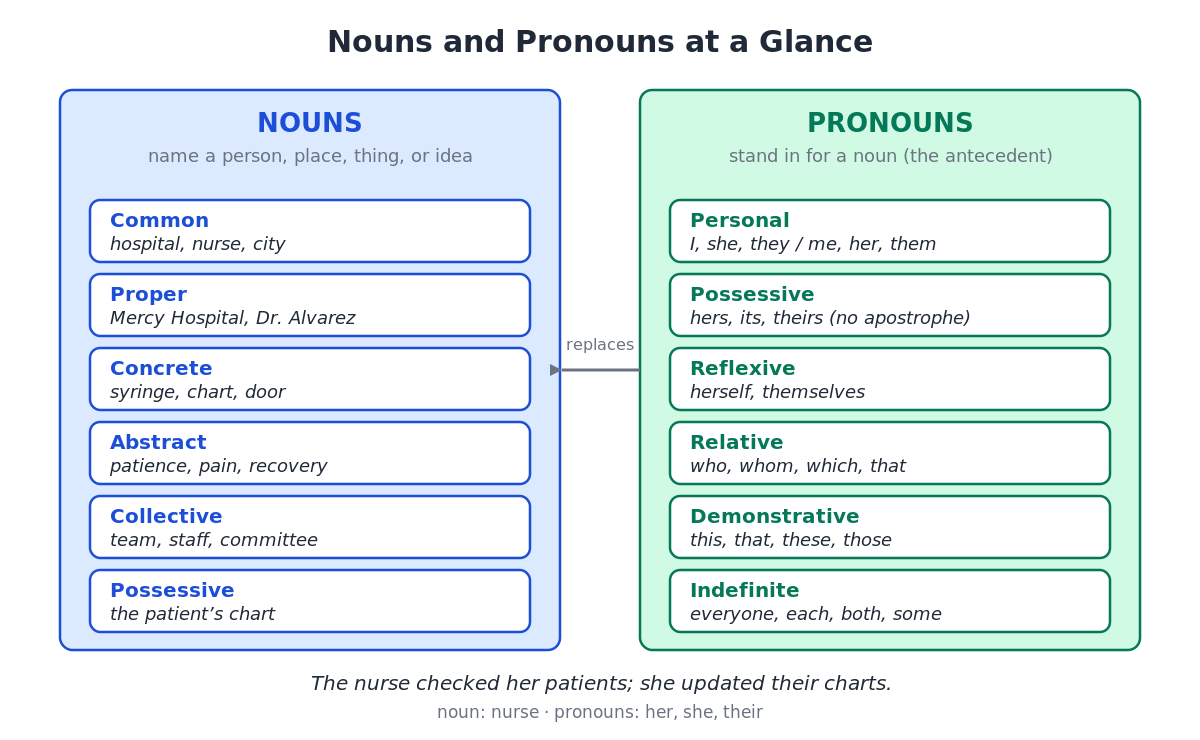
A noun names a person, place, thing, or idea: nurse, clinic, stethoscope, patience. A pronoun replaces a noun so you do not have to repeat it: he, she, it, they, who, this. The noun a pronoun refers back to is called its antecedent, and every pronoun should point clearly to exactly one antecedent.
What are the types of nouns?
You do not need to memorize a long taxonomy, but four contrasts come up again and again:
- Common vs. proper. A common noun names a general category and stays lowercase: hospital, doctor, city. A proper noun names one specific member of that category and is capitalized: Mercy Hospital, Dr. Alvarez, Chicago.
- Concrete vs. abstract. Concrete nouns are things you can see or touch: syringe, chart, door. Abstract nouns name ideas and qualities: pain, recovery, honesty.
- Singular vs. plural. Most nouns add -s or -es, but English keeps a set of irregulars you simply learn: child/children, foot/feet, criterion/criteria.
- Collective. A collective noun names a group acting as one unit: team, staff, committee, family. In American English these usually take singular verbs: The team meets at noon.
Possessive nouns show ownership with an apostrophe: the patient’s chart (one patient), the patients’ charts (several patients). The apostrophe placement, not the meaning, tells the reader how many owners there are.
What are the types of pronouns?
Pronouns come in families, and each family answers a different need:
- Personal: I, you, he, she, it, we, they – and their object forms me, him, her, us, them.
- Possessive: my/mine, your/yours, his, her/hers, its, our/ours, their/theirs. Note that none of these takes an apostrophe. Its is possessive; it’s always means it is.
- Reflexive: myself, herself, themselves – used when the subject acts on itself: The patient dressed herself. Never use a reflexive as a plain subject or object: not “Sam and myself checked the vitals” but “Sam and I checked the vitals.”
- Relative: who, whom, whose, which, that – they attach descriptive clauses: the nurse who answered the call light.
- Demonstrative: this, that, these, those – they point: These results look better than those from Monday.
- Indefinite: everyone, each, either, both, few, some, all. Most singular-sounding ones (everyone, each, nobody) really are singular: Each of the residents has a locker.
How do pronouns and antecedents work together?
A pronoun borrows all of its meaning from its antecedent, so the two must match in number (singular or plural) and person, and the connection must be unmistakable. Two checks cover most errors:
Check 1 – agreement. Each patient must sign their form is a mismatch in formal writing, because each is singular. Formal fixes: Each patient must sign his or her form, or better, make it plural: All patients must sign their forms.
Check 2 – clear reference. In “When the aide spoke to the charge nurse, she seemed rushed,” who was rushed? The pronoun she could point to either woman. Rewrite so it points to one: The charge nurse seemed rushed when the aide spoke to her.
How do I choose between subject and object pronouns?
Personal pronouns change form depending on the job they do. That form is called case, and a small table keeps it straight:
| Job in the sentence | Use | Example |
|---|---|---|
| Subject (does the action) | I, he, she, we, they, who | She and I organized the supply room. |
| Object (receives the action or follows a preposition) | me, him, her, us, them, whom | The manager thanked her and me. |
| Possessive (owns something) | my, his, her, our, their, whose | Their shift ends at seven. |
When a pronoun is paired with a noun, test it alone. “The instructor praised Jamal and I” sounds polite but fails the test: you would never say “The instructor praised I.” So it must be Jamal and me.
Watch: A Short Video Lesson
EA Learning English walks through this skill clearly in a few minutes. It is a helpful companion to the reading above:
What is a quick routine for noun and pronoun questions?
- Find every pronoun in the sentence and underline it.
- Name its antecedent. If you cannot point to exactly one noun, the sentence has a reference problem.
- Match the number. Singular antecedent, singular pronoun; plural antecedent, plural pronoun. Watch indefinite pronouns like each and everyone, which are singular.
- Check the case. Subject job takes I/he/she/they; object job takes me/him/her/them. Test paired pronouns alone.
- Scan the apostrophes. Possessive nouns need one (the nurse’s badge); possessive pronouns never do (its, hers, theirs).
Practice: can you spot the correct form?
- Choose the correct word: The clinic updated (its / it’s) intake process.
- Fix the error: Everyone on the night shift brought their own lunch. (formal writing)
- Choose the correct pronoun: The supervisor asked Maria and (I / me) to restock the cart.
- Identify the antecedent problem: When Dana called her sister, she was already at the pharmacy.
- Which noun is collective: nurses, committee, syringes, hallway?
- Choose the correct form: Neither of the applicants submitted (her / their) transcript on time. (formal writing)
Answers
- its – possessive pronouns never take an apostrophe; it’s means it is.
- Everyone is singular. Fix: Everyone on the night shift brought his or her own lunch, or recast: All the night-shift workers brought their own lunches.
- me – drop “Maria and” and you would say asked me, not asked I.
- She could refer to Dana or her sister. Rewrite: Dana’s sister was already at the pharmacy when Dana called.
- Committee – it names a group acting as a single unit and takes a singular verb.
- her (or his or her if gender is unknown) – neither is singular.
Where this fits
Nouns and pronouns are the first stop in our English and language usage study hub, and everything that follows builds on them. When you are ready, continue with pronoun agreement and clear reference, sharpen the subject-versus-object decision in pronoun case, see how nouns anchor complete sentences and clauses, and make sure your subjects and verbs get along in subject-verb agreement.
Recommended Prep Books
These study guides and practice books help you keep building momentum as you prepare:


Related to This Article
More math articles
- Full-Length GED Math Practice Test
- Direct Substitution in Limits: Everything you need to know
- Top 5 GED Math Study Guides
- Income Inequality: Causes, Evidence and Policy Choices
- Top 10 Tips to ACE the ASVAB Math
- What is a Perfect SAT Score?
- Emancipation Proclamation: Scope, Policy and the Path to Freedom
- Chi-Square Calculator — Goodness of Fit Test (Free)
- Free Grade 7 English Worksheets for Florida Students
- 15 Free Math Websites for Students: Lessons, Practice and Tools





















What people say about "Nouns and Pronouns: Types, Rules, and Examples"?
No one replied yet.