Parabola Calculator — Vertex, Focus & Directrix
AlgebraFreeNo sign-up
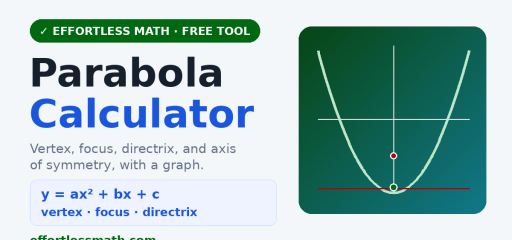
A parabola calculator finds the vertex, focus and directrix from the equation. For y = ax² + bx + c the vertex is at x = −b/(2a), and the focus sits p = 1/(4a) above it. For y = x² − 4x + 3: vertex (2, −1), p = 1/4, focus (2, −3/4) and directrix y = −5/4. The parabola opens upward and crosses the x-axis at 1 and 3.
| Form | Equation |
|---|---|
| Standard form | y = x² − 4x + 3 |
| Vertex form | y = (x − 2)² − 1 |
| Factored form | y = (x − 1)(x − 3) |
| Focus–directrix (conic) form | (x − 2)² = y + 1 |
| General form | x² − 4x − y + 3 = 0 |
Show steps
- Standard form: y = x² − 4x + 3, so a = 1, b = −4, c = 3. Because a is positive, the parabola opens upward.
- Vertex: x = −b/(2a) = −(−4)/(2 × 1) = 2. Then y = c − b²/(4a) = 3 − (−4)²/(4 × 1) = −1. Vertex (2, −1).
- Completing the square gives the vertex form y = (x − 2)² − 1.
- Focal length: p = 1/(4a) = 1/(4 × 1) = 1/4. The focus is p units from the vertex along the axis: (2, −3/4). The directrix is p units on the other side: y = −5/4.
- Axis of symmetry: x = 2. Latus rectum (the chord through the focus): length |4p| = |1/a| = 1, with endpoints (3/2, −3/4) and (5/2, −3/4).
- x-intercepts (set y = 0): Discriminant b² − 4ac = (−4)² − 4 × 1 × 3 = 4. x = (−b ± √(b² − 4ac))/(2a) = 1 and 3. y-intercept (set x = 0): y = c = 3.
- Check with the focus–directrix definition: every point is as far from the focus as from the directrix, which gives (x − 2)² = y + 1 (here 4p = 1).
How to use the parabola calculator
- Choose Vertical (y = …, opens up or down) or Horizontal (x = …, opens left or right).
- Pick what you know: an equation (standard, vertex, factored or general form), 3 points, the vertex and one point, or the focus and directrix. Missing terms are entered as 0.
- Type integers, decimals or fractions such as 3/4 and press Analyze. Answers stay exact, with decimals beside any fraction.
The result lists the vertex, focus, directrix, axis of symmetry, focal length, latus rectum, intercepts, domain and range, the equation in all five forms, a graph drawn to scale, and every step of the working.
Vertex, focus and directrix formulas
Write the parabola in vertex form with p = 1/(4a), the signed distance from the vertex to the focus:
| Feature | Vertical: y = a(x − h)² + k | Horizontal: x = a(y − k)² + h |
|---|---|---|
| Vertex | (h, k) | (h, k) |
| Opens | up if a > 0, down if a < 0 | right if a > 0, left if a < 0 |
| Focus | (h, k + p) | (h + p, k) |
| Directrix | y = k − p | x = h − p |
| Axis of symmetry | x = h | y = k |
| Latus rectum length | |4p| = |1/a| | |4p| = |1/a| |
| Conic form | (x − h)² = 4p(y − k) | (y − k)² = 4p(x − h) |
From standard form y = ax² + bx + c you do not need to complete the square first: h = −b/(2a) and k = c − b²/(4a). Every parabola is the set of points that are the same distance from the focus as from the directrix, which is why the focus and directrix sit at equal distances on either side of the vertex.
Converting between parabola forms
- Standard to vertex form: complete the square. y = x² − 4x + 3 = (x − 2)² − 4 + 3 = (x − 2)² − 1.
- Vertex to standard form: expand. b = −2ah and c = ah² + k.
- Factored form y = a(x − r₁)(x − r₂) shows the x-intercepts r₁ and r₂. It exists over the real numbers only when the discriminant b² − 4ac is 0 or more.
- General (conic) form Ax² + Bx + Cy + D = 0 is solved for y: divide by −C. For a horizontal parabola, Ay² + Bx + Cy + D = 0 is solved for x by dividing by −B.
Worked examples
Upward opening: y = x² − 4x + 3
Here a = 1, b = −4, c = 3. The vertex is at x = 4/2 = 2 and y = 3 − 16/4 = −1, so V(2, −1). With p = 1/(4 × 1) = 1/4, the focus is (2, −3/4) and the directrix is y = −5/4. The latus rectum has length 1, from (3/2, −3/4) to (5/2, −3/4). It factors as (x − 1)(x − 3), so the x-intercepts are 1 and 3; the y-intercept is 3.
Downward opening: y = −2x² + 8x − 3
The vertex is at x = −8/(2 × −2) = 2 and y = −3 − 64/(−8) = 5, so V(2, 5) and the vertex form is y = −2(x − 2)² + 5. Now p = 1/(4 × −2) = −1/8, so the focus is below the vertex at (2, 39/8) and the directrix is above it at y = 41/8. The discriminant is 64 − 24 = 40, so the x-intercepts are 2 ± √10/2 ≈ 0.419 and 3.581.
Through three points
Find the parabola through (−1, 8), (1, 0) and (4, 3). Substituting into y = ax² + bx + c gives a − b + c = 8, a + b + c = 0 and 16a + 4b + c = 3. Subtracting the first from the second gives b = −4, and then a + c = 4 and 16a + c = 19, so a = 1 and c = 3. The answer is y = x² − 4x + 3, the parabola from the first example.
From the focus and directrix
The focus is (0, 2) and the directrix is y = −2. The vertex is halfway between them at (0, 0), and p = 2, so a = 1/(4 × 2) = 1/8. The equation is y = x²/8, or x² = 8y in conic form, with latus rectum length 8.
A horizontal parabola in general form
Take y² − 4x − 2y + 9 = 0. Solving for x gives x = (1/4)y² − (1/2)y + 9/4 = (1/4)(y − 1)² + 2. The vertex is (2, 1), p = 1, the focus is (3, 1), the directrix is x = 1, and the parabola opens to the right.
The latus rectum and focal width
The latus rectum is the chord through the focus parallel to the directrix. Its length |4p| = |1/a| is also called the focal width, and its two endpoints are 2|p| either side of the focus. Plotting the vertex and these two endpoints gives three accurate points, which is the quickest way to sketch a parabola by hand.
Practice the graph and review a mistake
Sketch y = −2x² + 8x − 3 before you open the calculator: mark the vertex (2, 5), the axis x = 2, the y-intercept (0, −3) and its mirror image (4, −3), then join them with a smooth curve opening downward. Then enter the equation and compare your sketch with the graph.
The most common mistake is a sign error in the vertex: for y = (x + 3)² the vertex is at x = −3, not 3. Other frequent slips:
- Putting the focus on the wrong side: when a < 0, p is negative and the focus is below the vertex.
- Writing the directrix as a point. It is a line: y = k − p for a vertical parabola.
- Forgetting a when completing the square. Factor a out of the x-terms first: 2x² + 12x = 2(x² + 6x).
- Using three points with two equal x-values. No vertical parabola can pass through them; try the horizontal orientation.
Parabola practice quiz: 10 questions
Test yourself with 10 multiple-choice questions. Choose an answer and press Submit to see if you are right and why. Your score appears at the end.
a = 1/12, so p = 1/(4a) = 3. The vertex is (0, 0), so the focus is (0, 3).
The directrix is as far below the vertex as the focus is above it: y = 0 − 3 = −3.
a = −1 is negative, so it opens down. h = −4/(2 × −1) = 2 and y = −4 + 8 = 4.
It is a horizontal parabola with a > 0, so it opens right. p = 1/(4 × 1/4) = 1, so the focus is (1, 0).
c = 1 from (0, 1). Then a + b = 1 and 4a + 2b = 4, so a = 1 and b = 0.
The discriminant is 2² − 4 × 1 × 5 = −16, which is negative, so the parabola never touches the x-axis.
Half of −8 is −4, and (−4)² = 16. So x² − 8x + 10 = (x − 4)² − 16 + 10 = (x − 4)² − 6.
Quiz complete
Frequently asked questions
How do you find the vertex of a parabola?
For y = ax² + bx + c, the x-coordinate is −b/(2a). Substitute it back to get y. In vertex form y = a(x − h)² + k the vertex is simply (h, k).
How do you find the focus and directrix of a parabola?
Find the vertex (h, k) and p = 1/(4a). For a vertical parabola the focus is (h, k + p) and the directrix is y = k − p. For a horizontal parabola the focus is (h + p, k) and the directrix is x = h − p.
How do you find the equation of a parabola from three points?
Substitute each point into y = ax² + bx + c to get three linear equations in a, b and c, then solve them by elimination. If the solution gives a = 0, the points are on a line and no parabola fits.
Does every parabola have x-intercepts?
No. A vertical parabola crosses the x-axis twice when b² − 4ac > 0, touches it once when it equals 0, and misses it when it is negative. Every vertical parabola has exactly one y-intercept, (0, c).
What is the eccentricity of a parabola?
Always 1. That is what makes it a parabola rather than an ellipse (eccentricity below 1) or a hyperbola (above 1): every point is exactly as far from the focus as from the directrix.
Related calculators
- Quadratic equation solver: the x-intercepts of y = ax² + bx + c
- Completing the square calculator: standard form to vertex form
- Ellipse calculator: foci, vertices and eccentricity
- Hyperbola calculator: the other open conic
- Function grapher: plot several curves together
More algebra calculators

Related to This Article
More math articles
- 15 Geniuses Who Changed the World of Mathematics Forever
- Religion
- Do You Need to Pass the CBEST to be a Substitute Teacher?
- Delaware Algebra 1 Free Worksheets: Printable Algebra 1 Test-Prep Worksheets with Answer Keys
- Chief legislator
- North Dakota NDSA Grade 5 Math Prep, the Calm Way: 49 Free Single-Skill Worksheet PDFs
- Why do I Struggle with Math so much?
- NREMT Paramedic Exam Changes: What the 2024 Shift Means for 2027 Prep
- Factors and Factor Pairs for 4th Grade
- How Students Can Learn Difficult Math Concepts More Effectively





What people say about "Parabola Calculator: Vertex, Focus, Directrix & Graph"?
No one replied yet.