How Students Can Learn Difficult Math Concepts More Effectively
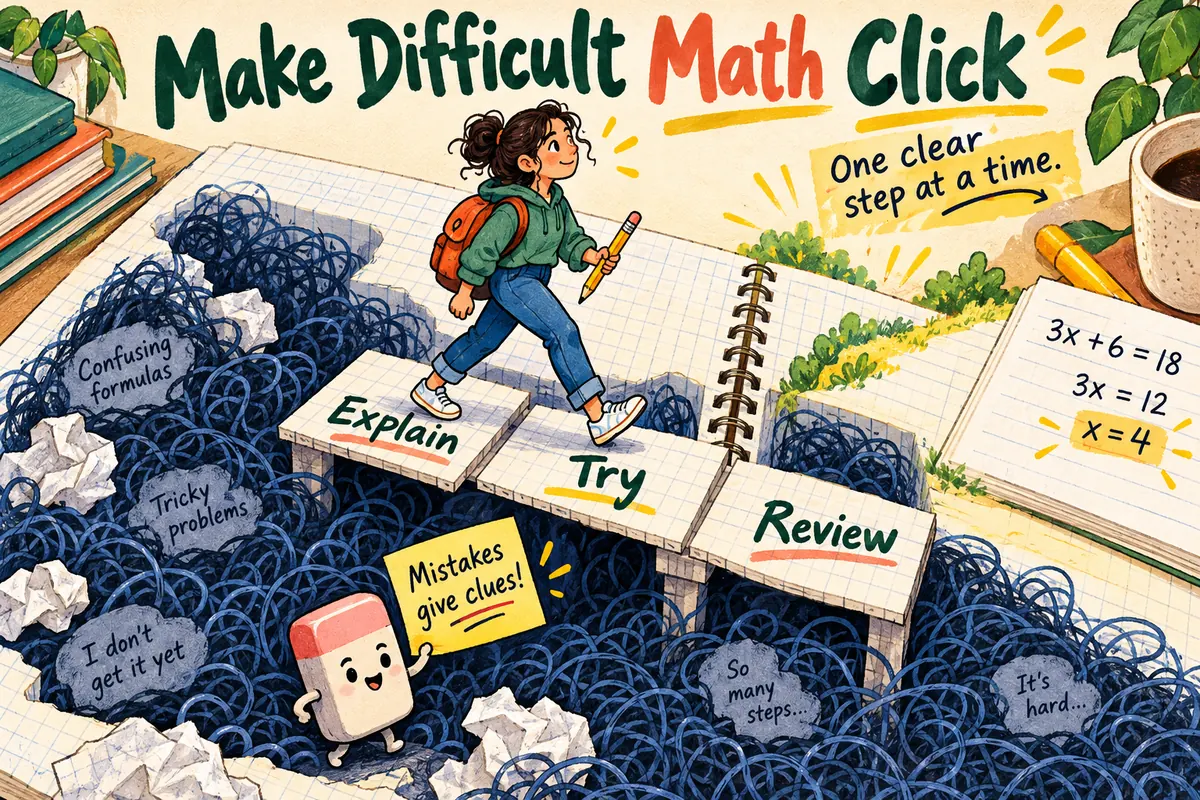
During a lesson, every algebraic step can seem reasonable, yet an unfamiliar homework question later leaves you wondering where to begin.
Students can learn difficult math concepts more effectively by checking prerequisite knowledge, studying explained solutions, and returning to problems across several sessions. A useful study routine connects explanations, independent attempts, and specific feedback so students understand why procedures work and when they apply.
Why do some math concepts seem so difficult?
Difficulty often begins with missing prerequisite knowledge, unfamiliar notation, or uncertainty about what a mathematical question actually requires. Before reviewing an entire chapter, identify the first step you cannot explain.
A problem involving linear equations may actually expose confusion about fractions or negative numbers. Use a short diagnostic check:
- define each symbol and technical term in the question;
- identify the arithmetic or algebraic skills the solution requires;
- complete one simpler example involving the same operation.
Review that specific skill, then retry the original question. Keep your focus narrow enough to identify exactly what changed between the unsuccessful attempt and the corrected solution.
As students gain confidence with individual math problems, they may need to apply the same concepts in larger assignments that involve research, calculations, and written explanations. Managing these projects alongside exams and other coursework can be challenging, especially when several due dates fall within the same week. When a major university task becomes difficult to organize, turning to capstone project writing services can help students develop clear arguments, present findings effectively, and benefit from time-saving features when managing tight deadlines. The guidance can be useful for academic tasks that combine mathematical analysis with written explanations, requiring learners to communicate their methods and conclusions clearly. By planning their work in stages, students can allocate enough time to review calculations, correct mistakes, and revisit concepts they find difficult. A structured approach makes demanding assignments more manageable while helping learners strengthen their problem-solving skills and apply mathematical knowledge with greater confidence.
How can worked examples improve mathematical understanding?
Worked examples reveal the reasoning behind a solution, giving students a starting point for independent problem-solving. Pay attention to the choices behind each calculation, especially where a new operation or unfamiliar rule appears.
Choose an example with explanations beside the calculations, then follow this sequence:
- Read the problem and predict which mathematical relationship might help.
- Examine the solution and explain the purpose of each operation.
- Cover the example and attempt a similar problem independently.
- Compare both solutions and investigate the first difference in reasoning.
As the method becomes familiar, complete a partially solved example before moving to a question without hints.
How should you explain each algebraic step?
Explain each algebraic step by naming the operation and the mathematical property that justifies it. For 3x + 6 = 18, subtracting six from both sides preserves equality.
Dividing both sides by three isolates the variable, while substituting four into the original equation confirms the solution. Describing those decisions demonstrates more understanding than remembering where the numbers moved.
Challenge your explanation with a different equation to check whether you can connect the procedure with a general principle.
How can diagrams clarify abstract mathematical relationships?
Diagrams clarify abstract relationships by connecting symbols with quantities, positions, or changes that students can inspect. Pair each drawing with a verbal explanation that connects its labels and measurements to the mathematical question.
Consider the function y = 2x + 1. Calculate several coordinate pairs, plot them, and describe what happens when x increases by one.
The graph rises by two units, connecting the coefficient to the line’s slope. Its vertical intercept also gives the constant term a visible meaning.
For geometry, label known lengths and angles before selecting a formula. For fractions, sketch equal partitions and explain what the denominator represents.
How often should students revisit difficult math topics?
Students should revisit difficult math topics across several days, adjusting the time between sessions according to how well they can solve problems independently. Start with a brief review the next day, then return to the material later that week.
During each session, attempt a problem before opening your notes. If you get stuck, identify the missing step and review the explanation that addresses it.
Use your performance to plan the next review. When a method still feels unfamiliar, revisit it sooner; once you can explain it unaided, gradually extend the interval.
Keep a few earlier topics in your weekly practice, especially when new lessons depend on them. Focus each review on a specific question or skill.
Should students mix different types of math problems?
Students should mix familiar problem types once they can follow the basic method for each one. This approach, called interleaving, involves switching between exercises that require different strategies.
An algebra practice set might include solving an equation, simplifying an expression, and working through an inequality.
Before calculating, identify what the question asks and explain why your chosen method fits. Check whether you need a value, an equivalent expression, or a range of possible solutions.
Begin with several examples of a new procedure before adding it to a mixed set. Keep the combinations manageable while you learn to recognize the differences between questions.
After checking your answers, revisit any problem where you chose the wrong method. Write down the clue you missed and apply it to another question.
How can students check whether they understand a concept?
Students can check understanding by solving an unfamiliar problem without notes and explaining why their chosen approach works. Recognizing a familiar solution does not demonstrate that you can produce one independently.
Try a question with different numbers or a different presentation, then justify the method, interpret the answer, and check its plausibility.
Retrieving a formula from memory can form part of this check, but mathematical understanding also requires applying it appropriately. For a geometry problem, explain what each measurement represents before deciding which formula fits the information provided.
Use independent attempts to locate gaps. When you need a hint, record which decision required help and revisit that decision during your next session.
When consulting a digital explanation, predict the next step before revealing it, then attempt a fresh question before reopening the explanation.
What should students do when they keep making the same mistake?
Students should identify why a mistake recurs, correct the reasoning, and test the correction on a fresh problem. Keep a brief error log with the incorrect step, the reason it failed, and the corrected reasoning.
Distinguish an arithmetic slip from a misunderstanding of the method. Losing a negative sign calls for a different response than choosing an unsuitable formula.
If the error remains confusing, bring your working to a teacher, tutor, or study partner. Ask a focused question about the exact step where your reasoning breaks down. For instance, ask why dividing an inequality by a negative number reverses its direction.
After receiving help, solve another problem independently, then return several days later to check whether you can still explain the correction.
What does an effective math study session include?
An effective math study session combines a clear goal, guided explanation, independent practice, and review of mistakes. Choose one manageable objective, perhaps understanding why an equation needs the same operation on both sides.
Work through an explained example, attempt related questions, and finish by identifying what still needs attention. Schedule another attempt before putting the material away.
Measure progress through specific evidence: a method chosen correctly, an error explained, or a problem solved without a hint. Those changes give your next study session a useful starting point.

Related to This Article
More math articles
- Math As The Language Of Chance: An Introduction To Probability
- How to Calculate Limits of Functions
- Derivative of Polar Coordinates: How to Find dy/dx
- Taft-Hartley, the Fair Deal and the Election of 1948
- Point of View, Bias, and Propaganda
- Solicitor general
- First Amendment Freedom of Speech: Rules and Examples
- The Best Grade 8 Math Book for Hawaii Students
- How maths helps in everyday life
- The Best Grade 7 ELA Practice Tests for Minnesota Students





















What people say about "How Students Can Learn Difficult Math Concepts More Effectively - Effortless Math"?
No one replied yet.