Building a Well-Organized Paragraph
You can know every comma rule and still write a paragraph that confuses people. That is because a paragraph is not just a stack of correct sentences — it is a small argument with a shape. The shape is what exam questions about organization are really testing, and it is also what makes your own writing easy to follow.
The good news: the shape is learnable, and it is the same shape almost every time. Once you can see it, you can build it on purpose and spot it (or its absence) in any passage a test puts in front of you.
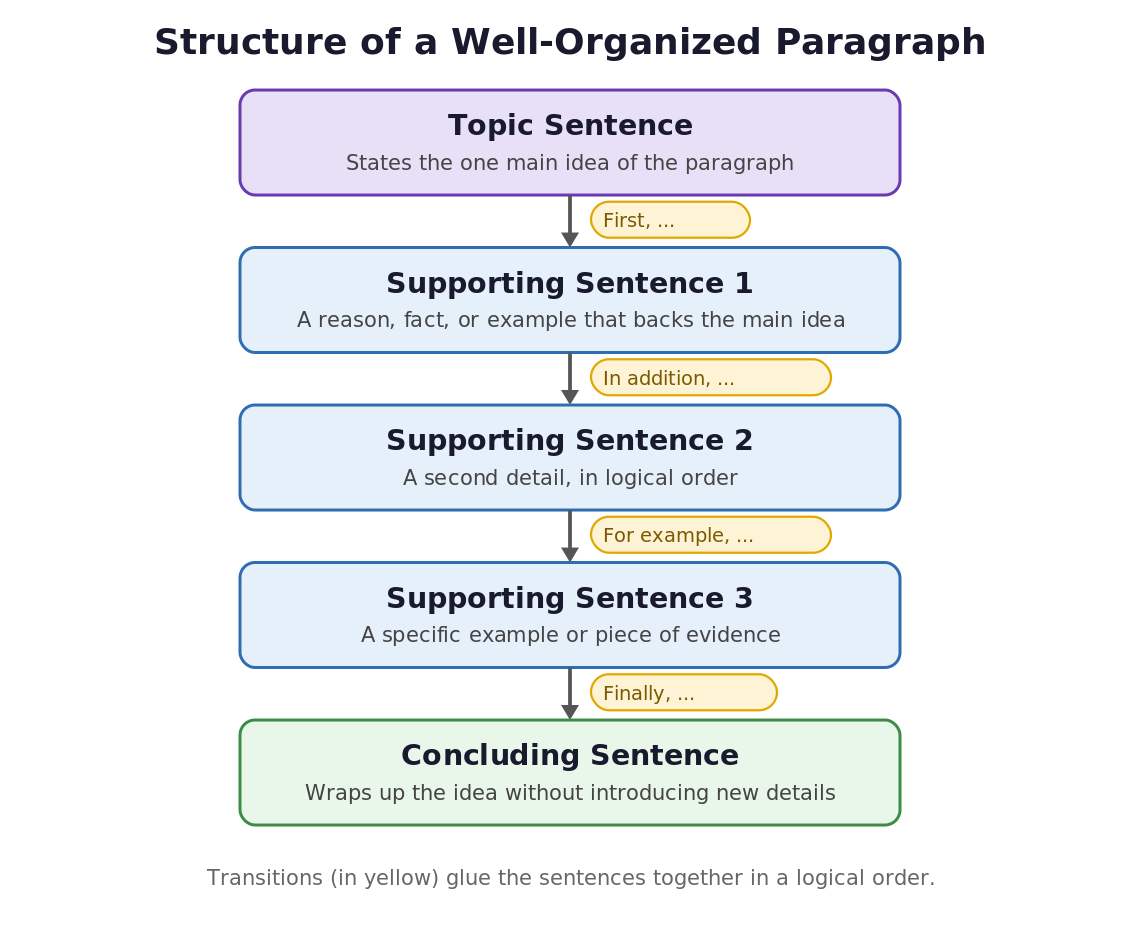
A well-organized paragraph develops one main idea. It opens with a topic sentence that states that idea, continues with supporting sentences arranged in a logical order and connected by transitions, and ends with a concluding sentence that wraps the idea up. Every sentence in the paragraph relates directly back to the topic sentence — anything that does not belongs somewhere else.
What does a topic sentence do?
The topic sentence tells the reader, in one sentence, what the whole paragraph is about. It usually comes first, and it makes a claim that the rest of the paragraph has to earn. Compare these two openers:
- Weak: “There are many things to say about night-shift nursing.”
- Strong: “Night-shift nurses need deliberate sleep strategies to stay sharp on the job.”
The weak version could be followed by anything, so it guides nothing. The strong version commits to one idea — sleep strategies — and every later sentence can be checked against it. That checking step is exactly what test questions mean when they ask which sentence “does not belong” in a paragraph.
How should supporting sentences be ordered?
Supporting sentences are the reasons, facts, and examples that back up the topic sentence. What matters is that they follow a logical order the reader can feel. The three most common orders are:
- Time order — first this happened, then that. Natural for processes and instructions.
- Order of importance — either building to the strongest point or leading with it.
- General to specific — a broad statement, then details and examples that make it concrete.
When a question asks where a new sentence should be inserted, identify the paragraph’s order first. A sentence that gives a specific example belongs after the general claim it illustrates, not before it.
How do transitions hold a paragraph together?
Transitions are the signal words that tell the reader how the next sentence relates to the last one. They are small, but they carry the logic. A quick reference:
| The sentence is adding… | Useful transitions |
|---|---|
| another point | in addition, also, furthermore |
| an example | for example, for instance, in particular |
| a contrast | however, on the other hand, in contrast |
| a result | as a result, therefore, consequently |
| a step in time | first, next, then, finally |
Choose the transition that matches the actual relationship. A “however” in front of a sentence that agrees with the previous one is a wrong answer waiting to be picked.
How do I fix a scrambled paragraph? A worked example
Exams love to hand you sentences out of order. Here are five, scrambled:
- A. Finally, keep the room dark and cool so daytime sleep is as deep as possible.
- B. Night-shift nurses need deliberate sleep strategies to stay sharp on the job.
- C. First, they should sleep on a fixed schedule, even on days off.
- D. In addition, short naps before a shift can reduce errors in the early morning hours.
- E. With habits like these, working nights does not have to mean working exhausted.
Work the routine: B is the topic sentence — it makes the claim the others support. C announces itself with “First,” so it leads the support. D says “In addition,” so it follows C. A says “Finally,” closing the list of strategies. E looks back at all of it (“habits like these”) without adding a new detail — a classic concluding sentence. Correct order: B–C–D–A–E. Notice that the transitions alone nearly solve the puzzle.
What is my paragraph-building routine?
- Write one topic sentence that makes a single, specific claim.
- List two to four supports: reasons, facts, or examples.
- Put the supports in a deliberate order — time, importance, or general to specific.
- Add a transition to each support that names its relationship to the sentence before.
- Close with a sentence that restates the idea in fresh words, adding nothing new.
- Reread and delete any sentence that does not point back at the topic sentence.
Watch: A Short Video Lesson
Smrt English walks through this skill clearly in a few minutes. It is a helpful companion to the reading above:
Practice: can you spot the structure?
- Which sentence states a paragraph’s main idea?
- A paragraph about a hospital’s history describes 1950, then 1985, then 2010. Which order is it using?
- Which transition best introduces a sentence that contradicts the one before it: “for instance,” “however,” or “as a result”?
- A paragraph argues that hand-washing prevents infection. Which sentence does not belong: (a) “Soap breaks down the outer layer of many germs.” (b) “Alcohol rubs are effective when soap is unavailable.” (c) “The cafeteria recently updated its lunch menu.”
- What is the job of a concluding sentence?
- You must insert “For example, one clinic cut infections by a third after adding sanitizer stations.” Should it go before or after the general claim it supports?
Answers
- The topic sentence.
- Time (chronological) order.
- “However” — it signals contrast.
- (c). The menu has nothing to do with hand-washing; it fails the point-back test.
- To wrap up the paragraph’s one idea without introducing new information.
- After — specific examples follow the general statements they illustrate.
Where this fits in your prep
Paragraph organization sits at the top of the language-skills ladder, so it draws on almost everything else. Keep building with our English and language usage hub, sharpen the glue words in transitions and conjunctive adverbs, keep sentences in matching shapes with parallel structure, trim the fat using wordiness and word-order fixes, and put it all together by editing a whole passage.
Recommended Prep Books
These study guides and practice books help you keep building momentum as you prepare:

Related to This Article
More math articles
- Binary, Decimal & Hexadecimal Converter (Free, with Steps)
- Equivalent Fractions for 4th Grade
- Push polls
- AI Contract Makers: How to Make Drafting Easier
- 12 Math Apps for Students in 2026: Free and Paid Options
- Interpreting Cell-Cycle Experiments: Data and Worked Examples
- Social Control and Sanctions
- Top 10 3rd Grade STAAR Math Practice Questions
- How long Is the ACCUPLACER Test?
- The Most Useful AI Tutors for Math Education





















What people say about "Building a Well-Organized Paragraph: Structure That Works"?
No one replied yet.