Indiana Algebra 1 Free Worksheets: Free Skill-Targeted Algebra 1 Worksheets with Answer Keys

It helps to picture Algebra 1 as a workshop rather than a classroom. Before this year, math was largely about following directions, finish the calculation, simplify the fraction, run the algorithm. Algebra 1 changes the job description. Now your student isn’t just running the algorithm; they’re choosing it. Which method solves this quadratic, factoring or the formula? Which form of a line answers this question, slope-intercept or point-slope? Which inequality matches this real situation? The course hands a student a kit of tools and asks them, day after day, to pick the right one. That kind of judgment doesn’t come from a lecture. It comes from working enough problems that the right tool starts to feel obvious.
These 60 worksheets are designed to build that judgment, one tool at a time. A ninth grader in Indianapolis finishing a problem set after dinner, a Fort Wayne freshman catching up on a snow day, an Evansville homeschooler working at a steady self-paced clip, a South Bend student fitting math practice between sports and a part-time job. They all benefit from the same simple approach. Find the skill that wobbles. Work it on a focused page. Move on. Tomorrow, find the next one.
Every PDF on this page is aligned to the Indiana Algebra 1 standards. Each one is one skill. Each one is a short, finishable sitting.
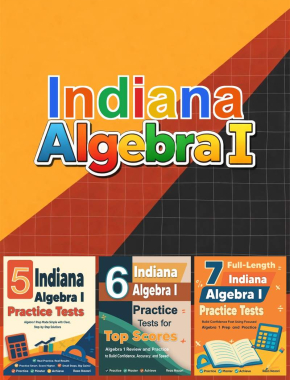
What’s on this page
Sixty single-skill worksheets, aligned to the Indiana Algebra 1 standards, which follow the Common Core framework. The set covers every major topic in the course: algebraic expressions, the properties of operations, every level of linear equation from one-step through literal, inequalities and compound inequalities, absolute value, the formal idea of a function with domain and range, arithmetic and geometric sequences, slope and rate of change, the equation of a line in three forms, parallel and perpendicular lines, direct and inverse variation, systems of equations and inequalities, linear-quadratic systems, the rules of exponents, polynomial operations, special products and factoring, factoring trinomials, solving quadratics by factoring, completing the square, the quadratic formula, plus statistics, probability, and exponential models to close.
Each PDF follows the same shape so a student isn’t relearning the format every time. The opening page is a Quick Review: the skill in plain language, one example carried through with every step visible, and a short note on the typical slip. Then 12 practice problems that build from straightforward into harder territory. Then a student-facing answer key written like a patient tutor, short explanations, every step shown, the kind of writing a ninth grader can read alone and actually understand. No login, no email, no signup. The PDF prints, and the work begins.
Foundations of Algebra
Foundations come first, writing and evaluating expressions, honoring the order of operations, and stretching the ideas into everyday money math. It’s a frequent early hurdle for learners in Indianapolis and across the state.
Solving Linear Equations
Solving linear equations takes center stage, progressing from quick solves to multi-step reasoning and formula rearrangement. These worksheets give Indiana students focused, low-pressure practice.
- Solving One-Step Equations
- Solving Two-Step Equations
- Solving Multi-Step Equations
- Equations with Variables on Both Sides
- Literal Equations and Formulas
Inequalities and Absolute Value
Inequalities behave like equations but answer with a range, and absolute value adds the idea of distance from zero. For Indiana students, fluency here shows up directly on the Indiana Algebra 1 course.
- Solving One-Step Inequalities
- Solving Multi-Step Inequalities
- Compound Inequalities
- Absolute Value Equations
Relations, Functions, and Sequences
Students formalize relations and functions, read domain and range, and meet arithmetic and geometric sequences. Getting comfortable here pays off all the way through the Indiana Algebra 1 course.
- Function Notation and Evaluating Functions
- Domain and Range
- Graphing Functions and Transformations
- Arithmetic Sequences as Linear Functions
- Geometric Sequences
- Piecewise Functions
- Inverse Functions
Linear Functions and Their Graphs
Students graph and write linear functions, connect slope to rate of change, and explore direct and inverse variation. Time spent here is time saved when the Indiana Algebra 1 course rolls around.
- Slope and Rate of Change
- Slope-Intercept Form
- Point-Slope Form
- Standard Form of a Linear Equation
- Writing Linear Equations from Graphs and Tables
- Parallel and Perpendicular Lines
- Inverse Variation
- Understanding Graphs as Solution Sets
Systems of Equations and Inequalities
Systems of equations, and inequalities, anchor this unit, with three solution methods and applied problems. Across Indiana, this is one of the skills that rewards regular reps.
- Solving Systems by Graphing
- Applications of Systems of Equations
- Systems of Linear Inequalities
- Solving Linear-Quadratic Systems
Exponents, Polynomials, and Real Numbers
Exponent laws and polynomial work drive the unit, with special products and the real-number system rounding it out. It is worth the extra reps for Indiana learners aiming for a strong score on the Indiana Algebra 1 course.
- Properties of Exponents
- Adding and Subtracting Polynomials
- Multiplying Polynomials
- Special Products of Polynomials
Factoring
Factoring runs multiplication in reverse, pulling out common factors, factoring trinomials, and spotting special patterns. Indianapolis families can use these pages to lock the skill in before it’s tested.
- Greatest Common Factor and GCF Factoring
- Factoring Trinomials: \(x^2 + bx + c\)
- Factoring Trinomials: \(ax^2 + bx + c\)
- Factoring Special Products
Quadratic Functions and Equations
Students explore quadratic functions and solve them several ways, with the discriminant predicting the number of solutions. In Indianapolis classrooms it tends to separate confident students from hesitant ones.
- Graphing Quadratic Functions
- Characteristics of Quadratic Functions
- Solving Quadratics by Factoring
- Solving Quadratics by Completing the Square
- Solving Quadratics by Square Roots
- The Discriminant
- The Quadratic Formula
Statistics and Probability
The chapter turns to data and chance, measures of center and spread, graphical displays, and counting and probability. Steady practice now makes the Indiana Algebra 1 course feel far more manageable later.
- Measures of Center and Spread
- Scatter Plots and Correlation
- Lines of Best Fit and Predictions
- Counting Principles
- Probability
- Two-Way Frequency Tables
Exponential Functions and Modeling
Exponential functions round out the course, modeling rapid growth or decay and contrasting model types. Master it early and the rest of the Indiana course leans on it with ease.
More Topics
- Absolute Value Inequalities
- Direct Variation
- Displaying Data with Box Plots
- Displaying Data with Histograms
- Exponential Decay
- Graphing Cube Root Functions
- Graphing Square Root Functions
How to use these worksheets at home
The most effective habit is doing related skills in their natural order, on consecutive sittings. The Algebra 1 sequence is full of small ladders: “Solving Two-Step Equations” before “Solving Multi-Step Equations.” “Slope and Rate of Change” before “Slope-Intercept Form.” “Factoring Trinomials” before “Solving Quadratics by Factoring.” Each pair is one idea, slightly extended. When you work them in order across a few days, the second worksheet feels lighter than the first did, because it is, and that lightening is where a student begins to trust their own reasoning. Skill-by-skill practice in pairs is also faster than topic-roulette, because each session carries something forward from the last.
A ninth grader is fourteen or fifteen, old enough to handle their own practice and old enough to resist a parent who tries to teach the math at them mid-problem. The parent role at this age is quieter. Print the page the night before. Leave it on the desk. Keep the answer key nearby but not visible. After the work is done, sit with your student for ten minutes and walk only the problems that came out wrong, reading the answer-key explanation aloud and letting them point to where the slip happened. That short post-mortem is where the real learning happens, and it’s why we keep the answer keys student-facing, written for the kid in the chair to read, not the adult next to them.
Indiana school weeks have their own pattern, early-out Wednesdays in some districts, a packed winter sports schedule, county fair weeks that take whole evenings off the calendar. Don’t fight to keep a fixed practice hour. Fight to keep the habit returning at all. Twenty minutes twice a week, even on imperfect days, will keep an Algebra 1 student moving forward through the year.
A note about Algebra 1 in Indiana
Indiana does not currently require a separate statewide Algebra 1 end-of-course exam for graduation. Algebra 1 mastery is measured mainly inside the course, classwork, unit tests, semester exams, and through the state’s broader high school assessment system, which folds Algebra 1 content into its general math measure. The Indiana Algebra 1 standards are aligned to the Common Core framework, so the topics on these worksheets and the topics in your student’s classroom rest on the same framework.
That alignment is exactly why a skill-by-skill set is useful for Indiana families. Without one big end-of-course test pulling the year forward, the right question becomes a local one: which standards does my student own, and which still wobble? The 60 PDFs let you answer it honestly. After each classroom unit, pull the matching worksheets and use them as a private checkpoint. The pages where your student stumbles are the pages worth revisiting later in the spring. Each finished worksheet is one more piece of the course quietly confirmed.
A short closing
Algebra 1 is built one careful page at a time. Bookmark this page, print one PDF tonight on a skill that’s almost solid, and let your ninth grader finish it before bed. From the Region down by Lake Michigan to the Ohio River towns, Indiana kids do good, careful work when the next step is on the desk in front of them. A worksheet tomorrow morning is exactly that step.
New to Algebra? Start with the basics


Related to This Article
More math articles
- GACE Elementary Education Math Flashcards
- Cooley’s Looking-Glass Self
- Top 10 Free Websites for ACT Math Preparation
- PERT Math – Test Day Tips
- 10 Most Common 4th Grade Georgia Milestones Assessment System Math Questions
- Independent expenditures
- Same-Game Parlays: Why That 50/1 Payout Is Smaller Than It Looks
- How to Multiply Matrix? (+FREE Worksheet!)
- How to Find Transformation: Rotations, Reflections, and Translations?
- GED Calculator











What people say about "Indiana Algebra 1: Free Worksheets"?
No one replied yet.