YOUR ATI TEAS 7 STUDY COMPANION
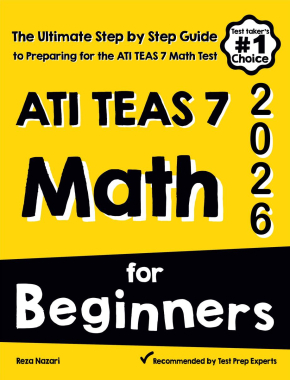
Begin a Captivating Journey with “ATI TEAS 7 Math for Beginners”: The Ultimate Guide and Solutions Handbook
Begin a Captivating Journey with "ATI TEAS 7 Math for Beginners": The Ultimate Guide and Solutions Handbook: this Effortless Math guide explains the topic in plain language, shows how it works through solved examples, and gives you free practice to try…
Begin a Captivating Journey with “ATI TEAS 7 Math for Beginners”: The Ultimate Guide and Solutions Handbook: this Effortless Math guide explains the topic in plain language, shows how it works through solved examples, and gives you free practice to try immediately, so the idea sticks instead of staying abstract.
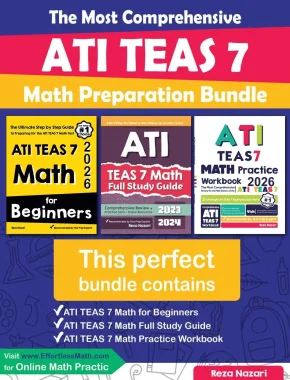
The Absolute Best Book to Ace the ATI TEAS 7 Math Test
Review your Math skills before choosing a book. The free test covers Math only; Complete Prep covers all four TEAS subjects. Loading signup. Open free Math practice now.Try a free TEAS Math test + optional study emails
Start with a free 38-question Math test
ATI TEAS 7 Math Exam Overview and Content
The ATI TEAS 7 (Test of Essential Academic Skills) math section evaluates numeracy and mathematical reasoning skills essential for nursing and health professions. Unlike pure mathematics tests, TEAS questions emphasize practical application in healthcare contexts. Understanding how mathematical concepts apply to patient care, medication dosages, IV flows, and medical calculations is necessary. This guide explains fundamental concepts and provides strategies for tackling each problem type successfully, with emphasis on healthcare applications.
Numbers and Operations: Foundation for Healthcare Math
Strong number skills are essential because patient safety depends on accurate calculations. Fractions appear in medication strengths: if a tablet contains 1/4 grain, how many tablets deliver 1 grain? Convert 1/4 to decimal: 0.25. Divide: 1 ÷ 0.25 = 4 tablets. Decimals appear in dosage calculations where precision is critical. When multiplying decimals, count total decimal places and place the decimal point correctly. For example, 2.5 mg × 1.2 mL = 3.00 mL. Percentages express concentrations: a 5% solution means 5 parts per 100 parts.
Fraction Conversions and Medical Applications
Convert fractions to decimals by dividing the numerator by the denominator: 3/4 = 3 ÷ 4 = 0.75. Convert decimals to percentages by multiplying by 100: 0.75 × 100 = 75%. In healthcare, these conversions enable accurate medication administration. For example, if a patient needs 1/2 of a medication, that’s 0.5 or 50% of the full dose. Adding fractions requires common denominators. If a patient receives 1/4 dose in the morning and 1/3 dose in the evening, find the total: 1/4 + 1/3 = 3/12 + 4/12 = 7/12 of the daily dose.
Percentage Calculations in Clinical Settings
To find 20% of 80 mg: 0.20 × 80 = 16 mg. To find what percentage 12 mL is of 60 mL: 12/60 = 0.20 = 20%. To calculate percent change: (New – Old)/Old × 100%. If a patient’s blood pressure increases from 120 to 130, the percent increase is (130-120)/120 × 100 = 8.3%. Understanding percentages helps interpret lab values, dosage strengths, and statistical data in medical literature.
Ratio Applications in Healthcare
In healthcare, understanding medication ratios is critical. A drug concentration of 1:1000 means 1 part drug per 1000 parts solution. To prepare 500 mL of a 1:5 solution from a 1:1 concentrate, set up the proportion: (1 part concentrate)/(5 parts final solution) = (x mL concentrate)/(500 mL final). Cross-multiply: 5x = 500, so x = 100 mL concentrate plus 400 mL of diluent equals 500 mL of 1:5 solution.
Algebraic Thinking in Medical Problem-Solving
TEAS questions embed algebraic thinking in practical scenarios. Example: “A patient weighs 150 pounds. After treatment, the weight decreases by 10%. What is the new weight?” Calculate the decrease: 150 × 0.10 = 15 pounds. Subtract from original: 150 – 15 = 135 pounds. Alternatively, multiply by the remaining percentage: 150 × 0.90 = 135 pounds. This approach helps solve problems about drug interactions, vital sign changes, and outcome measurements.
Geometry and Measurement in Clinical Practice
Geometry appears in wound measurements and body surface area calculations. A rectangular bandage measuring 6 cm by 8 cm has area 6 × 8 = 48 square centimeters. A cylindrical medication container with radius 2 cm and height 10 cm has volume V = πr²h = π(2)²(10) ≈ 125.6 cubic centimeters. Understanding measurements helps with equipment sizing, storage calculations, and equipment specifications.
Step-by-Step Problem-Solving Methodology
- Read the question carefully and identify the scenario
- Extract relevant numbers and units
- Identify what is being asked for
- Select an appropriate formula or computational method
- Perform calculations systematically
- Check your work and verify reasonableness
- Ensure your answer includes appropriate units
Common TEAS Math Mistakes and Prevention
Misreading percentages causes many errors: 20% off means multiply by 0.80, not 1.20. Unit confusion leads to incorrect calculations, ensure measurements are compatible before computing. Rounding prematurely introduces errors; keep extra decimal places during calculations and round only the final answer. Formula mistakes occur from using the wrong equation; double-check that you’re applying the correct formula for the situation. Contextual errors involve unrealistic answers; medication dosages shouldn’t be negative, for example.
Building Mathematical Confidence for Nursing
Confidence comes from thorough practice. Work through problems daily, focusing on areas where you feel less confident. Time yourself on practice tests to build speed and endurance. Review every mistake carefully to understand what went wrong and why. Connect mathematical concepts to real healthcare scenarios you’ll encounter in nursing practice. By test day, consistent practice should have built your capability to handle any TEAS math problem type accurately and efficiently.
Essential Study Materials
Improve your TEAS math preparation with targeted resources. The Ultimate ACT Math Course covers similar foundational content. GED Math Test-Taking Strategies apply to standardized testing generally. Dosage calculation practice is particularly important for future nursing students, master these calculations now to ensure patient safety in your career.
Progressing Toward Test Success
Your preparation in TEAS math builds not just test success, but foundational skills for nursing practice. Mathematics underpins clinical decision-making, medication safety, and patient care quality. Taking this preparation seriously demonstrates commitment to excellence in your future career.

Related to This Article
More math articles
- Hawaii SBAC Grade 8 Math Free Worksheets: Printable Practice Worksheets with Worked Solutions
- Working Through a Passage Set
- Data, Graphs, and Evidence
- Budgetary controls
- Top 10 Tips You MUST Know to Retake the ISEE Math
- Free Grade 6 English Worksheets for Nevada Students
- 7th Grade NHSAS Math Worksheets: FREE & Printable
- The Best Grade 5 ELA Practice Tests for Tennessee Students
- Tracking, Hidden Curriculum, Credentials, and Unequal Signals
- Measurements – Time









What people say about "ATI TEAS 7 Math for Beginners: Answer Guide"?
No one replied yet.