How to Graph the Cosecant Function?
The cosecant function is the reciprocal of sine where sine is nonzero. Zeros of sine correspond to vertical asymptotes of the cosecant graph.
The cosecant function is the reciprocal of the trigonometric function sine. In this guide, you will learn more about the graph of the cosecant function.

Graph the Cosecant Function: what to notice and how to work it
What to notice first
Common student mistake
Key formulas and cues
A reliable path
- Choose the modelUse a right triangle, the unit circle, or a transformed graph.
- Track unitsConvert degrees and radians when needed.
- Use identitiesReplace complicated trig expressions with equivalent simpler ones.
Worked examples
Find secant asymptotes
- Secant is 1/cosine.
- Asymptotes occur where cosine is 0.
- Cosine is 0 at pi/2 plus multiples of pi.
Find cosecant asymptotes
- Cosecant is 1/sine.
- Asymptotes occur where sine is 0.
- Sine is 0 at multiples of pi.
Try one before moving on
Graph the Cosecant Function: pop-up practice
A step-by-step guide to graphing the cosecant function
The cosecant function is the reciprocal of the trigonometric function \(sin\). Since the cosecant function is the reciprocal of the \(sin\) function, we can write its formula as:
\(\color{blue}{csc (\theta)=\frac{Hypotenuse}{opposite\: side}=\frac{1}{sin\:\theta}}\)
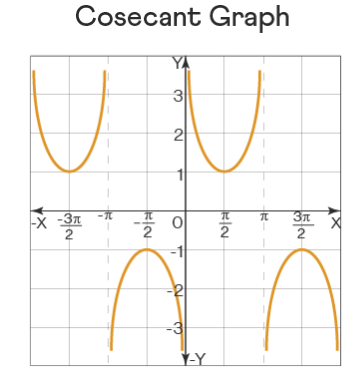
\(cosec x\) is defined for all real numbers except for values where \(sin x\) is equal to zero. Therefore, we have vertical asymptotes at points where \(csc x\) is not defined. Also, using the values of \(sin x\), we have \(y=csc x\) as:
- When \(x = 0\), \(sin x = 0\) \(\rightarrow\) \(csc x =\) not defined
- When \(x = \frac{\pi }{6}\), \(sin x = \frac{1}{2}\)\(\rightarrow\) \(csc x = 2\)
- When \(x =\frac{\pi }{4}\), \(sin x=\frac{1}{\sqrt{2}}\)\(\rightarrow\) \(csc x = \sqrt{2}\)
- When \(x =\frac{\pi }{3}\), \(sin x= \frac{\sqrt{3}}{2}\)\(\rightarrow\) \(csc x = \frac{2}{\sqrt{3}}\)
- When \(x =\frac{\pi }{2}\), \(sin x = 1\)\(\rightarrow\) \(csc x=1\)
Therefore, by drawing the above points on a graph and connecting them, we have the cosecant graph as follows:



Related to This Article
More math articles
- NES Elementary Education Math (103) Worksheets: FREE & Printable
- Theme and How It Is Supported
- The Best Grade 5 Math Book for Nevada Students
- Top 10 Tips to Create an ACT Math Study Plan
- Volume Calculator (3D Solids, with Diagram)
- How to Solve Powers of Products and Quotients? (+FREE Worksheet!)
- How to Solve Rational Exponents and Radicals?
- The Best Books for Math Teachers
- How to Add Mixed Numbers? (+FREE Worksheet!)
- 10 Most Common 5th Grade STAAR Math Questions
What people say about "How to Graph the Cosecant Function"?
No one replied yet.