The Postwar Problem: Lincoln, Johnson, and Competing Reconstructions
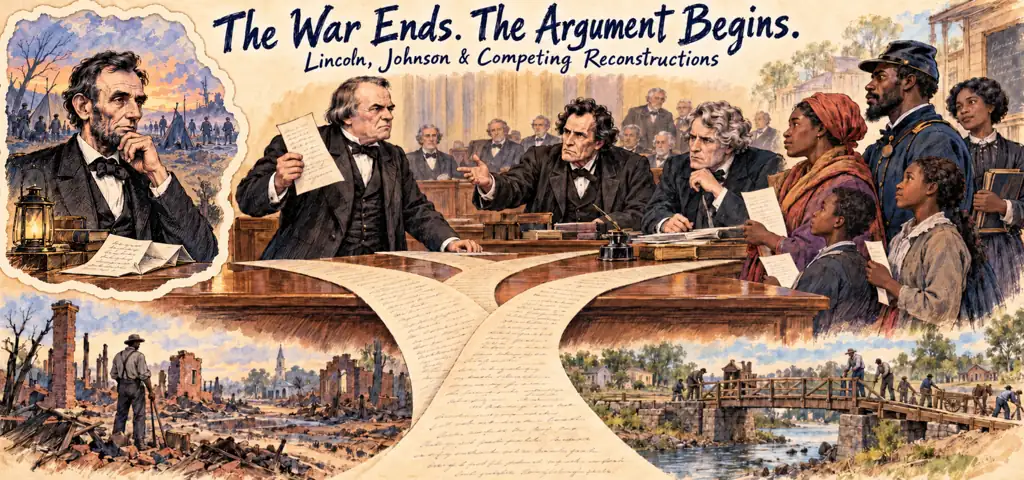
Chapter 1 of the CLEP History of the United States II study guide on Effortless Math covers The Postwar Problem: Lincoln, Johnson, and Competing Reconstructions: the key terms, the core ideas, and worked examples showing how this topic is tested on the exam.
CLEP History of the United States II, Chapter 1
A victory without a settlement
In April 1865, Union armies had defeated the Confederacy, but victory did not settle the politics of emancipation. Eleven states had claimed to leave the Union. Southern roads, farms, and towns were damaged, and nearly four million formerly enslaved people were defining freedom. Widows and disabled veterans also faced a shattered regional economy. The urgent questions were political: Who could restore a state? Would Congress or the president set the terms? Could former Confederate leaders quickly regain power? Above all, would emancipation end legal ownership only, or would it bring enforceable civil and political rights? Reconstruction was the struggle over those answers, not merely the physical rebuilding of the South.
Veterans' support followed the constitutional result of the war
The federal government built a large pension system for Union veterans and their dependents. Former Confederate service did not qualify, because the United States did not recognize rebellion against it as federal military service. Southern states instead created their own Confederate pension and artificial-limb programs, often with far fewer resources. The two systems therefore reflected different governments and fiscal capacities rather than one national veterans program serving both armies.
Lincoln's wartime approach
Abraham Lincoln treated secession as the action of disloyal individuals rather than the lawful destruction of states. His December 1863 Proclamation of Amnesty and Reconstruction offered most Confederates a pardon after an oath of loyalty and allowed a new state government when loyal voters equal to 10 percent of the state's 1860 electorate had taken the oath. The Ten Percent Plan was deliberately lenient: Lincoln hoped to weaken the Confederacy and create loyal governments while war continued. It required acceptance of emancipation but did not guarantee Black suffrage. Because it was an executive wartime initiative, it also provoked a constitutional dispute over whether Congress or the president controlled restoration.
Congress proposes a stricter route
Republicans in Congress feared that a small loyal minority could restore the planter elite without protecting freedpeople. The Wade-Davis Bill of 1864 required a majority of white male citizens in a former Confederate state to take an oath that they had never voluntarily supported the rebellion before forming a government. It also demanded stronger safeguards for emancipation. Lincoln prevented the bill from becoming law with a pocket veto. The contrast matters: Lincoln emphasized rapid reunion and presidential discretion; Wade-Davis embodied congressional control and a harder loyalty test. Neither proposal by itself created racial equality, but their conflict forecast the institutional struggle that followed the war.
Johnson's restoration program
After Lincoln's assassination, Andrew Johnson inherited Reconstruction. A Tennessee Unionist and Democrat placed on the Republican ticket in 1864, Johnson despised wealthy planters yet held deeply racist views and favored white control of Southern politics. In May 1865 he offered pardons to most former Confederates, while wealthy property holders and leading officials could apply to him personally. Provisional governors organized conventions that repealed secession ordinances, repudiated Confederate debts, and ratified the Thirteenth Amendment. Johnson did not require Black voting rights. His numerous individual pardons soon allowed many former Confederate leaders and planters to recover property and political influence.
The clash becomes visible
Southern voters returned prominent former Confederates to office in 1865, while new Black Codes restricted freedpeople's movement and labor. When Congress met in December, Republican majorities refused to seat many Southern representatives. Article I, Section 5 supplied the immediate authority: each chamber judges its members' elections, returns, and qualifications. Congress created the Joint Committee on Reconstruction to investigate conditions. In 1866 Johnson vetoed an expanded Freedmen's Bureau and the Civil Rights Act. Congress overrode him on civil rights and later enacted a new Bureau bill over another veto. The dispute was now constitutional: could the president declare restoration complete, or could Congress demand protections before recognizing representation?
Three competing meanings of reunion
Moderate Republicans generally sought loyal state governments and basic civil equality, while Radical Republicans such as Thaddeus Stevens and Charles Sumner argued that Congress should remake Southern institutions and protect Black political power. Johnson wanted quick restoration with limited federal intervention and no federal guarantee of Black suffrage. Southern white Unionists, former Confederates, and freedpeople added further agendas. Freedpeople held conventions, petitioned officials, built institutions, and demanded land, education, family autonomy, legal equality, and voting rights. The debate therefore cannot be reduced to a two-person argument: different groups agreed that the war was over but disagreed over who belonged to the reconstructed polity.
follow the evidence
A question may present the Ten Percent Plan and Johnson's pardons as evidence of continuity.
Chronology and a common trap
Keep the order straight. Lincoln announced the Ten Percent Plan in 1863; Congress passed Wade-Davis in 1864; Johnson began restoration in May 1865; Congress challenged him in 1866; and the Reconstruction Acts opened congressional Reconstruction in 1867. In Texas v. White (1869), Chief Justice Salmon P. Chase later called the Union "indestructible" and treated Texas's secession ordinance as null. Do not assume that Lincoln's leniency proves he would have followed Johnson's full course. His assassination makes that unknowable. The record supports a narrower claim: Lincoln favored flexible reunion, yet shortly before his death he publicly considered limited suffrage for educated Black men and Black veterans.
distinguish legal freedom from practical access
A state repeals a slave code, but local officials refuse to enforce labor contracts for freedpeople.
Watch the history in motion
This short lesson adds voices, images, and chronology to the ideas you just studied.
Video: RECONSTRUCTION [APUSH Review Unit 5 Topic 10] Period 5: 1844-1877, Heimler's History.
Try four CLEP-style questions
- Which feature most clearly characterized Lincoln's Ten Percent Plan?
- It required a majority of white male citizens to swear that they had not voluntarily supported the rebellion before a state convention could begin.
- It permitted a state government to form after loyal voters equal to 10 percent of the 1860 electorate took an oath.
- It divided former Confederate states into military districts and registered Black male voters.
- It made ratification of the Fourteenth Amendment a condition of congressional representation.
- It required wealthy former Confederates to seek individual presidential pardons before recovering political influence.
- Why did congressional Republicans refuse to accept Johnson's claim that Reconstruction was complete in late 1865?
- They concluded that secession had permanently converted the former states into federal territories.
- They objected that Johnson had conditioned pardons on Black male suffrage.
- Black Codes and the return of former Confederate leaders suggested that emancipation lacked protection.
- They wanted restoration completed under Lincoln's wartime 10-percent threshold without any congressional role.
- They regarded ratification of the Thirteenth Amendment as unconstitutional without former Confederate votes in Congress.
- Which statement best distinguishes Moderate from Radical Republican goals during Reconstruction?
- Moderates generally sought loyal governments and basic civil equality, while Radicals pressed for deeper institutional change and protection of Black political power.
- Moderates demanded immediate confiscation of plantations and permanent military rule, while Radicals made presidential pardons the sole test of national loyalty and state restoration.
- Moderates favored permanent territorial status for the South, while Radicals sought rapid readmission under former Confederate leaders.
- Moderates and Radicals proposed identical terms but disagreed only over which committee should administer them.
- Moderates accepted Johnson's restored governments without further safeguards, while Radicals opposed national civil-rights legislation.
- Which sequence is chronologically correct?
- Ten Percent Plan; Lincoln's assassination; Wade-Davis Bill; Johnson's restoration program
- Wade-Davis Bill; Ten Percent Plan; Johnson's restoration program; Lincoln's assassination
- Lincoln's assassination; Johnson's restoration program; Ten Percent Plan; Black Codes
- Ten Percent Plan; Wade-Davis Bill; Lincoln's assassination; Johnson's restoration program
- Wade-Davis Bill; Johnson's restoration program; Lincoln's assassination; congressional Reconstruction
Check your answers and reasoning
Independent preparation. CLEP is a registered trademark of the College Board, which does not endorse this lesson.

Related to This Article
More math articles
- How to Graph Polar Equations
- Hawaii SBAC Grade 4 Math Free Worksheets: Printable Practice Worksheets with Worked Solutions
- Cycles, Biomes, and Human Effects
- Free Grade 7 English Worksheets for South Dakota Students
- The Best Worksheets for Florida Grade 2 Students
- How to Understand the Fundamental Properties of Parallelograms
- FREE ASTB Math Practice Test
- How to Calculate Mortgage Payments (With Real Examples)
- Free Grade 7 English Worksheets for Tennessee Students
- The Best Algebra 1 Book for Delaware Students




















What people say about "Lincoln, Johnson and Competing Reconstructions"?
No one replied yet.