CLEP U.S. History I 053: Missouri Compromise and Sectional Balance
Lesson 10.3 of Chapter 10 of the U.S. History to 1877 study guide on Effortless Math covers CLEP U.S. History I 053: Missouri Compromise and Sectional Balance: the key terms, the core ideas, and worked examples showing how this topic is tested on the exam.
U.S. History to 1877 | Chapter 10 | Lesson 10.3
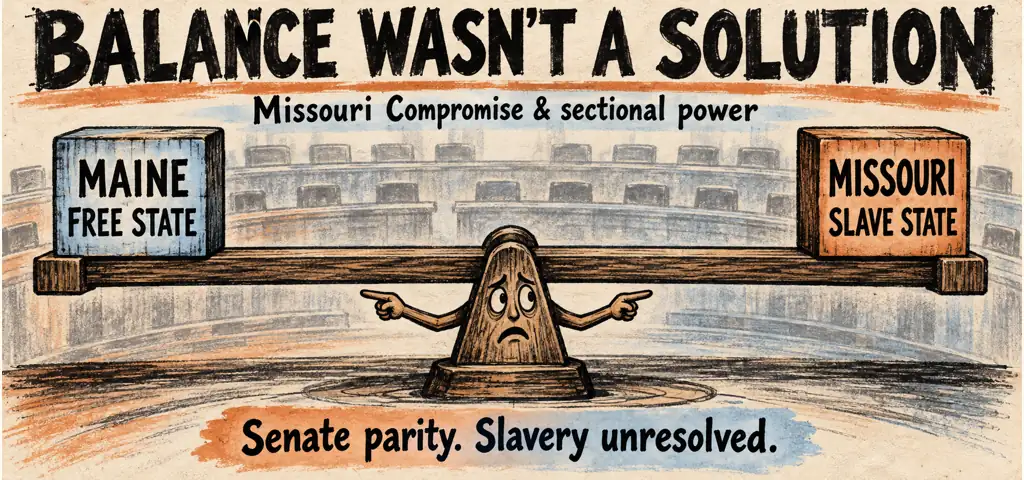
In 1819 Missouri Territory requested admission with slavery. Since the Senate contained an equal number of free and slave states, admission threatened political balance. Representative James Tallmadge proposed restricting further slavery in Missouri and providing gradual emancipation for children born there. The proposal passed the House, where the more populous North had greater weight, but failed in the Senate. Debate exposed different constitutional and moral arguments. Southerners claimed that Congress could not impose special restrictions on a new state and defended slaveholders’ property rights. Restrictionists emphasized congressional power over territories and feared the political expansion of slavery.
The 1820 settlement admitted Maine as a free state and Missouri as a slave state, preserving the Senate balance. It also prohibited slavery in the remaining Louisiana Purchase territory north of latitude 36 degrees 30 minutes, except Missouri. The line did not apply to states already established, and the compromise did not end slavery where it existed. A second dispute arose when Missouri’s proposed constitution excluded free Black people. Henry Clay helped arrange admission in 1821 with a condition that Missouri not violate rights of U.S. citizens, wording that postponed rather than resolved the status of Black citizenship.
The compromise worked institutionally for a generation: it established a rule for much of the Louisiana Purchase and enabled admission without immediate disunion. Yet its very structure made sectional balance explicit. Congressional debate increasingly sorted by free and slave sections rather than by the old Federalist-Republican divide. The three-fifths clause already increased slave-state representation in the House and Electoral College, while Senate parity gave admission decisions enormous significance.
Thomas Jefferson compared the controversy to an alarm in the night because it revealed a geographical line joined to moral and political principle. That insight does not mean civil war was inevitable in 1820. Political choices, later territorial acquisitions, party changes, and resistance would matter. The compromise instead showed that expansion repeatedly forced the nation to decide whether slavery would expand with it.
A focused video lesson
Watch this account from History Savant with one question in mind: which evidence makes the lesson's strongest claim hold up?
Video: Missouri Compromise of 1820 Explained: Balancing Slavery and Sectional Tensions | 3-Minute History, History Savant.
Check your understanding
- The paired admission of Maine and Missouri was intended mainly to preserve
- Senate sectional balance
- House population equality
- British trade privileges
- Native land claims
- judicial review
- The compromise prohibited slavery in most Louisiana Purchase territory
- north of 36°30′, including Missouri
- north of 36°30′, except Missouri
- south of 36°30′, except Arkansas Territory
- west of the Mississippi, including Louisiana
- bordering the existing free states to the east
- Deep Practice: select all that apply. The controversy involved
- congressional power over territories
- status of new states
- political power of slave states
- Black citizenship
- acquisition of California from Mexico
- Deep Practice: open response. Explain why the compromise was both effective and alarming.
Write a brief response using a named fact from the lesson.
Open the answers and reasoning
Independent preparation. CLEP is a registered trademark of the College Board, which does not endorse this lesson.

Related to This Article
More math articles
- How to Solve Equations with Multiple Angles
- The Best Algebra 1 Book for Montana Students
- Open-Economy Macroeconomics and Exchange Rates
- 3rd Grade SBAC Math Worksheets: FREE & Printable
- The Best Grade 4 Math Book for Pennsylvania Students
- Grade 5 Discussion and Research Skills: Stronger Speaking, Listening, Notes, and Sources
- MEC Testing, Exposure, and Corrective Action
- 10 Most Common 4th Grade MAP Math Questions
- Political speech
- 7th Grade NYSE Math FREE Sample Practice Questions














What people say about "The Missouri Compromise and Sectional Balance"?
No one replied yet.