Contagion, Convergence, and Emergent Norms
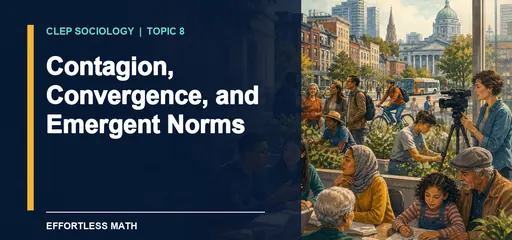
Chapter 8 of the CLEP Sociology study guide on Effortless Math covers Contagion, Convergence, and Emergent Norms: the key terms, the core ideas, and worked examples showing how this topic is tested on the exam.

CLEP Sociology – Chapter 8
Contagion, Convergence, and Emergent Norms
CLEP Introductory Sociology · Chapter 8
Three classic explanations can interpret the same crowded event. Contagion theory emphasizes rapidly transmitted emotion and behavior. Convergence theory emphasizes people with relevant prior tendencies gathering in the same place. Emergent norm theory emphasizes participants reading cues and building a situational rule during uncertainty.
Early contagion accounts pictured anonymity in a crowd as weakening ordinary restraint while excitement spread from person to person. A few frightened riders rush toward one door, nearby riders copy them, and urgency moves through the car. The useful question is whether visible emotion or action spreads through mutual stimulation.
Contagion has limits. It can make a crowd sound like one suggestible mind and can ignore people who remain calm, resist a cue, or interpret it differently. Evidence of simultaneous movement is not enough. Researchers need a sequence showing that exposure to others’ emotion or conduct increased adoption.
Convergence theory begins before the gathering. People who already share a grievance, taste, fear, or readiness for direct action may select the same event. A protest crowd looks united because people with similar commitments arrived there. Prior attitudes, recruitment paths, and self-selection provide the key evidence.
Convergence should not be used merely because participants end up agreeing. If riders entered the train with mixed views and formed a new evacuation rule only after the lights failed, prior similarity cannot carry the explanation. Interviews or surveys taken before an event help show whether the relevant disposition was already present.
Emergent norm theory focuses on interaction inside an unsettled situation. People watch a few visible actors, test possible responses, and notice approval or correction. A temporary standard forms. On the stalled train, riders may begin repeating every message through the car because the first attempts receive thanks and make coordination easier.
Evidence for an emergent norm should identify a rule that was unclear at the start, the actors who modeled it, the responses that supported or challenged it, and the point at which others treated it as expected. Video, timestamped messages, and participant accounts can reconstruct that sequence.
One event can contain all three processes. People already committed to helping may converge near the nurse. Calm can spread as riders copy her tone. A new rule then forms around keeping one side of the aisle open. Theories separate mechanisms, so a researcher can use more than one if the evidence supports distinct parts of the event.
A falsification comparison asks what each account would struggle to explain. Imagine a concert audience that begins moving away from one entrance. If people who could not see or hear early movers change at the same rate, direct interpersonal transmission loses support. If pre-event surveys show no difference between those who moved and those who stayed, selection on a prior tendency becomes less plausible. If no participant can identify a new expectation, model, correction, or moment when conduct became appropriate, an emergent-rule claim is weakened.
Researchers can improve the comparison by combining three records. Entrance surveys measure relevant prior intentions. Time-stamped video reconstructs exposure and adoption. Brief interviews ask what participants thought others expected. A contagion account predicts adoption following exposure even after prior intention is held constant. A convergence account predicts that preexisting intention sorts people into the action. An emergent norm account predicts that approval, correction, or a visible model changes what participants treat as proper in the setting. None of these patterns follows from a final head count alone.
The dependent variable must also be precise. Prior willingness may explain who approached the front, while a newly formed rule explains why those people sat down at a particular signal. Emotional transmission may explain the speed of a later exit. One event can therefore support several mechanisms at different stages. The researcher assigns each claim to a distinct outcome and time window, then asks which expected evidence is absent as well as which evidence is present.
Quick review: Emotional transmission points to contagion. Prior dispositions and selection point to convergence. A new situational rule formed through cues, modeling, and response points to emergent norm theory. Evidence about timing separates them.
Watch the chapter connection
How Societies Change gives you a second explanation of the chapter ideas surrounding this lesson. As you watch, pause when the lesson concept appears and explain how the example fits.
Use this lesson for CLEP practice
Write one original example, one close nonexample, and one observation that would help you choose between them. This turns vocabulary recognition into the kind of applied reasoning the exam expects.

Related to This Article
More math articles
- The Ultimate 6th Grade OST Math Course (+FREE Worksheets)
- Formation of political attitudes
- How to Pass the FTCE Math Test?
- Supporting Details
- Powers and Functions of Congress
- Comte, Martineau, and Spencer
- 5th Grade RISE Math Worksheets: FREE & Printable
- Grade 7 Informational Reading: Central Idea, Claims, and Text Structure Strategies
- Biotechnology: PCR, DNA Gels, and Gene Editing
- CLEP U.S. History I 066: Indian Removal and Native Resistance



















What people say about "Contagion, Convergence, and Emergent Norms | CLEP Sociology"?
No one replied yet.