CLEP U.S. History I 054: Monroe Doctrine and Hemispheric Diplomacy
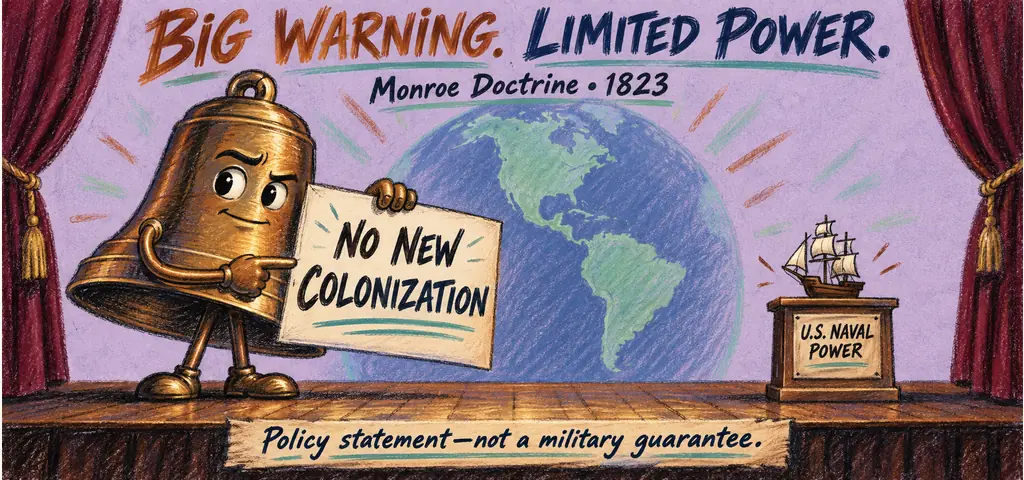
Lesson 10.4 of Chapter 10 of the U.S. History to 1877 study guide on Effortless Math covers CLEP U.S. History I 054: Monroe Doctrine and Hemispheric Diplomacy: the key terms, the core ideas, and worked examples showing how this topic is tested on the exam.
U.S. History to 1877 | Chapter 10 | Lesson 10.4
By the early 1820s, most Spanish American colonies had won or were winning independence. U.S. officials welcomed new republics and expanded commercial opportunity, while worrying that European monarchies might help Spain restore its empire. Russia’s claims and trading restrictions in the Pacific Northwest added concern. Britain also opposed renewed Spanish monopoly because British merchants benefited from independent Latin American markets.
British foreign secretary George Canning proposed a joint Anglo-American declaration against European recolonization. Secretary of State John Quincy Adams advised President Monroe to issue an independent statement instead of appearing to follow Britain. In his 1823 annual message, Monroe announced several linked principles. The Western Hemisphere was no longer open to new European colonization. European efforts to impose their political system or control newly independent American nations would be viewed as dangerous to U.S. peace and safety. In return, the United States would not interfere in existing European colonies or Europe’s internal wars.
The Monroe Doctrine was a unilateral policy statement, not a treaty or immediate military guarantee. The United States lacked the naval power to enforce it throughout the hemisphere. Britain’s Royal Navy and British commercial interests indirectly discouraged European intervention. No European coalition was then poised to recolonize all Latin America, so the declaration’s immediate test was limited. Its long-term importance came from later invocation. Nineteenth- and twentieth-century leaders expanded it from opposition to European intervention into claims of a special U.S. role in the hemisphere, sometimes against Latin American wishes.
The doctrine combined anticolonial language with national ambition. It recognized the political change created by Latin American independence and warned older empires. Yet U.S. leaders did not necessarily accept racial equality, fully support every revolutionary movement, or abandon territorial expansion. Latin American governments could welcome protection from European reconquest while distrusting U.S. power. Perspective matters.
See the history take shape
This HISTORY250 lesson supplies a second explanation of the same period. Note where chronology, cause, and perspective connect.
Video: The Monroe Doctrine Explained: America's Warning to Europe (1823) | Ep36, HISTORY250.
Check your understanding
- The Monroe Doctrine warned primarily against
- European diplomatic recognition of the new Latin American republics
- continued European possession of colonies already held in the Americas
- British commerce with independent nations in the Western Hemisphere
- new European colonization or political intervention in the Americas
- boundary negotiations between the United States and Spain
- Its practical credibility depended heavily on
- military guarantees from the new Latin American republics
- American troops stationed along the Canadian boundary
- British naval power and Britain’s interest in preventing recolonization
- a formal military alliance between the United States and France
- permanent United States naval squadrons throughout the Caribbean
- Deep Practice: select all that apply. The doctrine included
- noncolonization
- opposition to European political intervention
- U.S. noninterference in European internal wars
- acceptance of existing European colonies
- a mutual-defense alliance with the newly independent republics
- Deep Practice: open response. Explain why Latin American leaders could welcome and distrust the doctrine at the same time.
Write a brief response using a named fact from the lesson.
Open the answers and reasoning
Independent preparation. CLEP is a registered trademark of the College Board, which does not endorse this lesson.

Related to This Article
More math articles
- 8th Grade OSTP Math Worksheets: FREE & Printable
- Free GED Math Worksheets [Updated for 2026]
- The History of Random Number Generation: From Dice to Quantum Chips
- Free Grade 6 English Worksheets for Wisconsin Students
- How to Graph a Horizontal or Vertical line?
- 8th Grade WVGSA Math Worksheets: FREE & Printable
- Free Utah Grade 2 Math Worksheets
- 5th Grade SC Ready Math Worksheets: FREE & Printable
- Free Grade 6 English Worksheets for Michigan Students
- Advanced Vocabulary Words: Ostracize to Potable




















What people say about "The Monroe Doctrine and Hemispheric Diplomacy"?
No one replied yet.