CLEP U.S. History I 055: Election of 1824 and the Changing Party System
Lesson 10.5 of Chapter 10 of the U.S. History to 1877 study guide on Effortless Math covers CLEP U.S. History I 055: Election of 1824 and the Changing Party System: the key terms, the core ideas, and worked examples showing how this topic is tested on the exam.
U.S. History to 1877 | Chapter 10 | Lesson 10.5
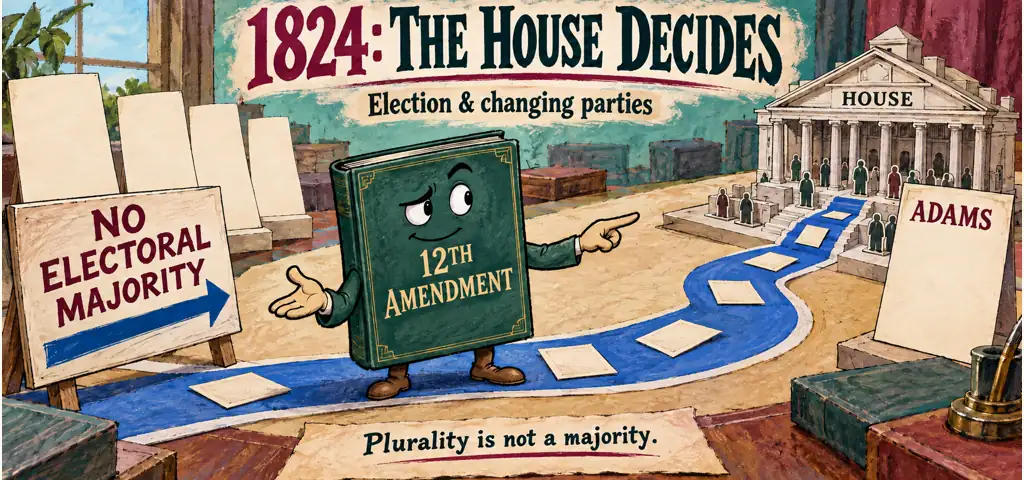
The collapse of the Federalist Party left several ambitious Republicans competing inside one broad organization. By 1824, the congressional caucus that had once nominated presidential candidates had lost legitimacy. Four candidates with regional bases won electoral votes: Andrew Jackson, John Quincy Adams, William Crawford, and Henry Clay. Jackson won the most popular votes reported and the most electoral votes, but not an Electoral College majority. Under the Twelfth Amendment, the House selected from the top three electoral finishers, with each state delegation casting one vote. Clay, who had finished fourth and was Speaker of the House, could not be selected but influenced the House. He supported Adams, who won.
Adams then appointed Clay secretary of state. Jackson’s supporters charged a “corrupt bargain”: Clay’s support in exchange for office. No conclusive evidence proves an explicit deal. Politically, proof mattered less than plausibility. The secretaryship was prestigious and had often led to the presidency. The sequence allowed Jacksonians to portray the outcome as elite manipulation against the people’s choice. Constitutionally, however, the House had acted through the prescribed procedure because no candidate held an electoral majority.
Adams proposed an ambitious national program of roads, canals, scientific institutions, and economic development. Opponents blocked much of it and attacked it as extravagant or unconstitutional. They also used the administration to build a durable coalition around Jackson. Martin Van Buren helped organize this new Democratic Party, uniting southern planters, western voters, and many northern workers through newspapers, committees, and disciplined campaigning. Adams supporters and economic nationalists would become National Republicans and then a core of the Whig Party.
The rematch in 1828 featured intense personal attacks and much wider white male voting participation than earlier elections, as many states had removed property requirements. Jackson won decisively. The transition did not create democracy for everyone: racial restrictions hardened in some states, women remained excluded from formal voting, and Native sovereignty faced greater danger. It did mark a shift toward mass parties, popular campaigning, and a presidency claiming a direct popular mandate.
Watch, then test the claim
The Daily Bellringer traces the people and chronology behind this lesson. Listen for the evidence that sharpens the written account, then try the questions below.
Video: Election of 1824 | Daily Bellringer, The Daily Bellringer.
Check your understanding
- The House decided the 1824 election because
- two candidates received the same national popular vote
- the leading candidates tied in the Electoral College
- several state electors declined to cast their ballots
- the Senate rejected the certified electoral returns
- no candidate received a majority of electoral votes
- The “corrupt bargain” accusation centered on
- Clay’s support for Adams followed by his appointment as secretary of state
- Calhoun’s withdrawal followed by an appointment as treasury secretary
- Crawford’s transfer of electors in exchange for a new bank charter
- Van Buren’s delivery of New York votes followed by a judicial appointment
- Monroe’s support for Adams followed by retention of his cabinet
- Deep Practice: select all that apply. Changes surrounding 1824-1828 included
- mass campaigning
- broader white male suffrage
- disciplined party organization
- a stronger popular-mandate claim
- universal adult suffrage
- Deep Practice: open response. Why could the House result be constitutional yet politically damaging?
Write a brief response using a named fact from the lesson.
Open the answers and reasoning
Independent preparation. CLEP is a registered trademark of the College Board, which does not endorse this lesson.

Related to This Article
More math articles
- Top 10 3rd Grade NYSE Math Practice Questions
- Advanced Vocabulary Words: Ostracize to Potable
- CLEP U.S. History I 044: Alien and Sedition Acts and the Election of 1800
- How to Translate Phrases into an Algebraic Statement? (+FREE Worksheet!)
- The Best Grade 8 Math Book for West Virginia Students
- TOEFL Score Scale and Rounding: Read Your Report (2027 Prep)
- Commerce and slave-trade compromises
- Full-Length ACT Math Practice Test-Answers and Explanations
- HiSET Math Formulas
- CLEP U.S. History I 051: Marshall Court and Judicial Review




















What people say about "The Election of 1824 and Party Realignment"?
No one replied yet.