CLEP U.S. History I 056: Roads, Canals, Steamboats, Railroads, and Telegraph
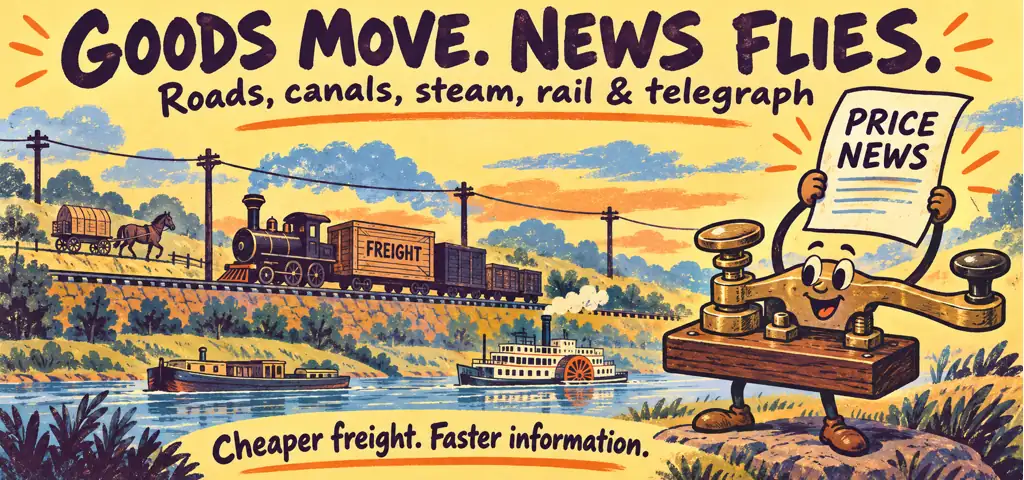
Lesson 11.1 of Chapter 11 of the U.S. History to 1877 study guide on Effortless Math covers CLEP U.S. History I 056: Roads, Canals, Steamboats, Railroads, and Telegraph: the key terms, the core ideas, and worked examples showing how this topic is tested on the exam.
U.S. History to 1877 | Chapter 11 | Lesson 11.1
Markets expand when moving goods, people, prices, and instructions becomes cheaper and more reliable. The federally supported National Road crossed the Appalachians from Maryland toward the Ohio Valley. Private turnpikes and state roads filled other routes, although tolls and poor surfaces remained. Robert Fulton’s commercially successful steamboat service demonstrated that steam power could move against currents. River transport helped connect western farms and southern plantations to New Orleans, while boilers, snags, and seasonal water made travel dangerous.
New York’s Erie Canal, completed in 1825, linked the Hudson River to Lake Erie. Freight costs and travel time between the Great Lakes and Atlantic fell sharply. New York City became the leading commercial port, canal towns expanded, and western farmers gained access to eastern consumers. Other states borrowed heavily for canals, with mixed financial results. Infrastructure redirected trade rather than benefiting every place equally.
Railroads grew rapidly from the 1830s. They could travel where waterways did not and operate on more flexible schedules, though early lines used incompatible gauges and required large capital. By the 1850s rail networks joined northeastern and midwestern markets more tightly than they joined the plantation South. Samuel Morse’s telegraph, first demonstrated on a major Washington-Baltimore line in 1844, separated information from physical transport. Merchants could learn prices before goods arrived. Newspapers could transmit reports quickly. Railroad dispatching became safer.
Government and private enterprise were partners. States chartered corporations, purchased stock, granted rights of way, and sometimes financed construction. Federal surveys, roads, postal policy, and land grants also mattered. “Private innovation” alone therefore misses public choices. So does a purely triumphant story: canals altered watersheds, rails crossed Native lands, accidents killed workers and passengers, and communities bypassed by routes could decline.
Watch the topic in context
Use this lesson from Matthew Nawn to review the period and its central historical problem. Pause when the video reaches the turning point named above.
Video: Transportation Revolution in the United States, Matthew Nawn.
Check your understanding
- The Erie Canal most directly connected Great Lakes producers to
- the Mississippi route through New Orleans
- New York’s Hudson River route
- Pennsylvania’s Main Line canal
- the National Road to Baltimore
- the St. Lawrence route to Montreal
- Compared with a canal or railroad, the telegraph’s distinctive contribution was faster movement of
- bulk grain between regions
- passengers on fixed schedules
- manufactured goods to interior markets
- price and dispatch information
- coal from mine to factory
- Deep Practice: select all that apply. Public support for transportation included
- charters
- stock purchases
- land grants
- surveys and roads
- a ban on private capital
- Deep Practice: open response. Explain how one route could produce regional growth and regional decline at the same time.
Write a brief response using a named fact from the lesson.
Open the answers and reasoning
Independent preparation. CLEP is a registered trademark of the College Board, which does not endorse this lesson.

Related to This Article
More math articles
- The Ultimate 6th Grade Common Core Math Course (+FREE Worksheets)
- The Ultimate AFOQT Math Course (+FREE Worksheets & Tests)
- North Dakota NDSA Grade 5 Math Prep, the Calm Way: 49 Free Single-Skill Worksheet PDFs
- 10 Most Common 8th Grade Georgia Milestones Assessment System Math Questions
- Intelligent Math Puzzle – Challenge 93
- 8th Grade DCAS Math Worksheets: FREE & Printable
- Electromagnetic Waves and Communication
- 10 Most Common 6th Grade IAR Math Questions
- Best Graphing Calculators for Precalculus
- Progressivism, Muckraking, Pragmatism, and Social Investigation




















What people say about "Roads, Canals, Railroads and the Telegraph"?
No one replied yet.