Praxis 8005 Phase-Change Questions: Heating Curves (2027 Prep)
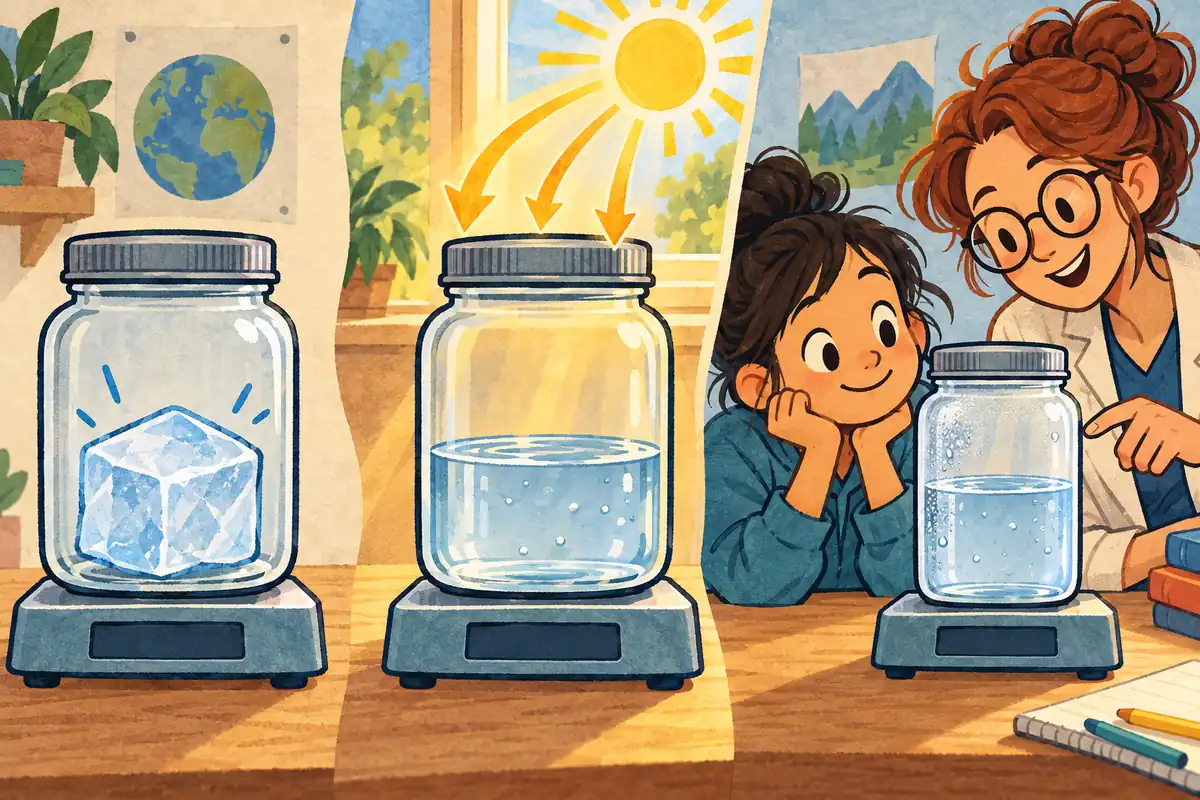
The ice cube is gone, but the water is still in the sealed bag. The scale sees the bag and what remains inside it. To read the result, separate the substance, energy crossing the boundary, and the temperature. They answer different questions about the system.
That same separation helps on Praxis 8005 items, where you may need to distinguish a sample temperature from its state. Matter is the substance you track. Energy can cross a system boundary or change form. A phase change leaves the substance the same unless the evidence points to a chemical reaction.
These are original practice examples, not ETS questions. The same lab setup will carry us through this article. Begin with the boundary. Then follow the energy and track the matter.
Praxis 8005 and the physical-science section
The current ETS page identifies Elementary Education Fundamentals: Science (8005) as a computer-delivered test with 74 selected-response questions in 90 minutes. An on-screen scientific calculator is provided. ETS names three content categories. They are Earth and Space Sciences, Life Sciences, and Physical Sciences. Its current companion lists 24 Earth and Space questions, 25 Life Sciences questions, and 25 Physical Sciences questions. Each full-test category has a separate 30-minute limit beginning September 1, 2026. Physical Sciences therefore accounts for 25 of 74 questions, about 34 percent, with its own 30-minute clock. [1][2]
The official companion includes conservation of energy and matter, potential and kinetic energy, energy conversions, and physical or chemical properties. It also names total mass during physical or chemical change, heat transfer by conduction, convection, or radiation, the greenhouse effect, and changes of state. ETS estimates that 10-15 percent of questions integrate Science and Engineering Practices. Another 10-15 percent use a teaching scenario or instructional task. NGSS 5-PS1-2 asks grade-five students to measure and graph evidence for conservation across heating, cooling, or mixing. Its grade-band boundary does not require students to distinguish mass from weight. Keep that instructional note separate from the Praxis companion’s wording. [3] Check your state’s requirements before registration. A state must adopt Praxis Steps before you can take an individual section. The 2027 title label does not rename the official test. [1][2]
A simple check for system, energy, and matter
Start by drawing an imaginary boundary around the thing the question asks you to measure. A sealed freezer bag can be the system. So can the water in a beaker, if the question defines it that way. The answer can change when the boundary changes, even though the science does not.
- Define the boundary by naming what the question measures. Is the lid closed, and does the scale include the complete container and its contents?
- Next, trace how energy crosses that edge. Sunlight, contact with a warm surface, moving air, and electric devices can all transfer energy.
- Then track the matter the measurement includes. Water vapor moves outside the system only after it leaves the pot.
A sealed bag with an ice cube makes the boundary easy to picture. Put the complete bag on a scale. Warm air transfers energy through the plastic. The ice melts. If the bag stays closed and the scale measures all of it on the same scale, the total mass stays the same through the melting process. The contents change state, and their energy changes. The water has not vanished.
Energy entering a system does not mean matter entered with it. Sunlight can pass through a window into a room. The window’s material stays put. For a classroom model, draw a boundary students can point to, then ask two separate questions about energy and matter.
| What you observe | Energy transfer | Matter and boundary | What the measurement includes |
|---|---|---|---|
| Ice melts in a sealed bag | Warm air transfers energy through the bag into the water. | Water stays inside. | The scale includes the sealed bag and contents, whose total mass stays unchanged. |
| Water boils in an open pot | The burner and pot transfer thermal energy into the liquid. | Liquid leaves the pot. | The scale includes the pot and remaining liquid, while escaped vapor lies outside its boundary. |
| A metal spoon warms in soup | Thermal energy moves from soup into the spoon by contact. | The spoon stays solid. | The combined setup includes both soup and spoon inside one boundary. |
| A surface warms in sunlight | Radiation transfers energy into the dark surface. | Surface material stays put. | A thermometer can record a higher surface temperature after energy is absorbed. |
Reading a heating curve without guessing
For a pure substance melting at steady pressure, a flat segment can show energy entering while the material changes from solid to liquid. The thermometer stays level. After melting finishes, added energy raises the liquid’s temperature, so the curve climbs again. During freezing, the material changes back to a solid while thermal energy moves out to its surroundings.
Read the graph’s conditions before making a broad claim. Mixtures can behave differently, and pressure matters. Classroom readings also have limited precision. In an elementary test item, use the stated substance, graph axes, and interval. When the question asks what the data support, stay with those facts.
When a line goes flat, a rushed reader may decide that heating stopped. Check the setup first. The graph tracks temperature over time, while the procedure says whether the heater stayed on. Put both pieces of evidence together before choosing an explanation. Temperature alone cannot show the precise energy transfer.
Name the phase change, then account for the sample
Ask what happened to the substance. Ice, liquid water, and water vapor are all water, just in different states. A phase change is physical. A chemical change produces substances with different properties. Total matter is conserved when the system includes every reactant and product.
A rusting nail gives a useful contrast. Its reddish-brown coating has different properties from iron, which is evidence of a new substance. Freezing water changes its state but leaves the substance as water. For a conservation question, identify what formed and include every product inside the measured system.
Heat transfer has three useful routes
The same system boundary helps with heat-transfer choices. Conduction moves thermal energy through direct contact, as a metal spoon warms in soup. Convection moves energy with the bulk movement of a fluid, such as warm water rising while cooler water sinks. Radiation transfers energy by electromagnetic waves, as sunlight warms pavement. A real scene can combine these routes, so match the question wording to the transfer it asks you to identify. Name the one the question asks about.
These words describe how energy moves. They do not name matter leaving or entering. A warm breeze carries both air and energy, while sunlight transfers energy across space. Keep the mechanism in the energy column and any physical movement of substance in the matter column.
Four original Praxis 8005 practice questions
1. Read the flat segment
A class heats a pure water sample at ordinary air pressure. Its recorded temperatures are −6°C at minute 0, −2°C at minute 2, 0°C at minutes 4, 6, and 8, and 4°C at minute 10. The class confirms that the heater stayed on. Which interpretation best fits the data?
- The sample stopped receiving energy from minute 4 through minute 8.
- The sample was likely changing from solid to liquid during the flat interval while energy continued to enter.
- The water changed into a new substance because its temperature did not rise.
- The thermometer proves that no energy transfer happened during the full experiment.
Answer B. The readings stay near 0°C while the heater remains on, a pattern that fits melting in pure water at ordinary air pressure. A conflicts with the stated procedure, while C mistakes a physical change for a chemical one. D overclaims what a thermometer can measure. The readings on both sides show warming.
2. Keep the boundary in view
A sealed bag contains ice and a little air. The class weighs the complete bag, then leaves it in a warm room until the ice melts, taking care not to open the seal. What should the second reading show, if the scale is working and both measurements include the entire bag?
- A lower mass, because melting removes some water.
- The same mass, because energy can enter while the matter remains inside the sealed system.
- A higher mass, because warmth enters through the plastic.
- A reading that proves the water has turned into a chemical substance.
Answer B. Both scale readings include the sealed bag, so melting leaves the total mass unchanged. Heat crosses the bag as energy. Water does not cross it as matter. A confuses state with substance. C confuses heat with matter, while D calls a physical change chemical.
3. Explain a lower mass in an open system
A student heats water in an uncovered pot and finds less liquid at the end. What best explains the change?
- Some water evaporated or boiled into vapor and moved out of the pot. A lab can weigh the full setup before and after, routing vapor through a cool, vented condenser and collecting it all.
- Water was destroyed when its temperature rose.
- The burner changed water matter into energy, so no vapor exists.
- The result proves that matter is not conserved in a physical change.
Answer A. The scale counts the pot and the liquid still inside it. Escaped vapor remains matter, but it has crossed the scale’s boundary. To compare the full system, weigh the pot, water, empty collection cup, tubing, and vented condenser together before heating. Route the vapor through the cool condenser, capture it all, let the setup cool, and weigh that same complete apparatus again. Keep the vapor path open so pressure does not build in a sealed vessel. The two readings should match when no matter escapes the defined system. Options B and D call a lower reading a loss of matter, even though water vapor remains present just beyond the pot’s measured boundary. C treats the burner energy transfer as if it could replace or erase water matter.
4. Identify the transfer route
A metal spoon rests in hot soup. Several minutes later, the handle feels warmer. Which mechanism carries thermal energy through the metal from the immersed bowl toward the handle?
- Conduction carries thermal energy through the solid spoon from the immersed bowl toward the handle.
- The spoon creates thermal energy as it warms.
- Convection carries energy along the solid metal from the bowl to the handle.
- Radiation from the soup is the only route that can warm the handle.
Answer A. The question asks how thermal energy travels inside the solid spoon. Conduction passes energy through the metal toward the handle. The soup can also circulate and carry energy to the spoon’s surface. That fluid motion is convection. B says the spoon creates energy. C assigns fluid motion to the metal. D ignores the path through the spoon after contact with the soup.
A quick review routine for this topic
After a missed item, take out scratch paper and make three columns labeled system, energy, and matter. Record each piece of evidence where it belongs. What did the scale measure? Did the heater stay on? Read the graph axes too, then decide whether the item asks for a phase name, transfer route, graph meaning, or conservation claim.
When a mass reading changes, return to the setup before deciding matter disappeared. Did the scale include the container and lid? Temperature needs a different clue. Did heating continue? For a new-substance claim, look for changed chemical properties. A new state or shape alone cannot prove a reaction. Keep the measured system in view.
The existing States of Matter and Changes lesson names each change of state. The Praxis Elementary Science study hub lays out the full 8005 study route. Return to this post when a problem combines heating, a graph, and a mass measurement. [4]
Questions candidates ask
Does ice gain mass when it melts?
A closed system keeps the same amount of water as it melts. An open container can gain or lose matter. Check the boundary in the question and include everything within it.
Does a flat line always prove a phase change?
No. Check the substance, pressure, axes, and written procedure. A flat reading can have another cause, so use the conditions the question gives before naming the process.
Is evaporation a chemical change?
No. Evaporation changes water’s state, not its substance. A chemical change produces substances with different properties.
How many Praxis 8005 questions cover phase changes?
ETS lists 25 questions for Physical Sciences, about 34 percent of the test. It does not publish a separate phase-change count. [1][2]
Are these official ETS practice questions?
No. These original examples are unofficial. ETS did not write or review them.
Sources

Related to This Article
More math articles
- Vector-Valued Functions: Fundamentals and Applications
- Top 10 3rd Grade SBAC Math Practice Questions
- Political speech
- How to Transform Linear Functions: Rules and Examples
- Survey mode, weighting, and panel designs
- The Best Grade 8 ELA Practice Tests for New Mexico Students
- Domain and Range Worksheet with Answers PDF
- 49 Free Grade 5 Math Worksheets for Mississippi MAAP Prep, Built Around the Real Skill List
- PSAT Math Worksheets: Free Topic Practice
- CLEP U.S. History I 063: Spoils System and the Presidency
















What people say about "Praxis 8005 Phase-Change Questions: Heating Curves (2027 Prep) - Effortless Math"?
No one replied yet.