The GI Bill, Higher Education, and Postwar Mobility
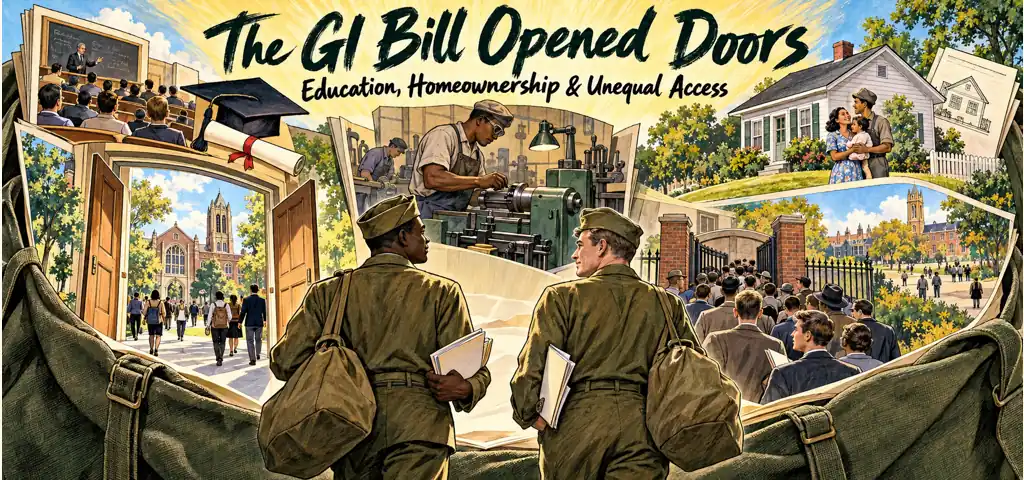
Chapter 12 of the CLEP History of the United States II study guide on Effortless Math covers The GI Bill, Higher Education, and Postwar Mobility: the key terms, the core ideas, and worked examples showing how this topic is tested on the exam.
CLEP History of the United States II, Chapter 12
Demobilization made readjustment a national economic problem
More than twelve million Americans served in the armed forces during the Second World War, and millions returned within a short period. Policymakers feared that veterans seeking jobs at once could revive mass unemployment and social conflict. The Servicemen's Readjustment Act of 1944, commonly called the GI Bill, spread adjustment over time by supporting education, training, homeownership, and temporary income. The program did more than reward service. Federal guarantees and payments shaped the pace and direction of postwar household formation.
The statute combined benefits that worked through different channels
Eligible veterans could receive tuition and living support for approved education or vocational training, federally guaranteed loans for homes, farms, or businesses, and unemployment allowances sometimes nicknamed the "52-20 Club." A loan guarantee was not the same as Washington giving a veteran the purchase price. The government absorbed part of a lender's risk, making favorable credit more available. Tuition payments moved through approved institutions, while unemployment benefits supplied short-term income. One law therefore joined human-capital investment, credit policy, and income support.
Education changed the scale and social meaning of college
Veterans filled universities, teachers colleges, trade programs, and vocational schools. Institutions added temporary classrooms, faculty, housing, and accelerated schedules. College increasingly appeared as a route into professional and managerial employment rather than a preserve for a small hereditary elite. Enrollment growth did not originate only with the GI Bill: state investment, rising high-school completion, later baby-boom demand, and a growing economy also mattered. The law accelerated and legitimized a mass system already developing.
Local delivery converted formal equality into unequal access
The statute drew no racial distinction, but benefits operated through segregated colleges, local banks, real-estate markets, employers, and state offices. Black veterans in the South often could not enter white universities, and historically Black colleges lacked enough seats and facilities to absorb demand. Lenders and developers could deny mortgages in neighborhoods restricted by race. A universal federal entitlement thus met discriminatory local institutions. Eligibility in statutory text and usable opportunity in practice are different historical facts.
The college bottleneck had lasting consequences
A white veteran admitted to a well-funded university could acquire a credential, professional network, and higher lifetime income. A Black veteran denied admission or confined to an overcrowded institution lost one year's schooling and a sequence of later opportunities. The unequal effect was cumulative. Many Black veterans did benefit, and their education strengthened professional communities and civil-rights leadership. Aggregate enrollment totals must therefore be disaggregated by institution, region, race, and completion.
Mortgage guarantees joined mobility to property wealth
VA-guaranteed mortgages lowered down payments and lengthened repayment for many veterans. Home equity could later finance education, retirement, or assistance to children. Yet federal guarantees entered a housing system shaped by FHA underwriting, racial covenants, redlining, and developer exclusion. Families shut out of appreciating suburban property missed an intergenerational asset as well as a residence. The program helped enlarge a homeowning middle class while distributing its most durable wealth unevenly.
Vocational approval created both opportunity and abuse
Training benefits supported apprenticeships, technical schools, and on-the-job education, allowing veterans who did not seek a four-year degree to build skills. Rapid federal payments also attracted low-quality or fraudulent schools. Administrators had to decide which programs qualified and whether training led to real competence. This is a general policy problem: expanding access quickly can create weak oversight, while overly restrictive approval can block legitimate new institutions. Participation counts alone do not establish educational quality.
Public systems expanded after the veteran surge
States enlarged universities, created branch campuses, and later built community-college networks. Between 1960 and 1970 enrollment rose especially rapidly as the baby-boom generation reached college age. The demographic wave was predictable years earlier, but capacity still required appropriations, faculty, buildings, and transportation. The GI Bill demonstrated that federal aid could increase demand; state construction determined whether many students found a place. Mass higher education was a federal-state-institutional system rather than one national university.
Postwar mobility was real without being automatic
Education and housing benefits helped veterans enter salaried work, purchase property, and relocate. Economic growth created positions that credentials could unlock. But a diploma did not guarantee a particular income, and a loan guarantee did not make every applicant creditworthy in a discriminatory market. Mobility depended on the interaction of benefit, institution, labor demand, place, and prior resources. The law changed probabilities on a vast scale without giving every veteran the same result.
The 1966 veterans law broadened the service boundary
The Veterans' Readjustment Benefits Act of 1966 extended education benefits to veterans whose service occurred after January 1955, including service during the Vietnam era. Unlike the 1944 program's close connection to a declared global war and mass demobilization, the later law established a more continuing principle of educational readjustment for military service. The change shows how an emergency benefit can become a durable expectation and how Congress can redefine the eligible cohort without recreating the original economic crisis.
Veterans' policy acquired a cabinet voice
Congress consolidated several veterans' programs in the Veterans Administration in 1930. The agency already managed hospitals, compensation, pensions, education, loan guarantees, and cemeteries when a 1988 statute elevated it to the cabinet-level Department of Veterans Affairs, effective in March 1989. Elevation did not transfer those benefits to the Defense Department or create them for the first time. It gave an existing program complex representation by a cabinet secretary. In a longer service-policy sequence, the first peacetime draft came in 1940, the GI Bill in 1944, Truman's equality order in 1948, and cabinet elevation in 1989.
The Fulbright Program made educational mobility international
Congress created the Fulbright exchange program in 1946 on Senator J. William Fulbright's proposal, initially using proceeds from the sale of American war surplus abroad. It sent students, teachers, and scholars to study and teach in one another's countries. Unlike GI Bill tuition for returning veterans, the exchange joined education to public diplomacy and mutual understanding. The comparison shows that postwar educational mobility could serve domestic readjustment or international relationship-building through different statutes and funding mechanisms.
follow a benefit through its gatekeepers
A statute promises tuition support to every eligible veteran, but completion rates differ sharply by race and region.
A mobility program should be evaluated across generations
The GI Bill's immediate outputs included enrollments, loans, and allowances. Its longer effects included credentials, occupational mobility, home equity, suburban settlement, and expanded universities. Unequal access also compounded across generations. A strong evaluation distinguishes authorization from delivery, participation from completion, and short-term readjustment from asset accumulation. The program could be transformative and discriminatory in operation at the same time.
Watch the history in motion
This short lesson adds voices, images, and chronology to the ideas you just studied.
Video: Mr. Laubach – APUSH – Post WWII America (GI Bill, Baby Boom, Levittowns, Rise of the Sunbelt), Mr. Chet Laubach.
Try four CLEP-style questions
- A state approved many vocational schools for veterans, but complaints claimed that some programs produced worthless credentials. Which evidence would best test whether rapid approval created useful training?
- Enrollment totals for each school during its first semester of approval
- Program-level completion, licensing-pass, job-placement, inspection, and closure records across several cohorts
- Catalogs listing course titles, equipment, faculty, and advertised program length
- Veterans' first-week satisfaction surveys collected before instruction was completed
- The average number of days between application, approval, and tuition payment
- Veteran enrollment is rising faster than available campus capacity. Which action could most directly create additional places without changing statutory eligibility?
- Congress broadens the dates of military service that qualify for education benefits.
- The Veterans Administration shortens the time needed to certify a tuition payment.
- A college hires additional instructors and leases classrooms, laboratories, and student housing.
- A bank relaxes its credit standard for a veteran seeking a guaranteed mortgage.
- A state approving agency adds another occupation to its list of eligible programs.
- A veteran finances a house through a bank using a VA guarantee. Which arrangement distinguishes that guarantee from a direct government loan?
- A public authority owns the house while the veteran pays income-based rent.
- A federal agency supplies the purchase price and services every monthly payment.
- The city acquires the parcel and transfers it to a developer after clearance.
- The bank supplies principal, while the government covers a share of default loss.
- A private insurer assumes the whole balance without any federal commitment.
- Two groups received VA-backed mortgages at similar rates in 1947, but by 1970 one held substantially more housing wealth. Which evidence would best explain why equal program use did not produce equal long-term mobility?
- Original interest rates, down payments, loan balances, and guarantee percentages
- Household income, property-tax payments, and early delinquency records
- Length of ownership and spending on maintenance or improvements
- Purchase location, later appreciation, accumulated equity, and access to refinancing
- Dates and nominal prices recorded when owners eventually sold
Check your answers and reasoning
Independent preparation. CLEP is a registered trademark of the College Board, which does not endorse this lesson.

Related to This Article
More math articles
- Washington SBAC Grade 4 Math Free Worksheets: 72 Free Printable Worksheets with Step-by-Step Keys
- Top 10 3rd Grade STAAR Math Practice Questions
- How to Solve Percent Problems: Examples and Free Practice
- Complementary and Supplementary Angles: Definitions and Examples for 2026
- Kentucky KSA Grade 8 Math Free Worksheets: Printable Standards-Based Practice, No Signup
- 6th Grade OST Math Practice Test Questions
- The Virtual Classroom Advantage: How Online Math Tutors Enhance Elementary Math Education
- How Students Can Understand Math for Free
- How to Calculate Probability: A Beginner’s Guide
- 10 Most Common 8th Grade IAR Math Questions













What people say about "The GI Bill and Postwar Mobility"?
No one replied yet.