The Bay of Pigs, Berlin, and the Cuban Missile Crisis
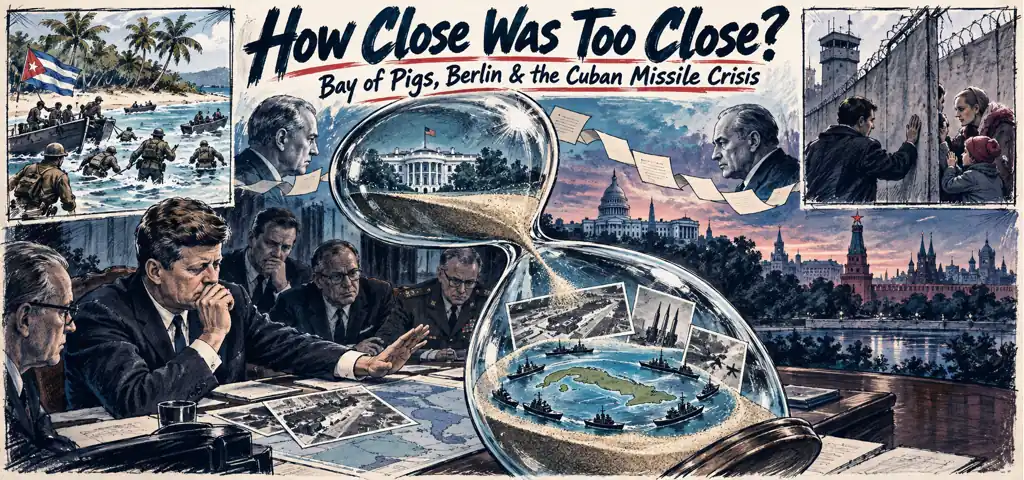
Chapter 11 of the CLEP History of the United States II study guide on Effortless Math covers The Bay of Pigs, Berlin, and the Cuban Missile Crisis: the key terms, the core ideas, and worked examples showing how this topic is tested on the exam.
CLEP History of the United States II, Chapter 11
The U-2 collapse narrowed trust before Kennedy took office
In May 1960 a Soviet missile brought down an American U-2 reconnaissance plane flown by Francis Gary Powers. The Eisenhower administration first issued a cover story, but Soviet possession of the pilot and aircraft exposed it. Nikita Khrushchev then disrupted the Paris summit and demanded an apology Eisenhower would not give. The incident did not create superpower rivalry, yet it demonstrates how deception can magnify the diplomatic cost of an intelligence operation once evidence becomes public. Kennedy inherited both the reconnaissance capability and a damaged negotiating climate.
The Bay of Pigs inherited assumptions as well as a plan
The Eisenhower administration had authorized the CIA to train Cuban exiles after Fidel Castro's revolution moved toward the Soviet Union. Kennedy approved a revised landing at the Bay of Pigs in April 1961. Planners expected the exile brigade to establish a beachhead and stimulate an uprising or provisional government. To preserve plausible deniability, Kennedy limited conspicuous American military support. Castro's forces defeated the invasion quickly. The failure exposed the central contradiction: the operation required enough power to succeed but little enough visible American involvement to remain deniable.
Postfailure review changed presidential procedure
After the invasion Kennedy accepted public responsibility while investigators examined faulty assumptions, intelligence, interagency coordination, and the pressure to maintain consensus. Advisers had not rigorously tested whether Cubans would revolt or whether an exile force could survive without direct intervention. Kennedy later sought more varied advice and, during the missile crisis, used an Executive Committee that debated alternatives outside ordinary cabinet meetings. Institutional learning did not guarantee wise decisions, but it changed how disagreement reached the president.
Vienna intensified pressure over Berlin
Kennedy and Khrushchev met in Vienna in June 1961. Khrushchev renewed demands for a German settlement that could threaten western access to West Berlin, while Kennedy affirmed that access and the western presence. East Germany was losing skilled workers and citizens through Berlin, where movement remained easier than along the fortified inter-German border. The confrontation joined alliance credibility to a local migration crisis. Neither leader wanted general war, but each feared that backing down would invite greater pressure.
The Berlin Wall was coercive and stabilizing at once
East German authorities, with Soviet support, closed crossings and began constructing the Berlin Wall in August 1961. The barrier confined East Germans and separated families; it did not blockade western access routes or transfer West Berlin to communist rule. Kennedy condemned the wall but did not attack it. The wall brutally solved the East German regime's population-loss problem while reducing the immediate danger that movement through the city would trigger a superpower clash. Moral outrage and strategic effect therefore point in different directions.
Soviet missiles in Cuba served several purposes
Khrushchev secretly deployed medium- and intermediate-range nuclear missiles to Cuba in 1962. The deployment could deter another American invasion of Cuba, strengthen a vulnerable ally, alter perceptions of the strategic balance, and answer American missiles placed near the Soviet Union. No single motive excludes the others. Castro welcomed protection but did not control the superpower bargain that followed. Analysts should distinguish a weapon's military range, its political signal, and the alliance commitment it represents.
Photographs turned suspicion into a decision problem
On October 14, 1962, U-2 photographs revealed missile sites under construction. Intelligence specialists compared images, construction patterns, and known Soviet equipment before briefing Kennedy. The evidence established deployment more securely than it established Soviet intentions. ExComm considered an air strike, invasion, diplomacy, and a naval quarantine. Each option carried different risks: an air strike might miss weapons and resemble Pearl Harbor, while doing nothing could damage credibility and leave the deployment in place.
A quarantine created time and controlled contact
Kennedy announced a naval quarantine of additional offensive weapons rather than an immediate attack. The term quarantine avoided the formal implication that the United States had declared a blockade, traditionally an act of war. Naval forces established an interception line, but commanders received rules designed to preserve presidential control over escalation. The measure could not remove missiles already in Cuba by itself. Its strategic value was to signal resolve, slow reinforcement, and create time for communication and bargaining.
Restraint mattered when events escaped the script
Soviet ships approached the line, a U-2 strayed over Soviet territory, and another U-2 was shot down over Cuba, killing Major Rudolf Anderson. Kennedy did not immediately retaliate for the shootdown. The administration answered a more conciliatory public message from Khrushchev while privately addressing a later demand concerning American Jupiter missiles in Turkey. Crisis management depended on threats but on refusing to let every local event dictate the next military step.
The settlement had public and private components
Khrushchev agreed to remove Soviet offensive missiles from Cuba under verification. Kennedy publicly pledged not to invade Cuba. Separately, Attorney General Robert Kennedy told Soviet ambassador Anatoly Dobrynin that American Jupiter missiles in Turkey would be removed later, provided the understanding remained secret and was not presented as a public trade. The missiles were obsolete and already scheduled for withdrawal, but alliance optics made secrecy important. A complete account must distinguish public commitments, private assurances, and prior plans.
After the crisis, communication and testing rules changed
Washington and Moscow established a direct communications link, popularly called the hot line, to speed written messages during emergencies. In 1963 the United States, Soviet Union, and Britain signed the Limited Test Ban Treaty, prohibiting nuclear tests in the atmosphere, outer space, and underwater while permitting underground tests. These measures did not end the arms race or resolve Cuba and Berlin. They reduced particular dangers revealed by the crisis: slow communication, atmospheric fallout, and uncontrolled signaling.
Recorded deliberations changed the historian's evidence
Kennedy secretly recorded many White House discussions. Those tapes later allowed historians to compare private uncertainty with public statements and memoirs. Participants who later appeared consistently cautious sometimes proposed riskier steps in the room; positions also changed as information changed. Recordings are unusually rich but not complete: people may speak strategically, informal conversations go unrecorded, and the president still controlled the final decision. A primary source can expose retrospective simplification without eliminating interpretation.
trace an escalation ladder
A prompt asks why quarantine was chosen over immediate bombing.
Crisis success should not become a formula for brinkmanship
Kennedy combined surveillance, military preparation, limited public action, private bargaining, and restraint. Luck also mattered: commanders and local forces did not turn every accident into escalation. The outcome strengthened beliefs in controlled crisis management, but later officials could overlearn the lesson that calibrated pressure always compels an opponent. Cuba demonstrates the value of options and communication while warning that nuclear crises contain uncertainty no decision process can remove.
Watch the history in motion
This short lesson adds voices, images, and chronology to the ideas you just studied.
Video: The history of the Cuban Missile Crisis – Matthew A. Jordan, TED-Ed.
Try four CLEP-style questions
- What operational contradiction most weakened the Bay of Pigs plan?
- A large Cuban popular uprising began before the exile brigade arrived across Cuba.
- The landing required decisive power while visible American support had to remain limited.
- Soviet troops openly commanded the invasion from ships inside Cuban waters.
- Congress had already recognized the exile brigade as Cuba's lawful government.
- Castro's forces lacked aircraft, communications, and knowledge of the landing area.
- Why could the Berlin Wall reduce immediate superpower danger while worsening repression?
- It ended the East German government and reunited the city through free elections.
- It transferred western access routes to neutral administration under the United Nations.
- It stopped East German emigration without directly expelling western forces from West Berlin.
- It removed every Soviet and American military unit from occupied Germany at once.
- It opened new routes for refugees while placing West Berlin inside East Germany.
- What was the chief decision-making advantage of a naval quarantine over an immediate air strike?
- It removed the deployed missiles before surveillance had to confirm their operational status.
- It isolated Soviet commanders from Moscow and reduced the risk of unauthorized launch.
- It shifted responsibility for the missile sites from Moscow to the Cuban government.
- It applied visible pressure while preserving time for evidence, signaling, and bargaining.
- It focused on equipment still at sea, making evidence about deployed sites unnecessary.
- How should historians use the secret recordings of ExComm deliberations?
- Compare changing private arguments with later accounts while noting gaps and strategic speech.
- Give private discussion priority over public evidence because advisers had little reason to posture in closed meetings.
- Treat proposals repeated by several advisers as decisions already authorized for implementation.
- Treat repeated positions as fixed preferences rather than responses to intelligence and debate.
- Use the final meeting as the baseline because earlier uncertainty contributed little to the decision.
Check your answers and reasoning
Independent preparation. CLEP is a registered trademark of the College Board, which does not endorse this lesson.

Related to This Article
More math articles
- Best Graphing Calculators for Math Teachers
- Number Properties Puzzle – Challenge 11
- Free Grade 3 English Worksheets for Nevada Students
- Artificial Selection: Examples, Breeding and Trade-Offs
- How to Perform Operations of Decimals and Whole Numbers: Word Problems
- How to Solve Trigonometric Equations?
- Free Grade 4 English Worksheets for Ohio Students
- Drawing Conclusions and Making Predictions
- Time, place, and manner restrictions
- Cell Theory and Cell Types


















What people say about "Bay of Pigs, Berlin, and the Missile Crisis"?
No one replied yet.