Calculator Tools: Choose a Model and Check Exam Rules

The useful calculator is the one that handles your coursework and meets your exam’s rules. A scientific model may be enough for numerical work; a graphing model adds plots and tables; a CAS model manipulates algebra symbolically; a financial model serves cash-flow tasks. Before buying another device, check what your course requires and what your current calculator already does.
Check exam rules first
The HP Prime is prohibited on the SAT and PSAT-related assessments, and on the ACT. It has a computer algebra system (CAS). College Board and ACT both name it in their prohibited-calculator guidance. An older approval list can lead you to the wrong purchase.
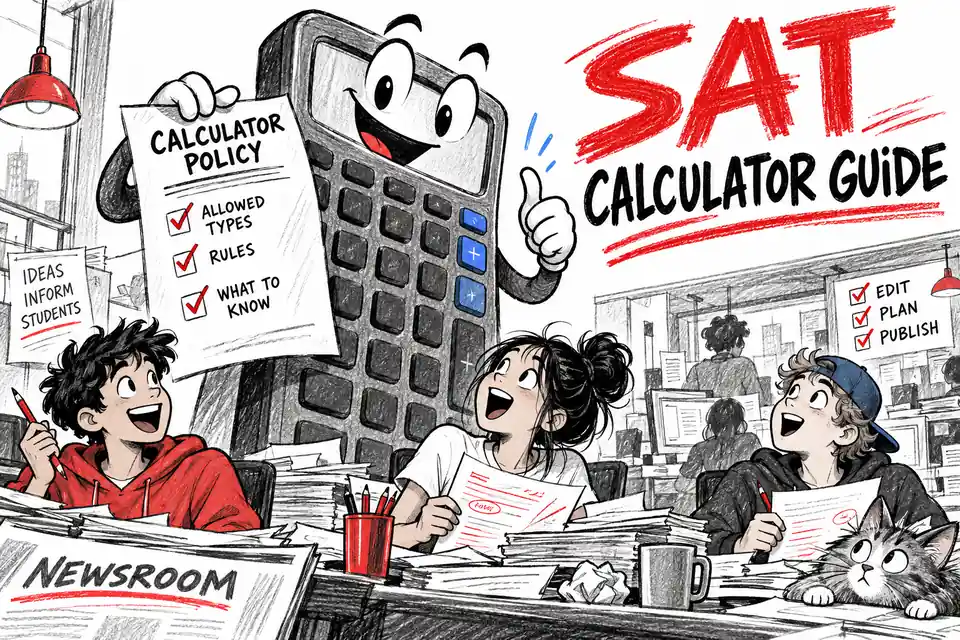
For SAT and PSAT-related tests, Bluebook includes Desmos graphing and scientific calculator options. A separate handheld calculator is optional. If you bring one, it must meet the current non-CAS and program restrictions. Read the official SAT Suite calculator policy and the ACT calculator policy before test day.
AP rules vary by subject and exam section. Check College Board’s AP calculator policies for your course rather than treating “AP approved” as a blanket permission. For a classroom assessment, follow your instructor’s instructions.
Compare five calculator models
These are different tools for different tasks, not a ranking based on hands-on testing. Check the exact model name, features, course requirements, and current seller price before choosing.
TI-84 Plus CE: graphs, tables, and statistics
This graphing calculator has a color screen and rechargeable battery. It is worth considering when your class regularly uses function graphs, tables, or statistical analysis. A familiar classroom model can make it easier to follow the same steps as your teacher, but ask which model they actually use. See Texas Instruments’ TI-84 Plus CE family details; distinguish the original and Python editions when shopping.
Casio fx-991CW: numerical scientific work
The fx-991CW is non-graphing and non-programmable. It offers a textbook-style display, numerical equation tools, statistics, matrices, vectors, and function tables. Solar and battery power support portable use. It can be useful when you need scientific calculations without a handheld graphing display. Casio’s QR visualization uses a separate smart device; that is not an on-device graph or permission to use a phone in an exam. Check the official fx-991CW specifications.
HP Prime: symbolic algebra where permitted
A CAS calculator can work with algebraic symbols, which is a different capability from finding a numerical result. The HP Prime is an option to investigate for coursework that explicitly allows CAS. It is not a SAT, PSAT, or ACT purchase: all three prohibit this model. Do not assume disabling one feature makes a prohibited model acceptable. Confirm the exact course or exam rules before considering it.
TI BA II Plus: finance calculations
For cash-flow problems, the BA II Plus includes net present value (NPV) and internal rate of return (IRR) calculations. Texas Instruments provides a BA II Plus NPV and IRR guide. It serves a different need from graphing functions for algebra. The CFA Institute calculator policy permits the BA II Plus, including the Professional model, and specified HP 12C models; general scientific or graphing capability does not establish CFA eligibility.
TI-30XS MultiView: a four-line scientific option
A four-line display helps you review a calculation instead of seeing only its final answer. Consider this model for scientific work when you do not need graphing or CAS. Read the matching TI-30XS MultiView guide in Texas Instruments’ scientific calculator guidebooks to check the functions you need. Compare actual prices rather than assuming it costs only a few dollars.
Useful functions and quick checks
Key names and available tools vary by model. Use its manual, then try a small calculation whose answer you know.
- Fractions and decimals: check that 3/8 converts to 0.375. Keep exact fractions when rounding early would change the result.
- Stored values: where variables are available, store a radius once and reuse it in calculations. Clear or replace old values so yesterday’s input does not enter today’s work.
- Function tables: if your calculator has a table tool, enter y = 2x + 3 and check x = 0, 1, 2. The outputs should be 3, 5, 7. A table helps inspect a pattern; it does not prove the pattern for every x.
- Angle mode: sin(30°) = 0.5. If you get a different value, check whether the device is using radians before changing your solution.
- Parentheses and negative signs: (−3)² = 9, while −(3²) = −9. Enter the expression you mean and estimate the sign before trusting the display.
Practice before you buy
Choose a few problems from the free Algebra 1 worksheets. Solve them on paper, then use your calculator to check a numerical result, table, or graph. If your goal is exam preparation, continue to the SAT Math Online Center or PSAT Math Online Center for relevant review resources. Practice with the permitted tool you plan to use on test day.

Related to This Article
More math articles
- FREE FTCE Math Practice Test
- ILTS TAP Math Flashcards
- Buffers and Titrations: Endpoint vs. Equivalence
- Economic cost includes implicit opportunity cost
- Intelligent Math Puzzle – Challenge 93
- Embark on Your SHSAT Math Adventure: Introducing the “SHSAT Math for Beginners” Solution Manual
- The Best Grade 4 Math Book for Florida Students
- A 4-Week Grade 5 ELA Study Plan: Reading, Writing, Vocabulary, and Review That Actually Fits Real Life
- How to Solve Word Problems of Elapsed Time
- How to Find Magnitude of Vectors?







What people say about "Calculator Tools: Features, Models, and Exam Rules"?
No one replied yet.