Ratification of the U.S. Constitution
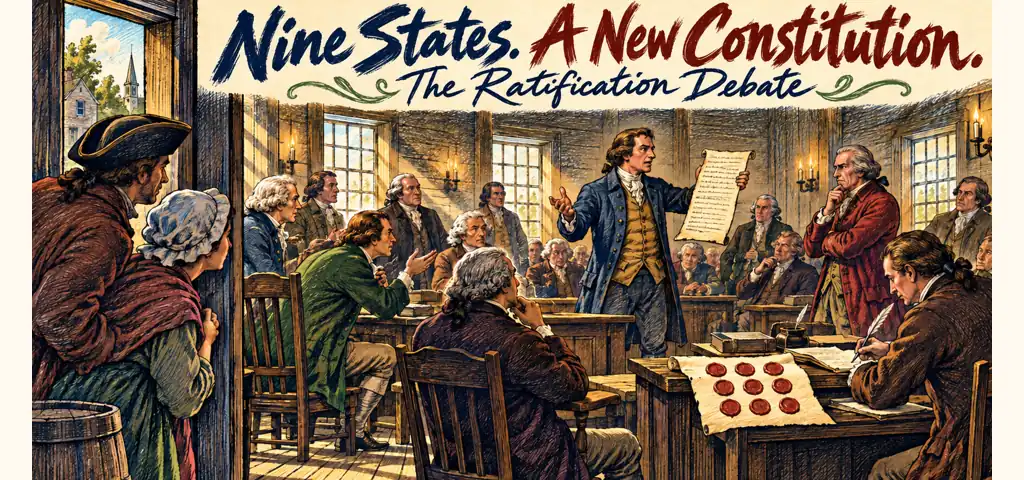
The Philadelphia Convention proposed a Constitution, but it could not make that Constitution law by itself. Article VII specified the authorizing rule: conventions in nine states had to ratify before the new framework could take effect among the ratifying states. A convention was a body of delegates chosen for the particular decision, not the ordinary state legislature. This method appealed to popular sovereignty because voters selected representatives to decide whether the people would accept the proposed fundamental law. It also avoided giving existing state legislatures the sole decision over a plan that would reduce some of their authority.
The nine-state threshold was a practical and constitutional choice. It did not require immediate unanimity among all thirteen states, which had made change under the Articles of Confederation exceptionally difficult. Delaware ratified first in December 1787. New Hampshire became the ninth state in June 1788, satisfying Article VII. Virginia and New York then ratified after closely fought conventions, giving the new government essential political support. The federal government began operating in 1789. North Carolina and Rhode Island ratified later, showing that the system could begin among participating states before every state had joined.
The governing rule for ratification of the u.s. Constitution
Ratification debates involved both persuasion and recommended changes. Delegates could vote for or against the Constitution as proposed. They could not rewrite its clauses within a state convention and then claim to have ratified a different document. Several conventions accompanied approval with proposed amendments or declarations. Those recommendations had political force but did not automatically become constitutional text. Once the Constitution took effect, changes had to proceed through Article V. This sequence explains how a delegate could vote to ratify while also demanding that the new Congress promptly propose a bill of rights.
Ratification of the U.S. Constitution: the legal or political boundary
Do not confuse original ratification with later amendment. Ratification answered whether the proposed Constitution would become operative. Article V answers how an operative Constitution can be changed. The president had no role in approving or vetoing the Constitution, and Congress under the Articles did not enact it as an ordinary statute. In a course question, clues such as state conventions, Article VII, the nine-state threshold, or the years 1787 to 1788 point to original ratification. Two-thirds proposal and three-fourths approval point instead to the amendment process.
Reason through an example of ratification of the u.s. Constitution
Ratification asks whether to adopt the proposed Constitution. Amendment asks how to change it afterward. Give one concrete example.
Check your reasoning
Article VII allowed the Constitution to take effect among ratifying states after approval by conventions in nine states. Using special conventions invoked popular sovereignty and bypassed state legislatures that might resist losing power. Ratification adopted the original Constitution. The demand for a Bill of Rights concerned changes promised or pursued during that debate.
Video lesson: Ratification of the U.S. Constitution
Heimler's History gives a focused explanation of this topic in RATIFICATION of the Constitution [AP Government Review, Unit 1 Topic 5].
If the player does not load, watch this lesson directly on YouTube.
Connect this lesson to the larger course
For a broader map connecting ratification of the u.s. Constitution to founding ideals, the Constitution, and federalism, use the AP U.S. Government and Politics learning hub.

Related to This Article
More math articles
- How to Find the Integral of Radicals
- Free Grade 6 English Worksheets for Washington, D.C. Students
- The Law of Cosines
- Free Grade 8 English Worksheets for North Dakota Students
- Free Grade 5 English Worksheets for Nevada Students
- Best Calculator for the PSAT: Bluebook and 5 Handheld Options
- Grasping, Holding, and Clamping Instruments
- Free Grade 8 English Worksheets for Michigan Students
- 6th Grade PARCC Math FREE Sample Practice Questions
- Which Test Should You Take: GED, TASC, or HiSET?



















What people say about "Ratification of the US Constitution"?
No one replied yet.