The Bill of Rights: Purpose and Protections
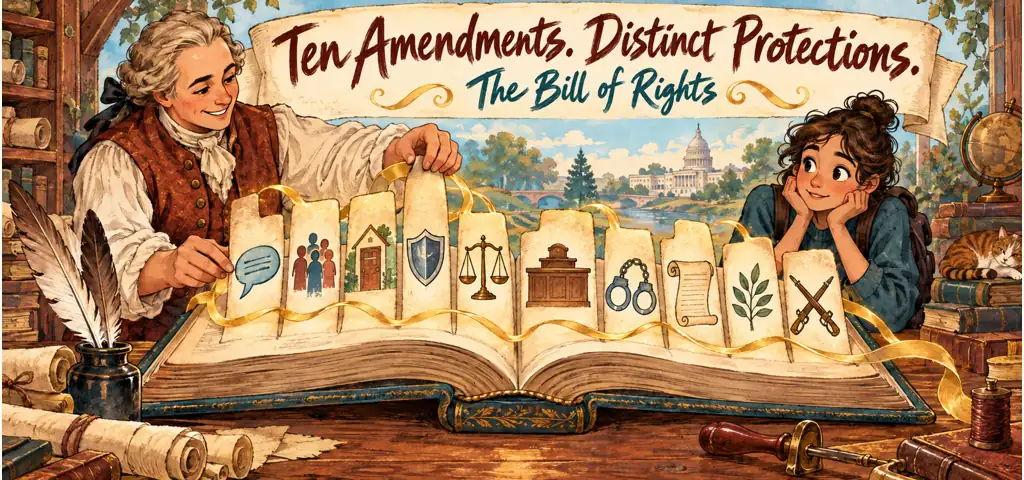
The Constitution drafted in 1787 created a stronger national government but contained few express guarantees of individual liberty. During ratification, Anti-Federalists warned that broad federal powers might be used against speech, religion, property, and criminal defendants. Federalists replied that the national government possessed only delegated powers, yet several states ratified while recommending amendments. James Madison drew on those proposals, and the first ten amendments became effective in 1791. The Bill of Rights therefore served both a legal and a political purpose: it placed specific limits on government and helped fulfill a promise that secured support for the new Constitution.
The amendments protect different kinds of interests. The First Amendment safeguards religion, expression, assembly, and petition. The Second protects the right to keep and bear arms. The Fourth through Eighth regulate searches, prosecutions, trials, punishment, and other exercises of coercive power. The Ninth warns that listing certain rights does not erase other rights retained by the people, while the Tenth reinforces the principle that the federal government has limited, enumerated powers. These provisions are related, but they are not interchangeable. A search question calls for the Fourth Amendment. A compelled confession raises the Fifth. A restriction on political advocacy begins with the First.
The mechanism behind the bill of rights: purpose and protections
Originally, the Bill of Rights restrained only the federal government. State and local conduct was governed principally by state constitutions and law. After the Civil War, the Fourteenth Amendment supplied the constitutional route through which most Bill of Rights guarantees became enforceable against the states. This process, known as selective incorporation, occurred right by right rather than in one sweeping decision. The actor therefore matters. A federal censorship rule directly implicates the First Amendment. A city censorship rule implicates the First Amendment as applied through the Fourteenth.
The Bill of Rights: Purpose and Protections: key distinctions
Civil liberties and civil rights also answer different questions. Civil liberties protect freedom from unjustified government interference, while civil rights protect equal legal status and access. A single dispute may involve both. If a city permits one political group to use a public auditorium but excludes another because of its viewpoint, freedom of speech and equal treatment are both relevant. in a course question, identify the government actor, the protected interest, and the constitutional route before deciding whether the burden is justified. Rights are powerful limits, not automatic answers: many require courts to weigh the kind of restriction, the setting, and the standard of review.
Practice with the bill of rights: purpose and protections
For Purpose of the Bill of Rights, identify the constitutional text, whether government action is federal or state, and whether incorporation or another Fourteenth Amendment rule is required. Give one concrete example.
Check your reasoning
The Bill of Rights added explicit protections for liberty, procedure, and retained powers, responding to ratification-era concerns. It originally limited the federal government. Civil liberties protect freedom from improper government interference. Civil rights protect equality and access under law.
Video lesson: The Bill of Rights: Purpose and Protections
Khan Academy gives a focused explanation of this topic in The Bill of Rights: an introduction | US government and civics.
If the player does not load, watch this lesson directly on YouTube.
Connect this lesson to the larger course
For a broader map connecting the bill of rights: purpose and protections to civil liberties, civil rights, and equal protection, use the AP U.S. Government and Politics learning hub.

Related to This Article
More math articles
- The Best Grade 8 ELA Practice Tests for Kentucky Students
- The Best Grade 8 Math Book for Tennessee Students
- Fourth Amendment
- Formal constitutional amendment process
- Roulette Wheel Bias: When the Casino’s Hardware Actually Tilts
- Health Disparities, the Sick Role, and Medicalization
- Free Grade 5 English Worksheets for Mississippi Students
- Indiana ILEARN Grade 4 Math Free Worksheets: Free Skill-Targeted Worksheets with Answer Keys
- Electricity and Simple Circuits
- Surveys, Samples, and Nonresponse




















What people say about "The Bill of Rights: Purpose and Protections"?
No one replied yet.