First Amendment Freedom of Speech
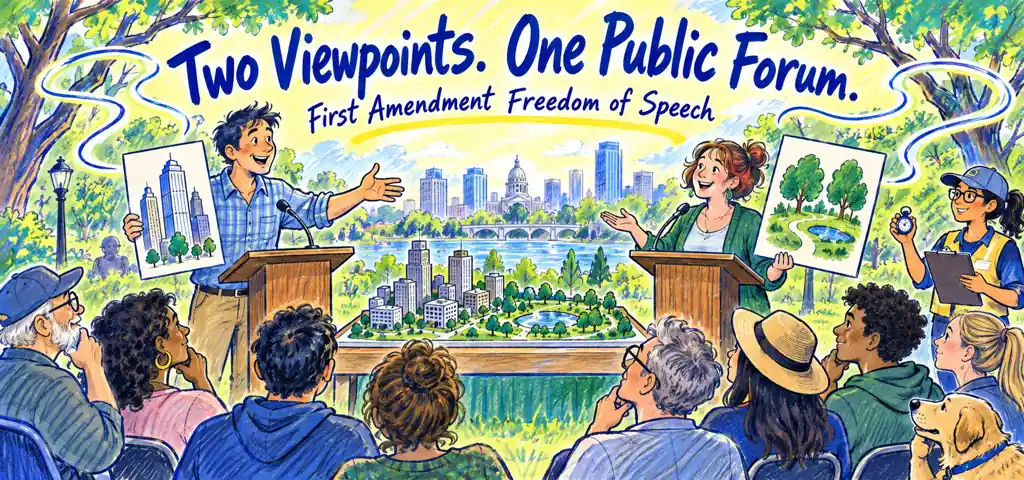
Political speech concerns public questions: elections, government policy, official conduct, social movements, and proposed political change. It receives especially strong protection because self-government depends on citizens’ ability to criticize those in power, organize opposition, and hear competing arguments. The protection is not reserved for polite, popular, or factually comforting ideas. Advocacy does not lose protection merely because it embarrasses an official, disturbs an audience, or demands a major change in law. Begin with government action. The First Amendment applies to federal, state, and local officials through the Constitution and incorporation doctrine. It ordinarily does not compel a privately owned newspaper, employer, or online platform to publish another person’s message. Yet an official may not use threats, licensing power, or regulatory use to pressure a private intermediary into suppressing protected advocacy. Government cannot accomplish indirectly what it could not order directly.
Next ask why government restricted the speech. A content-based rule turns on the subject or message, for example, permitting signs about real estate but not elections. Viewpoint discrimination goes further by favoring one position within a subject, such as allowing praise of a tax proposal while forbidding criticism. Viewpoint discrimination is especially disfavored, and content-based restrictions on protected speech ordinarily face strict scrutiny. A facially neutral explanation is not conclusive. Courts may examine the law’s operation and justification. In Chiles v. Salazar (2026), the Supreme Court held that Colorado could not avoid First Amendment review by calling regulated talk therapy professional conduct when the law, as applied, permitted speech supporting some counseling goals while prohibiting speech supporting the opposing goal. The principle is classification, not a general immunity for every professional practice: determine whether the challenged application regulates speech and whether it selects a viewpoint.
The governing rule for first amendment freedom of speech
Place and institutional role affect the analysis. Streets and parks are traditional public forums, where content-based exclusions are highly suspect and properly drawn content-neutral logistical rules may apply. A government can create a limited forum for a particular subject or group, but it generally may not exclude a participant because of viewpoint within the forum’s stated boundaries. In a nonpublic forum, such as an internal government mail system, restrictions may be reasonable and viewpoint neutral. Government ownership alone therefore does not settle the question. Political speech also appears in specialized institutions. Public employees, students, prisoners, and service members retain constitutional interests, but government may possess additional authority as employer, educator, custodian, or military administrator. The correct response is not “political speech always wins” or “government owns the setting.” It is to identify the forum or institutional rule before applying the protection.
First Amendment Freedom of Speech: the legal or political boundary
Consider a city auditorium opened to community groups discussing municipal policy. Officials accept a neighborhood association that supports a zoning plan but reject an association that opposes the same plan. The city has acted. The expression is political. The auditorium is a government-created forum. And the reason is opposition to the group’s viewpoint. Calling the group “controversial” does not create a separate exception. Use the same sequence whenever a question mentions offense. Anger, disgust, or fear of criticism may explain political pressure, but offense is not a doctrinal category. Government must point to a valid forum rule, a content-neutral interest, or a narrowly defined category such as incitement. The audience’s dislike cannot substitute for the elements of that rule.
Reason through an example of first amendment freedom of speech
For Political speech, classify the speech, forum, speaker, and restriction before choosing the applicable First Amendment standard. Give one concrete example.
Check your reasoning
Political advocacy lies at the core of First Amendment protection. Government generally needs a very strong justification for content- or viewpoint-based restrictions, though neutral rules governing time, place, and manner may be permissible. Conduct can receive speech protection when it is intended and understood as expression.
Video lesson: First Amendment Freedom of Speech
CrashCourse gives a focused explanation of this topic in Freedom of Speech: Crash Course Government and Politics #25.
If the player does not load, watch this lesson directly on YouTube.
Connect this lesson to the larger course
For a broader map connecting first amendment freedom of speech to civil liberties, civil rights, and equal protection, use the AP U.S. Government and Politics learning hub.

Related to This Article
More math articles
- Ratios produce averages and per-dollar comparisons
- 10 Must-Know Expert Tips for the HiSET Math Test
- How to Solve Literal Equations? (+FREE Worksheet!)
- Weight Measurements
- A Comprehensive Collection of FREE PSAT Math Practice Tests
- The Best TABE Math Worksheets: FREE & Printable
- Natural and Artificial Selection
- Top Calculator for the PSAT 10 Math Test: Quick Review
- Free Printable Grade 3 Math for Florida FAST Students: 49 Single-Skill PDF Worksheets
- How to Use Area Models to Multiply One-Digit Numbers By Two-digit Numbers



















What people say about "First Amendment Freedom of Speech"?
No one replied yet.