Private goods use market demand; public goods require vertical benefit addition
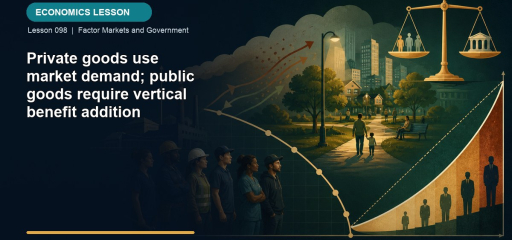
Private goods use market demand; public goods require vertical benefit addition: this Effortless Math guide explains the topic in plain language, shows how it works through solved examples, and gives you free practice to try immediately, so the idea sticks instead of staying abstract.
Free riding can hide willingness to pay for a public good.
Voluntary private provision of national defense tends to be insufficient because
- one person’s protection reduces everyone else’s protection
- users can be excluded cheaply
- marginal cost is necessarily zero
- only government values defense
- people can benefit without contributing
people can benefit without contributing Nonexcludability allows free riding, so private contributions do not reflect the full sum of beneficiaries’ willingness to pay.
The free-rider problem most directly causes private markets to
- overproduce resources that are rival in consumption
- charge every beneficiary the same voluntary amount
- underprovide goods whose beneficiaries can avoid paying
- eliminate rivalry among people who pay for a good
- make public goods automatically excludable
underprovide goods whose beneficiaries can avoid paying If people can benefit without paying, voluntary contributions understate willingness to pay and the market supplies too little.
Watch the idea in action
A focused video lesson from econhelp.
A private good is both rival and excludable. One person’s meal cannot be eaten by someone else, and a restaurant can require payment before serving it. Because different buyers can consume different quantities, market demand is found by adding individual quantities horizontally at each price. Exclusion lets the seller connect payment with access, while rivalry assigns the unit to one user. These features make the familiar private market possible. They do not guarantee perfect competition or eliminate every other market failure.
National defense, basic flood warnings, and some knowledge are nonrival and nonexcludable. Once provided, another user does not meaningfully reduce the benefit, and excluding nonpayers is difficult. A person can therefore hope others pay, causing voluntary contributions to understate true benefit and private provision to be too low.
For a public good, everyone consumes the same quantity, so individual marginal benefits are added vertically at each quantity. If household A values the third siren at $400 and B at $250, social marginal benefit is $650. Provide the unit if that sum is at least marginal cost.
A pure public good has two properties. It is nonrival: one person’s benefit does not substantially reduce the amount available to others. It is also nonexcludable: preventing nonpayers from receiving the benefit is difficult or prohibitively costly. National defense and a community tornado siren fit the model more closely than services such as public buses, which can be crowded and can charge fares.
Nonexcludability creates the free-rider problem. A person can enjoy the siren after neighbors pay for it, so the person has an incentive to understate willingness to pay. This is individually tempting but collectively damaging: if everyone waits for someone else, a project whose total benefit exceeds cost may not be financed. The problem is an incentive to conceal value, not proof that people place zero value on the good.
Public-good demand uses vertical addition because everyone consumes the same quantity. At the second unit of flood protection, Household A is willing to pay $80, B $50, and C $30. Social marginal benefit is $160 for that shared unit. If marginal cost is $140, provide it. If the next unit’s summed benefit is only $110, stop before that unit.
Do not add quantities
At a common price of $10, two buyers might demand 3 and 4 sandwiches, so private-good market quantity is 7. For a public siren, households do not consume separate numbers of the same siren. Add their dollar values for one shared siren instead.
Government provision can solve the collection problem through taxation, but it does not make benefit information perfect. Officials may use voting, surveys, property values, or benefit-cost analysis, each with limitations. Private provision can also occur through philanthropy, bundled products, advertising, social norms, or selective incentives. The economic claim is that ordinary voluntary-market incentives tend toward underprovision, not that provision is impossible.
Do not classify a good by who supplies it. A privately operated fireworks display may generate a public-good benefit if viewers cannot be excluded. Municipal water delivered through metered pipes is publicly supplied but rival and excludable, so it behaves more like a private good. The physical and institutional properties determine the category.
Finally, a public good is not merely “good for the public.” A park at dawn may be nearly nonrival, but a crowded park becomes rival at the margin. Gates can make it excludable. State both dimensions and use the facts at the quantity being analyzed. That habit prevents nearly every classification distractor.

Reza is an experienced Math instructor and a test-prep expert who has been tutoring students since 2008. He has helped many students raise their standardized test scores--and attend the colleges of their dreams. He works with students individually and in group settings, he tutors both live and online Math courses and the Math portion of standardized tests. He provides an individualized custom learning plan and the personalized attention that makes a difference in how students view math.
Related to This Article
More math articles
- How to Decide Between the ACT and SAT?
- How to Find Probabilities using Two-Way Frequency Tables?
- Seventeenth Amendment
- How to Use Benchmark to Compare Fractions?
- Top 10 6th Grade PARCC Math Practice Questions
- 3rd Grade Ohio’s State Tests Math Worksheets: FREE & Printable
- Geometry Puzzle – Challenge 73
- The Best Grade 6 ELA Practice Tests for Idaho Students
- The Best Grade 4 ELA Practice Tests for Arkansas Students
- The Housing Bubble, Financial Crisis, and Great Recession







What people say about "Private Goods, Public Goods and Demand"?
No one replied yet.