The Housing Bubble, Financial Crisis, and Great Recession
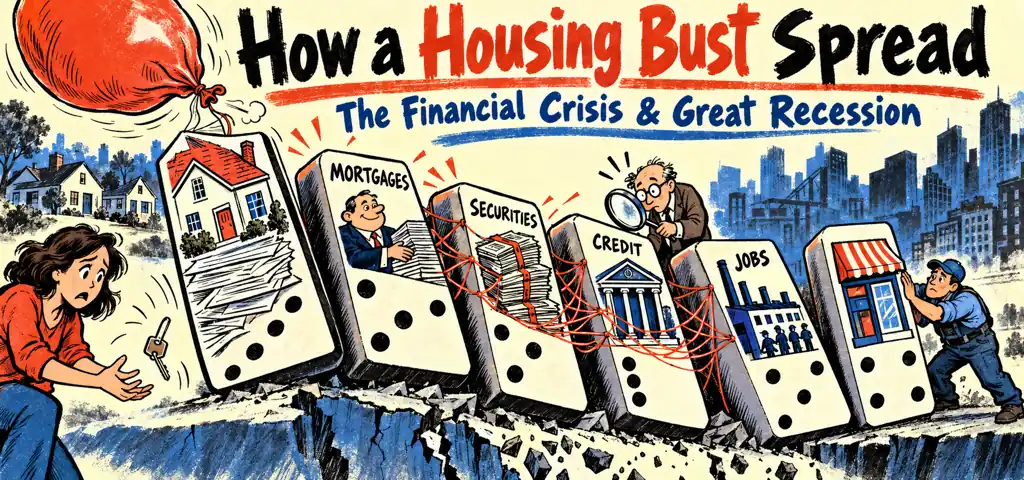
Chapter 16 of the CLEP History of the United States II study guide on Effortless Math covers The Housing Bubble, Financial Crisis, and Great Recession: the key terms, the core ideas, and worked examples showing how this topic is tested on the exam.
CLEP History of the United States II, Chapter 16
Housing finance spread risk through long chains
Mortgage brokers originated loans; lenders sold them; financial firms pooled them into securities; rating agencies evaluated tranches; investors bought claims on payments. Securitization could diversify risk and it separated loan quality from the originator who sold the loan. Subprime and adjustable-rate mortgages expanded credit while exposing borrowers to resets, fees, and falling home values.
The bubble depended on prices continuing to rise
Low interest rates, global capital, relaxed underwriting, speculation, tax preferences, and belief in national home-price growth increased demand. Borrowers could refinance or sell while prices rose. When prices flattened and fell, negative equity and payment resets produced defaults. The Community Reinvestment Act did not cover most high-risk independent mortgage originators and cannot by itself explain a global securities collapse.
Use turned losses into institutional crisis
Banks and shadow-banking firms financed large portfolios with borrowed short-term money. Small declines in asset value could erase thin capital. Derivatives and opaque counterparty ties spread uncertainty. When Lehman Brothers failed in September 2008, lenders could not tell which institutions were solvent, credit markets froze, and otherwise viable firms struggled to finance ordinary activity.
TARP targeted financial stabilization
Congress authorized the Troubled Asset Relief Program in October 2008. Treasury ultimately injected capital into banks and supported financial and automobile firms rather than mainly buying the troubled assets first advertised. The program was politically unpopular but many investments were repaid. TARP sought to stabilize finance; it was not the 2009 fiscal stimulus designed to support economy-wide demand.
The auto rescue addressed a production network
The Bush and Obama administrations supplied loans and restructuring support to General Motors and Chrysler. Bankruptcy reorganized obligations while keeping firms operating. Because automakers connected to parts suppliers, dealers, pensions, and regional employment, disorderly liquidation risked wider damage. Critics objected to government selection and losses; supporters emphasized systemic employment and supply chains.
ARRA used fiscal policy against collapsing demand
The 2009 American Recovery and Reinvestment Act combined tax cuts, aid to states, unemployment support, infrastructure, energy, education, and health spending. Its purpose was to offset private contraction and preserve services. Implementation delays and state budget rules affected timing. Debate concerned multiplier size, composition, deficit cost, and whether the package was large enough, not whether it was identical to TARP.
Dodd-Frank changed oversight rather than ending risk
The 2010 law created the Consumer Financial Protection Bureau, imposed derivatives and systemic-risk rules, required stress tests and resolution planning, and established an orderly liquidation process. It sought to make failure less likely and less destructive. Regulation cannot guarantee that prices, institutions, or policymakers will never err.
Foreclosure exposed unequal household vulnerability
Falling prices harmed owners broadly, but risk was not evenly distributed. Predatory terms, refinancing pressure, residential segregation, and targeted subprime marketing left many Black and Latino borrowers especially exposed, including households that might have qualified for safer loans. Foreclosure then depressed nearby property values and local tax bases, weakening schools and municipal services. The crisis was therefore both a financial-system failure and a transfer of household wealth, with consequences shaped by earlier housing and credit institutions. Recovery of stock prices did not restore every family's lost equity.
The Federal Reserve shifted from emergency lending to sustained support
The Fed cut short-term rates, opened lending facilities, supported key credit markets, and later purchased longer-term Treasury and mortgage securities through quantitative easing. These actions sought to prevent deflation, lower borrowing costs, and restore financial transmission after ordinary rate cuts reached their practical limit. Critics feared inflation, asset-price distortion, and protection of finance; supporters pointed to a deeper collapse avoided. Monetary policy could improve liquidity and aggregate demand without directly rebuilding a foreclosed household's equity or requiring a bank to lend to every qualified borrower. The instrument and the distributional outcome must be judged separately.
Recovery statistics moved at different speeds
Real output returned to growth in 2009, but unemployment peaked later and remained elevated as households reduced debt and firms hired cautiously. State and local governments cut jobs because balanced-budget rules constrained spending even while federal policy was expansionary. Home prices, corporate profits, stock values, labor-force participation, wages, and household wealth recovered on different schedules. Calling one quarter the end of the recession follows an economic dating convention; it does not mean families immediately regained employment or security. A strong answer identifies the indicator instead of using "recovery" as an all-purpose description.
follow a mortgage through the system
A broker sells a loan immediately, a bank packages it, and investors rely on a rating.
The shadow-banking system created bank-like risk without ordinary deposits
Investment banks, money-market funds, structured vehicles, and repurchase agreements supplied short-term finance outside traditional insured banking. These institutions could appear liquid while asset prices rose, yet they depended on creditors rolling over funding. When lenders demanded more collateral or refused renewal, firms had to sell assets into a falling market. The resulting run did not look like depositors lining up at a bank, but the mechanism was related: confidence vanished faster than long-term assets could be converted to cash. Regulation organized around charter labels had missed functions that had become economically similar.
Global connections transmitted an American housing shock
Foreign banks and investors held mortgage-linked securities, dollar funding tightened across borders, and collapsing trade reduced production in export economies. Governments responded with guarantees, stimulus, central-bank swaps, and international coordination, though policies differed. The crisis was not proof that every country's mortgage market copied the American one. It showed that balance sheets, trade, and expectations connected distinct national economies. A causal answer should identify the channel: ownership of losses, dependence on short-term dollars, falling demand, or domestic vulnerabilities. "Globalization spread the crisis" is only a label until that transmission mechanism is named.
Mortgage relief revealed the difference between stabilizing banks and repairing loans
Programs encouraged servicers to modify payments and helped some borrowers refinance, but participation, documentation, investor contracts, negative equity, and repeated redefault limited reach. Servicers often had incentives and systems built for collecting or foreclosing rather than negotiating thousands of complex modifications. Assistance that strengthened a lender's balance sheet did not automatically change a homeowner's monthly obligation. This gap fed anger from opposite directions: some believed rescue rewarded irresponsible finance, while others saw families losing homes after institutions had been protected. Evaluating relief requires separate counts for offers, permanent modifications, redefaults, foreclosures, and households eligible but not served.
The crisis changed household formation and local public finance
Young adults delayed independent households, construction collapsed, and families doubled up as jobs and credit disappeared. Foreclosures left vacant properties and reduced assessments, while recession cut sales and income-tax receipts. Local governments then faced rising demand for assistance with falling revenue, often cutting teachers, transit, and public safety. These secondary effects explain why a mortgage crisis could weaken communities far beyond borrowers with subprime loans. They also show why recovery in national credit markets arrived before many neighborhoods recovered population, services, or property wealth.
Watch the history in motion
This short lesson adds voices, images, and chronology to the ideas you just studied.
Video: How it Happened – The 2008 Financial Crisis: Crash Course Economics #12, CrashCourse.
Try four CLEP-style questions
- Why could securitization weaken underwriting incentives?
- Rating agencies could evaluate pooled securities without relying on loan-level borrower information.
- Lenders that retained mortgages until repayment had weaker incentives to examine borrower risk.
- Pooling mortgages prevented investors from buying claims tied to household payments.
- Originators could sell loans and avoid bearing the full long-term default risk.
- Adjustable rates shifted default risk from investors back to originating lenders.
- Why did Lehman's failure freeze credit beyond mortgage lending?
- Opaque counterparty ties made institutions uncertain about one another's solvency.
- Emergency bank rules redirected business lending toward resolution of mortgage claims.
- Lehman's ownership stakes gave it effective control over regional banks and public treasuries.
- Rising home prices absorbed available credit that otherwise supported business borrowers.
- The Federal Reserve suspended liquidity support while private lenders assessed counterparty exposure.
- How did TARP differ from ARRA?
- TARP restricted new lending, while ARRA required a balanced federal budget.
- TARP stabilized financial institutions; ARRA used taxes and spending to support demand.
- TARP emphasized public works, while ARRA purchased preferred shares in financial institutions.
- Both were financial-rescue programs enacted before the failure of Lehman Brothers.
- ARRA supplied capital to commercial banks, while TARP financed state operating budgets.
- Why did the auto rescue have effects beyond two companies?
- Automobile assembly accounted for most employment in the national service sector.
- Federal support required suppliers to separate from domestic automakers before receiving orders.
- Parts producers outside Detroit were insulated from changes in assembly output.
- Automakers were connected to suppliers, dealers, pensions, and regional employment.
- Court-supervised bankruptcy could restructure the firms without affecting supplier contracts or dealer networks.
Check your answers and reasoning
Independent preparation. CLEP is a registered trademark of the College Board, which does not endorse this lesson.

Related to This Article
More math articles
- Decoding Data: How to Identify Representative, Random, and Biased Samples
- The Best Grade 4 Math Book for Washington Students
- 10 Most Common Praxis Core Math Questions
- Citing Text Evidence in Grade 4: How to Move from Vague Answers to Clear Explanations
- 7th Grade North Carolina End-of-Grade Math Worksheets: FREE & Printable
- The Ultimate 6th Grade CMAS Math Course (+FREE Worksheets)
- Best PERT Math Prep Books-Which book is the best for you
- 7 Best Digital Pen Tablets for Online Math Teaching in 2026
- Top 10 8th Grade PSSA Math Practice Questions
- How to Add and Subtract Mixed Time Units



















What people say about "Housing Bubble, Crisis, Great Recession"?
No one replied yet.