The Iraq War and the Limits of American Power
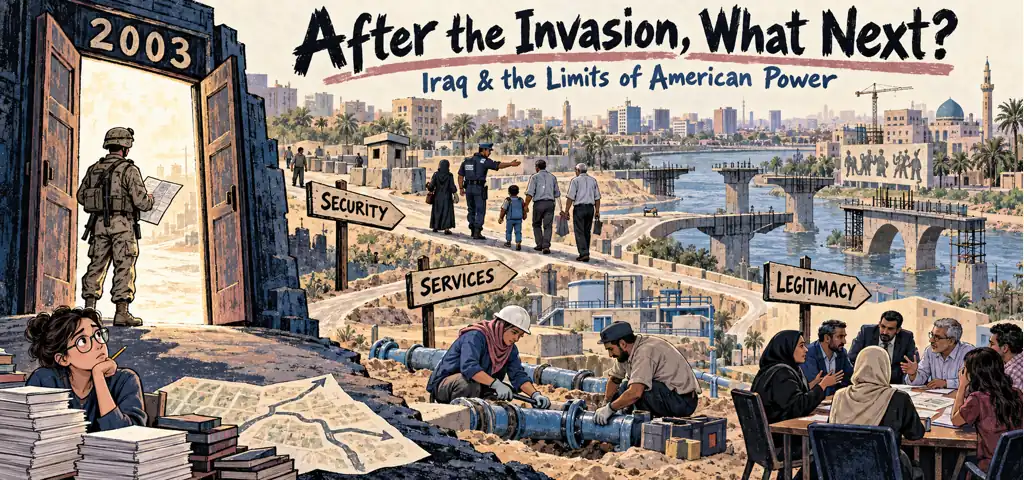
Chapter 16 of the CLEP History of the United States II study guide on Effortless Math covers The Iraq War and the Limits of American Power: the key terms, the core ideas, and worked examples showing how this topic is tested on the exam.
CLEP History of the United States II, Chapter 16
The Bush Doctrine emphasized prevention and preemption
The 2002 National Security Strategy argued that deterrence might fail against terrorists and hostile states seeking weapons of mass destruction. It claimed a right to act before threats fully materialized. Preventive war addresses a developing danger; preemption traditionally describes action against an imminent attack. Political rhetoric often blurred the distinction.
The Iraq case combined several rationales
The administration cited suspected chemical and biological weapons, possible nuclear ambition, violations of United Nations resolutions, terrorism, and dictatorship. Congress authorized force in 2002. Inspectors returned, but the United States invaded in March 2003 without a new Security Council resolution explicitly authorizing the war. Saddam's government fell quickly; stockpiles of the alleged weapons were not found.
Intelligence became a credibility problem
Assessments contained uncertainty and disagreement, but public presentations often conveyed greater confidence. The false weapons conclusion damaged American credibility and raised questions about selection, interpretation, and dissent within intelligence. A failure can arise from bad collection, analytic error, political pressure, or communication; evidence must distinguish these mechanisms rather than assume one automatically.
Occupation decisions helped create insurgency
The Coalition Provisional Authority disbanded the Iraqi army and pursued broad de-Baathification, removing personnel with administrative and military experience. Looting, unemployment, weak services, sectarian conflict, foreign fighters, and resistance followed. Rapid regime change had not supplied a plan for public order or legitimate government. Tactical victory and state reconstruction required different capacities.
Abu Ghraib damaged moral authority
Photographs revealed American personnel abusing Iraqi detainees at Abu Ghraib prison. Prosecutions focused largely on lower-ranking soldiers, while investigations debated command climate, interrogation policy, and responsibility. The scandal supplied adversaries with propaganda and undermined claims that occupation would establish lawful government.
The surge paired troops with a changed strategy
In 2007, the United States sent additional forces and emphasized population security, while Sunni tribal leaders in the Anbar Awakening turned against al-Qaeda in Iraq and sectarian violence had already reshaped neighborhoods. Violence declined substantially. Attributing the change solely to troop numbers ignores local alliances, tactics, timing, and prior displacement.
Authorization did not settle the legitimacy debate
Congress's 2002 authorization gave the president domestic statutory authority to use force against Iraq, but critics disputed the intelligence, necessity, and international basis for invasion. Several allies joined; other NATO partners opposed the war. United Nations resolutions required Iraqi disarmament, yet the Security Council did not adopt the additional resolution the United States sought immediately before invasion. Domestic authorization, allied participation, and international legitimacy are related questions, not interchangeable answers. Public support also changed as the weapons claim failed and the occupation lengthened. Elections did not erase those distinctions.
Human costs outlasted the initial campaign
American and coalition casualties, far larger Iraqi civilian losses, displacement, disrupted services, and injuries affected political judgment long after the invasion. Veterans returned with visible wounds, traumatic brain injuries, and post-traumatic stress, while military families absorbed repeated deployments. Contractors performed logistics, security, and reconstruction work on a scale that complicated oversight and the public accounting of personnel. Budget estimates also expanded as occupation, medical care, reconstruction, and debt service accumulated. A short battlefield victory can therefore generate obligations and costs that appear over decades rather than during the televised campaign.
Elections created institutions without ending the struggle over the state
Iraqis voted for a transitional assembly and ratified a constitution, but parties often mobilized through sectarian and ethnic identities. Disputes over federalism, oil revenue, policing, former regime members, and the status of Kirkuk affected whether citizens trusted national institutions. Elections can authorize officials while armed groups still contest territory and ministries distribute power unevenly. The appearance of ballots therefore measured one dimension of political reconstruction, not a complete monopoly on force or agreement over national identity. This distinction also explains why turnout figures alone could not settle whether the occupation had created durable legitimacy.
The war altered civil-military and public-information debates
Embedded journalists gained close access to units during the invasion but saw only parts of a wider campaign. Official casualty counts, intelligence claims, contractor activity, and restrictions on images of returning coffins shaped public knowledge. Military leaders and civilian officials later disputed troop levels and occupation planning, raising questions about professional advice and elected control. Civilian supremacy means elected leaders decide policy; it does not mean professional warnings are irrelevant evidence. Likewise, criticism of planning is not the same as opposition to every soldier or mission. A defensible judgment separates democratic authority, operational expertise, and the information available when decisions were made.
distinguish invasion capacity from political capacity
A military defeats an army in weeks but faces years of insurgency.
The Iraq Study Group reflected declining confidence in open-ended occupation
The bipartisan commission's 2006 report described a grave situation and recommended changes that included intensified diplomacy, training Iraqi forces, and shifting the American mission. The Bush administration did not adopt the report as a complete plan, choosing the surge instead. Its importance lies less in direct command than in evidence of establishment concern and a search for alternatives. Commission recommendations, military orders, congressional appropriations, and public opinion have different effects; a report can reshape debate without itself moving a brigade or ending a war.
Withdrawal agreements moved responsibility without resolving every conflict
A 2008 agreement set terms for American forces to leave Iraq, and the last troops departed in 2011 under Obama. Iraqi institutions remained, but sectarian exclusion, corruption, regional conflict, and the Syrian civil war helped create conditions in which the Islamic State later seized territory. The later crisis does not prove that one departure date alone caused every outcome, nor does it erase choices made during occupation. Historical explanation must follow institutions across administrations: the invasion, occupation design, Iraqi political bargains, regional shocks, withdrawal, and subsequent intervention formed connected but distinguishable stages.
Watch the history in motion
This short lesson adds voices, images, and chronology to the ideas you just studied.
Video: Terrorism, War, and Bush 43: Crash Course US History #46, CrashCourse.
Try four CLEP-style questions
- What was the central claim of the Bush Doctrine's preventive logic?
- Military action should follow a completed attack unless the Security Council declared a regional emergency.
- Traditional deterrence remained sufficient against states suspected of transferring catastrophic weapons.
- The United States might act before a developing threat became an imminent attack.
- Nonstate groups lacked the organization needed to acquire nuclear or biological weapons.
- Congressional authorization was unnecessary when a threat had not yet become imminent.
- What most damaged the stated weapons rationale for invading Iraq?
- The administration had emphasized conventional troop deployments rather than prohibited-weapons claims.
- Iraq documented destruction of the alleged stockpiles before Congress authorized force.
- The Security Council verified an operational Iraqi nuclear program before the invasion.
- Inspectors remained outside Iraq after 1998 and therefore offered no prewar findings at all.
- Post-invasion searches did not find the alleged stockpiles of weapons of mass destruction.
- Why were de-Baathification and army dissolution consequential?
- They incorporated former militia units into one national police command before sectarian fighting grew.
- They removed experienced personnel while leaving many armed and unemployed people outside the new order.
- They transferred administrative authority to elected provincial governments before a national transition.
- They preserved senior civilian ministries while removing only officers directly tied to war crimes.
- They retained the regular army for public security while rebuilding political leadership separately.
- Why should the 2007 decline in violence not be attributed to troop numbers alone?
- Coalition policing shifted from military units to an international constabulary during the same period.
- Changed tactics, Sunni alliances, sectarian displacement, and additional forces interacted.
- Iraqi tribal leaders remained outside the security bargains that accompanied the troop increase.
- Iraqi forces had already eliminated insurgent organizations before the strategy changed.
- American withdrawals preceded the decline and reduced the visibility of reported attacks.
Check your answers and reasoning
Independent preparation. CLEP is a registered trademark of the College Board, which does not endorse this lesson.

Related to This Article
More math articles
- The Best Grade 4 ELA Practice Tests for Ohio Students
- Free Grade 3 English Worksheets for New Jersey Students
- Top 10 8th Grade Common Core Math Practice Questions
- How to Define Elapsed Time
- How to Find the Greatest Common Factor (GCF)? (+FREE Worksheet!)
- Bicameral Congress: House and Senate
- How to Develop Foundational Math Skills for Career Success
- Number Properties Puzzle – Challenge 16
- Policy Mix, Transmission, Rules, and Lags
- Free California CAASPP Grade 5 Math Practice: 49 Printable PDFs for Classrooms, Tutors, and Parents


















What people say about "The Iraq War and American Power"?
No one replied yet.