Obama, the Affordable Care Act, and Intensified Partisanship
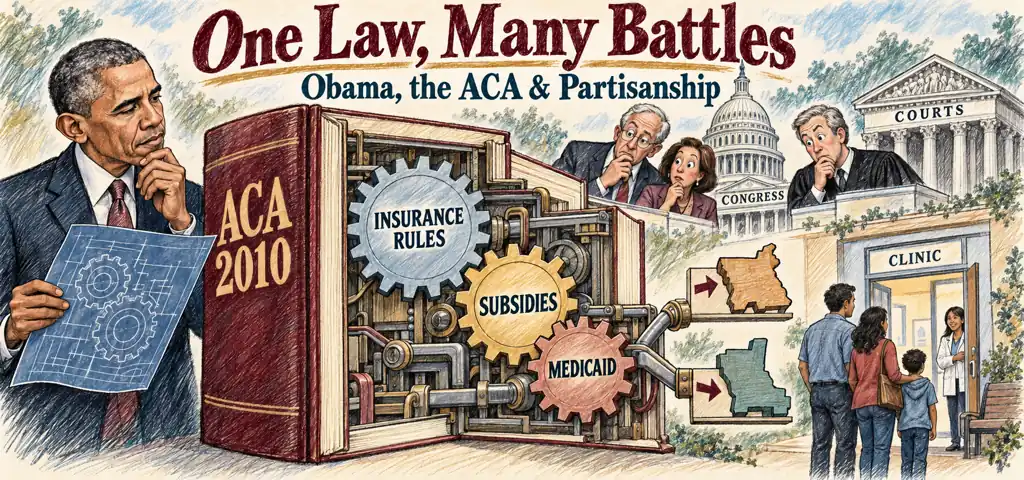
Chapter 16 of the CLEP History of the United States II study guide on Effortless Math covers Obama, the Affordable Care Act, and Intensified Partisanship: the key terms, the core ideas, and worked examples showing how this topic is tested on the exam.
CLEP History of the United States II, Chapter 16
Obama inherited crisis and war
Barack Obama became president amid recession, financial instability, Iraq, and Afghanistan. His coalition included younger voters, racial minorities, college-educated professionals, urban voters, and many working-class Democrats. Governing began with stimulus and financial rescue already in motion, making it important to distinguish policies initiated under Bush from those enacted under Obama.
The ACA combined markets, subsidies, and regulation
The 2010 Affordable Care Act expanded Medicaid in participating states, created insurance marketplaces and income-based subsidies, prohibited denial for preexisting conditions, allowed young adults to remain on family plans, and required most individuals to maintain coverage. It did not create a single national government insurer or abolish employer coverage.
Lopez marked a modern limit on the commerce power
In United States v. Lopez (1995), the Supreme Court struck down the Gun-Free School Zones Act because possessing a gun near a school was not itself economic activity and the statute lacked a sufficient connection to interstate commerce. The decision did not prevent Congress from regulating guns through other enumerated powers or invalidate federal education aid. It showed that the Commerce Clause, though broad, was not a general police power.
The Supreme Court divided the law's constitutional grounds
In NFIB v. Sebelius (2012), the Court held that the individual mandate could not be sustained under the Commerce Clause because Congress cannot regulate people for inactivity, but the payment could be treated as a tax. The Court also made Medicaid expansion optional for states by limiting the threatened loss of existing funds. The ruling both preserved and narrowed the law.
The Tea Party turned fiscal protest into electoral organization
Tea Party activists opposed the stimulus, ACA, taxes, deficits, and federal power. Networks ranged from local groups to national organizations and donors. Republicans made major gains in the 2010 midterms. The movement's constitutional language mixed genuine limited-government commitments with partisan opposition and, in some settings, racialized attacks on Obama.
Occupy Wall Street shifted attention toward inequality
Beginning in 2011, Occupy protesters used encampments and the phrase "We are the 99 percent" to criticize financial power, debt, foreclosure, and unequal wealth. The decentralized movement had no single legislative platform. Its impact appeared more in public language and later campaigns than in immediate federal enactment.
Partisan institutions rewarded confrontation
Filibusters, debt-ceiling brinkmanship, shutdown threats, partisan media, district patterns, donor networks, and primary electorates narrowed bargaining space. The 2013 government shutdown grew from an effort to defund or delay the ACA. Polarization was not just hostile rhetoric; it involved procedures and constituencies that could punish compromise.
Rights cases changed the political field
Shelby County v. Holder (2013) invalidated the Voting Rights Act's coverage formula, disabling preclearance until Congress adopted a new one. Obergefell v. Hodges (2015) required states to license and recognize same-sex marriages under the Fourteenth Amendment. The holdings addressed different institutions and cannot be reduced to a general pro- or anti-federal result.
Implementation made health reform a federalism test
States chose whether to create their own insurance marketplaces, use the federal exchange, and expand Medicaid after the Court made expansion optional. Enrollment therefore depended partly on residence, state administration, outreach, and litigation. The federal government set national insurance rules and financed subsidies, while states retained major regulatory and Medicaid roles. Describing the ACA as wholly national or wholly state-run misses the intergovernmental structure that shaped coverage.
Executive action grew as legislation stalled
After Congress failed to enact broad immigration reform, the administration announced DACA in 2012 for some people brought to the country as children. The policy deferred removal and allowed work authorization but did not confer citizenship or permanent residence. Its reliance on executive enforcement discretion made it vulnerable to litigation and later administrations. Gridlock can shift policymaking toward executive orders, agency rules, courts, and state governments without making those routes equivalent to a statute.
The recovery joined falling unemployment to persistent insecurity
Employment expanded for years after the Great Recession, the unemployment rate fell, and the auto industry stabilized. Yet weak early wage growth, underwater mortgages, long-term unemployment, and uneven regional recovery shaped how households experienced the same statistics. The administration's 2009 stimulus, payroll-tax relief, financial rules, and Federal Reserve policy operated through different channels; no one measure explains the entire recovery. Political arguments over whether government had done too much or too little often selected different dates and denominators. Comparing employment levels, rates, wages, participation, and household wealth reveals why a growing economy could still produce discontent.
Race and citizenship shaped both symbolism and policy conflict
Obama's election marked a major expansion of political representation, but it did not end racial inequality or racialized politics. Disputes over his citizenship, policing, voting rules, immigration, and the federal role drew on older conflicts in new forms. The Black Lives Matter movement emerged after highly publicized deaths and acquittals, using protest and digital networks to challenge police violence and accountability. Supporters and critics debated crime, state authority, unequal treatment, and movement tactics. Treating the period as either "post-racial" or wholly unchanged misses the simultaneous transformation in officeholding and persistence of institutional disparities.
parse a mixed holding
A Court preserves a payment as a tax but rejects the claimed commerce rationale.
Digital media lowered organizing costs while fragmenting shared information
Campaigns, movements, and officials used social networks to recruit, raise small donations, distribute video, and respond rapidly without relying on a broadcast gatekeeper. The same systems rewarded emotional content, allowed false claims to travel quickly, and placed ranking power in private platforms. Online participation could lead to voting or street action, but a click did not prove durable organization. The political effect depended on networks connecting digital attention to candidates, institutions, and local groups. This is why social media should be treated as an infrastructure that changes communication costs, not as a single ideological actor or an automatic cause of polarization.
Watch the history in motion
This short lesson adds voices, images, and chronology to the ideas you just studied.
Video: Here's Why the Affordable Care Act Is So Controversial | History, HISTORY.
Try four CLEP-style questions
- Which description of the ACA is most accurate?
- It shifted employer coverage into a federally operated hospital-insurance program.
- It used private insurance rules, subsidies, marketplaces, and Medicaid expansion rather than one national insurer.
- It preserved preexisting-condition exclusions while narrowing eligibility for public insurance.
- It extended Medicare's existing insurance structure to working-age adults through payroll contributions.
- It placed marketplaces and Medicaid administration under direct federal control in participating states.
- How did NFIB v. Sebelius treat the individual mandate?
- It treated the payment as an obligation arising from federal treaty power.
- It sustained the mandate as regulation of inactivity under the Commerce Clause.
- It struck the mandate and treated the remaining insurance rules as inseverable.
- It upheld the policy under the spending power rather than the taxing power.
- It upheld the payment as a tax while rejecting the Commerce Clause rationale.
- What did Shelby County change?
- It treated voting protections as a matter reserved to states unless Congress proved intentional discrimination case by case.
- It invalidated Section 2's nationwide ban on racial discrimination while preserving preclearance.
- It invalidated the coverage formula that determined which jurisdictions needed preclearance.
- It replaced the existing coverage formula with a national preclearance rule based on recent turnout.
- It shifted registration oversight from the Justice Department to federal examiners in covered states.
- How did Occupy differ from the Tea Party most clearly?
- The movements used similar decentralized structures and converged on financial-regulation demands.
- Occupy concentrated on electoral primaries, while the Tea Party emphasized encampments outside party politics.
- The Tea Party favored public ownership of banks, while Occupy opposed regulation of mortgage finance.
- Occupy centered inequality and financial power; the Tea Party centered taxes, spending, and federal reach.
- Occupy focused on student debt, while the Tea Party concentrated chiefly on foreign-policy intervention.
Check your answers and reasoning
Independent preparation. CLEP is a registered trademark of the College Board, which does not endorse this lesson.

Related to This Article
More math articles
- Free Grade 3 English Worksheets for Iowa Students
- Math Made Easy: Essential Tips to Memorize Formulas and Supercharge Your Learning
- Mobilizing voters
- Party identification
- Geometry Puzzle – Challenge 68
- FREE 8th Grade OST Math Practice Test
- Horse Racing Odds Explained: Probability & Expected Value
- Absolute Poverty, Relative Poverty, and Measurement
- Top 10 Websites to Learn About Scholarships, Federal Aid, and Student Funding
- Migration, Citizenship, and Belonging
















What people say about "Obama, the ACA, and Partisanship"?
No one replied yet.